

Behind the Shoot
McLaren 720S Photography
Behind the Scenes of an Official McLaren Studio Shoot - Photographing an Automotive Icon
Few modern supercars have captured the imagination of enthusiasts and the automotive press quite like the McLaren 720S. Instantly recognisable from almost any angle, it is a car that combines extraordinary engineering with a level of design sophistication that has helped define McLaren’s modern identity. Every line across its bodywork exists for a reason, every surface has been sculpted to channel airflow with precision and every detail contributes towards the remarkable performance that has made the 720S one of the most celebrated performance cars of its generation.
For me, however, the McLaren 720S represents something beyond its impressive performance figures or striking appearance. It represents one of those rare commercial photography commissions where years of experience, technical knowledge and absolute attention to detail come together to create imagery that would ultimately be used around the world. When McLaren commissioned me to produce the official studio photography for the 720S and its extensive range of McLaren Special Operations upgrades, it was my third assignment for the manufacturer and another opportunity to work with McLaren, one of the most respected automotive brands anywhere in the world.

The commission would see me spend an intensive week working from Calvert’s Studio in the UK, producing the photography that would feature throughout McLaren’s global marketing material and on the official worldwide McLaren website. While the finished photographs appear effortless, every image is the result of months of planning, careful collaboration and countless creative decisions, all made long before the first studio light is switched on.
That is often the part of commercial automotive photography that people never see.
Many imagine that photographing an exceptional car simply involves placing it inside a studio, pointing a camera towards it and allowing the beauty of the vehicle to do the rest. In reality, nothing could be further from the truth. When the client is McLaren, every photograph must communicate the same values that define the company itself: innovation, engineering excellence, craftsmanship and uncompromising quality. The imagery is not simply there to record the car; it becomes an extension of the brand and plays a vital role in how customers around the world first experience the vehicle.
Founded by the legendary racing driver Bruce McLaren, the company has always approached automotive design with an engineer’s mindset, where performance and innovation are inseparable from aesthetics. That philosophy has carried seamlessly from Formula One into its road cars, creating machines that are as technically advanced as they are visually dramatic. Unlike many manufacturers, where styling can sometimes dominate engineering, McLaren’s designers and aerodynamicists work hand in hand, ensuring that every vent, every curve and every panel contributes towards the car’s ability to move through the air as efficiently as possible.
The 720S became one of the purest expressions of that philosophy.
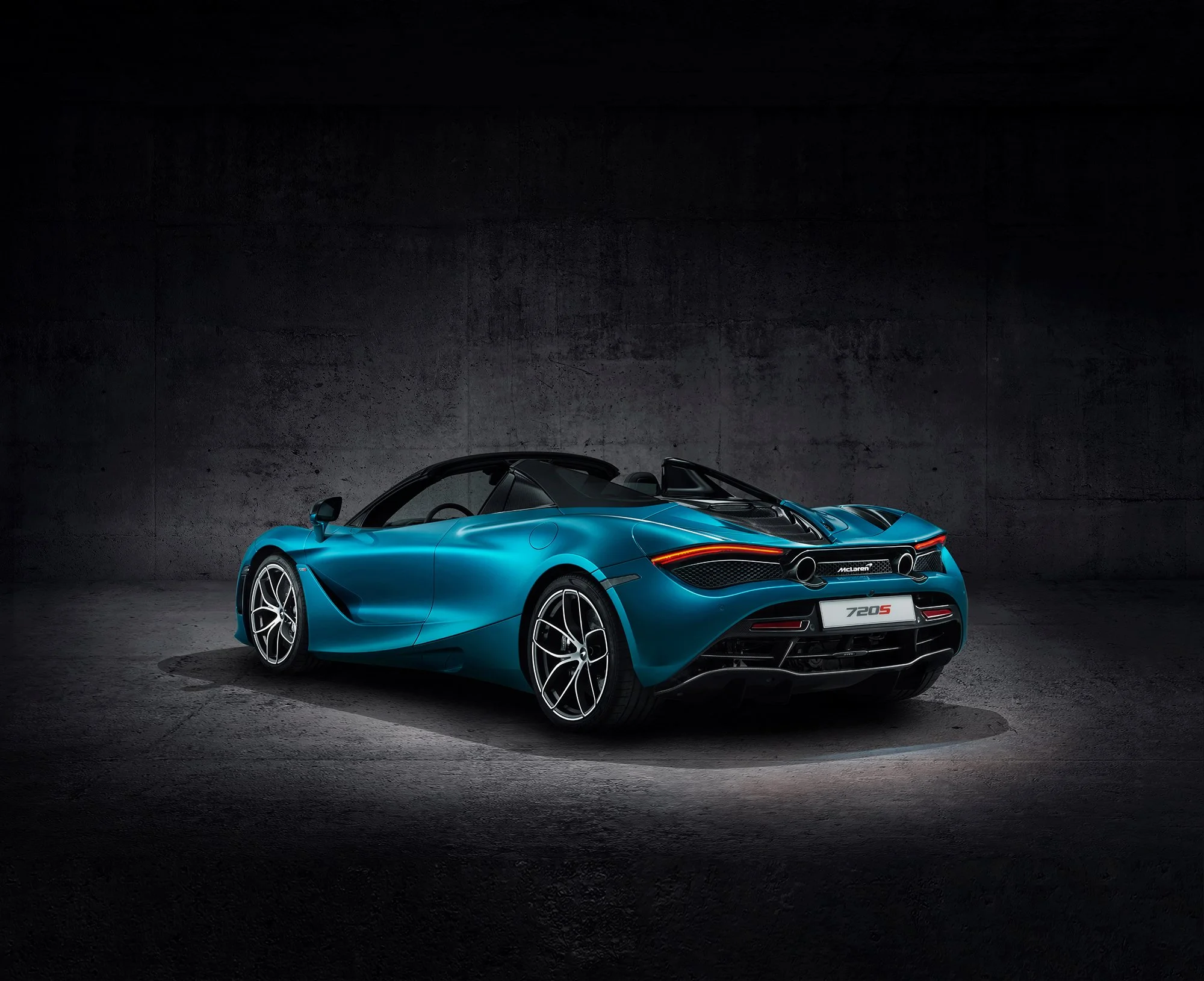
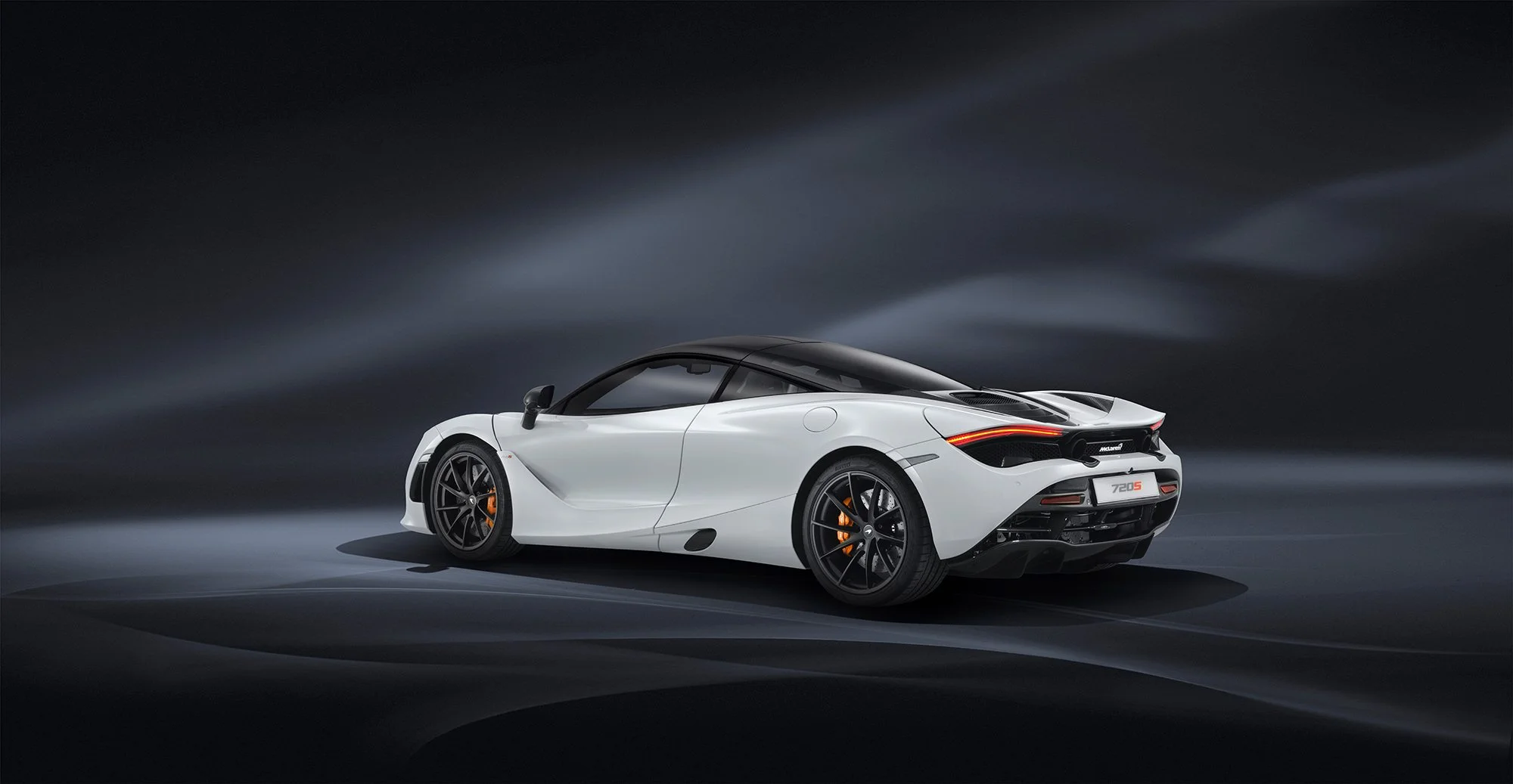
Introduced as the successor to the highly acclaimed 650S, the 720S was built around McLaren’s carbon fibre Monocage II chassis, an immensely strong yet incredibly lightweight structure that forms the foundation of the car’s exceptional performance. Behind the driver sits a 4.0-litre twin turbocharged V8 producing more than 700 brake horsepower, delivering breathtaking acceleration that carries the car from 0 to 60 mph in under three seconds before continuing towards a top speed of more than 210 mph. Yet remarkable numbers alone have never explained why the 720S has earned such admiration. What truly sets it apart is the way those engineering achievements have been wrapped within a body that is both beautiful and purposeful. One of the most distinctive elements of the design is something that many people never notice at first glance. Traditional side air intakes appear almost to disappear into the flowing bodywork, cleverly integrated within the sculpted door structure to create what McLaren refers to as the ‘double skin’ design.
This innovative approach allows airflow to be channelled efficiently without compromising the clean, uninterrupted form of the car. It is a wonderful example of engineering dictating design rather than design simply decorating engineering, and it is precisely this kind of subtle detail that makes the 720S such a rewarding subject for a professional car photographer.
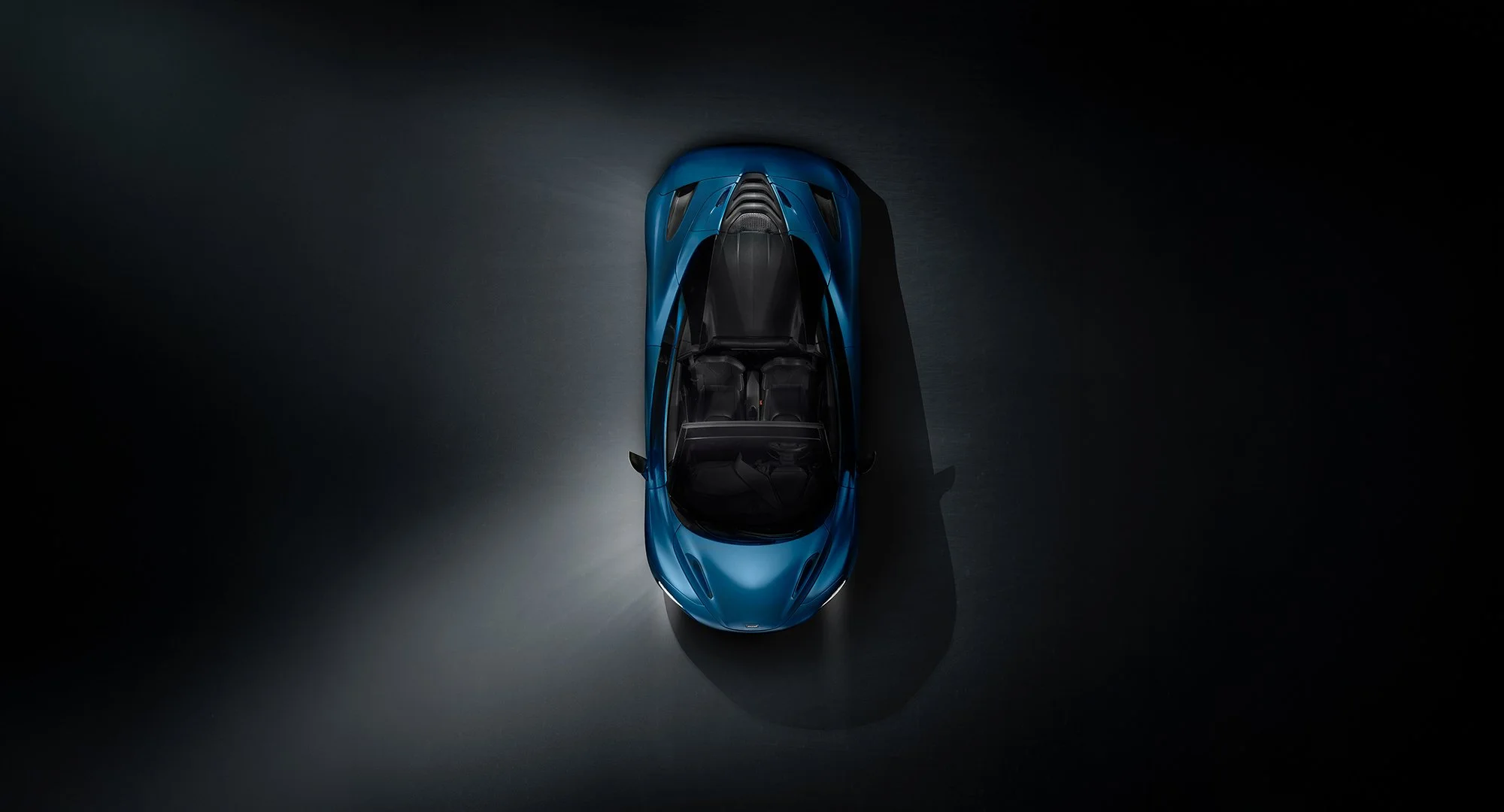
The car’s design language quickly attracted international recognition, receiving numerous awards for both engineering and styling while being widely praised by the world’s leading automotive journalists. Even today, years after its launch, the 720S remains instantly identifiable among the world’s most exclusive performance cars, proof that great design is timeless.
From behind the camera, that distinctive design presents both opportunity and challenge in equal measure.
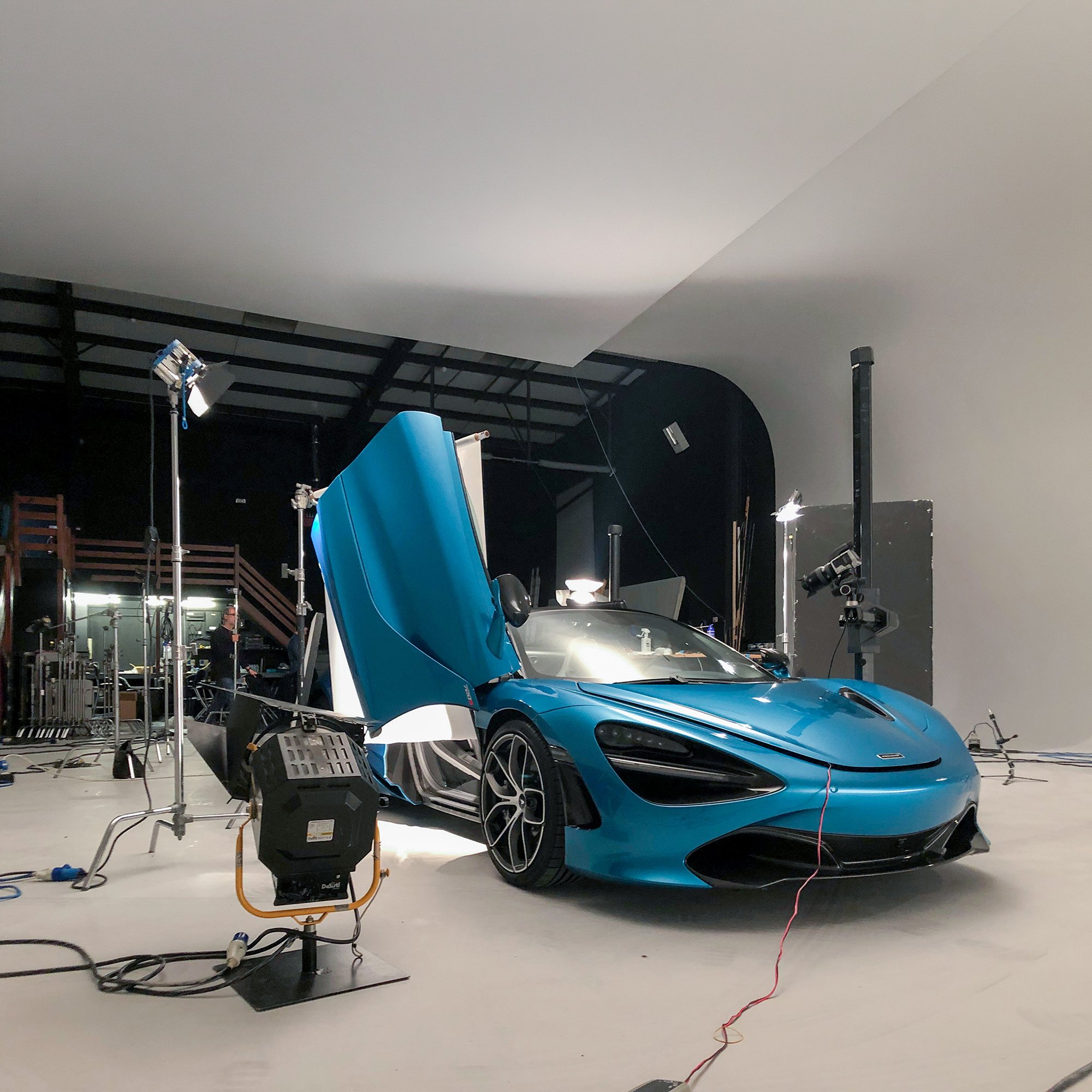
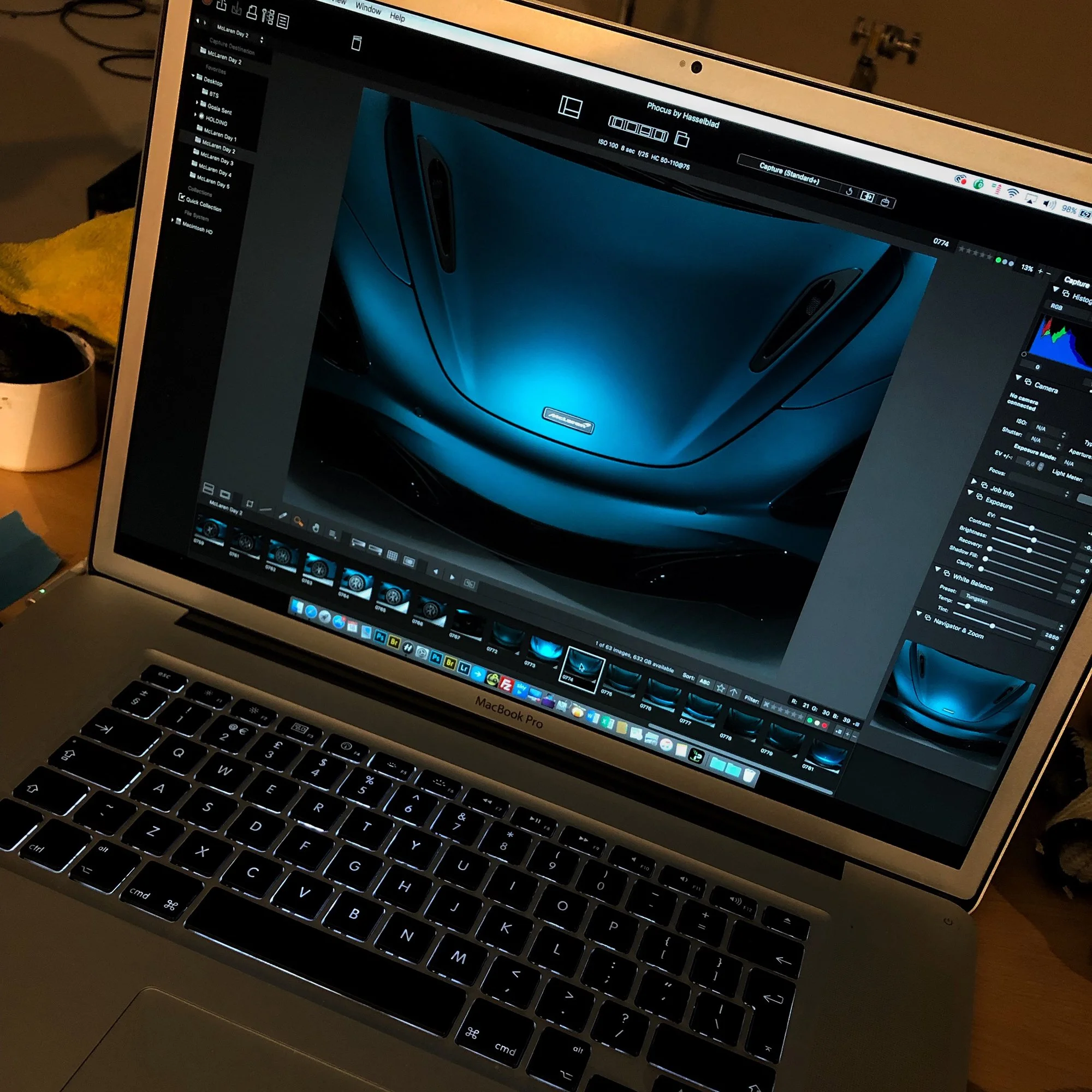
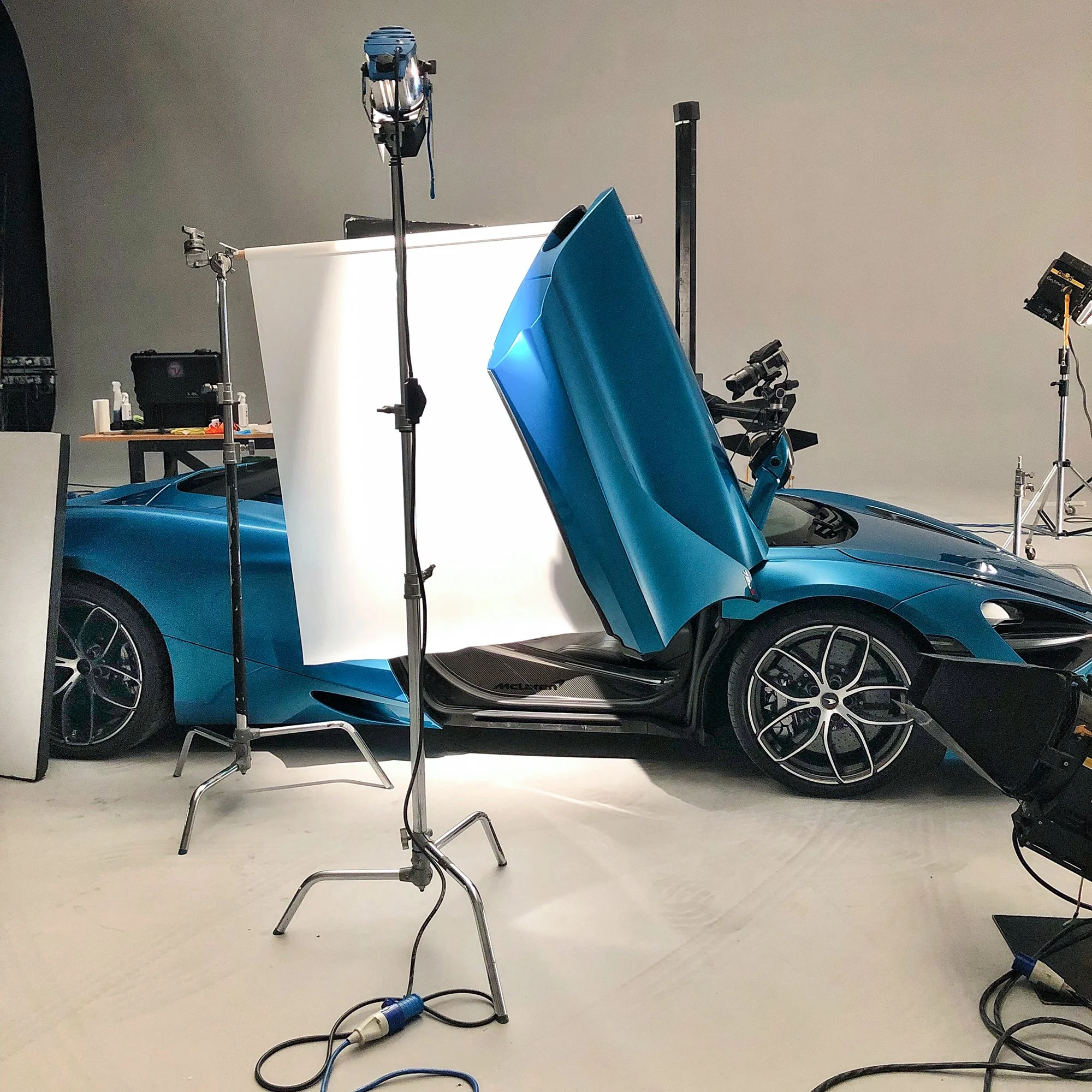
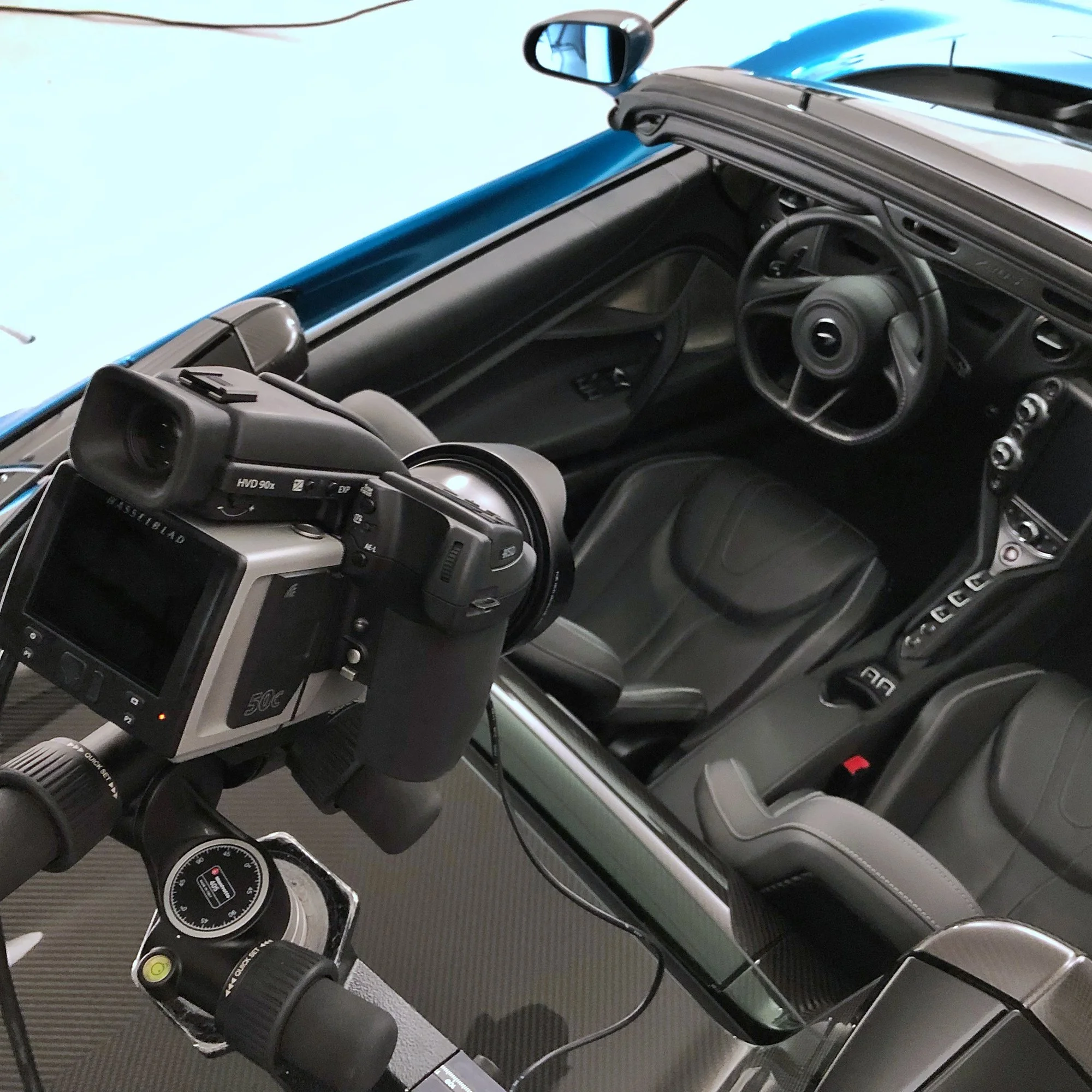
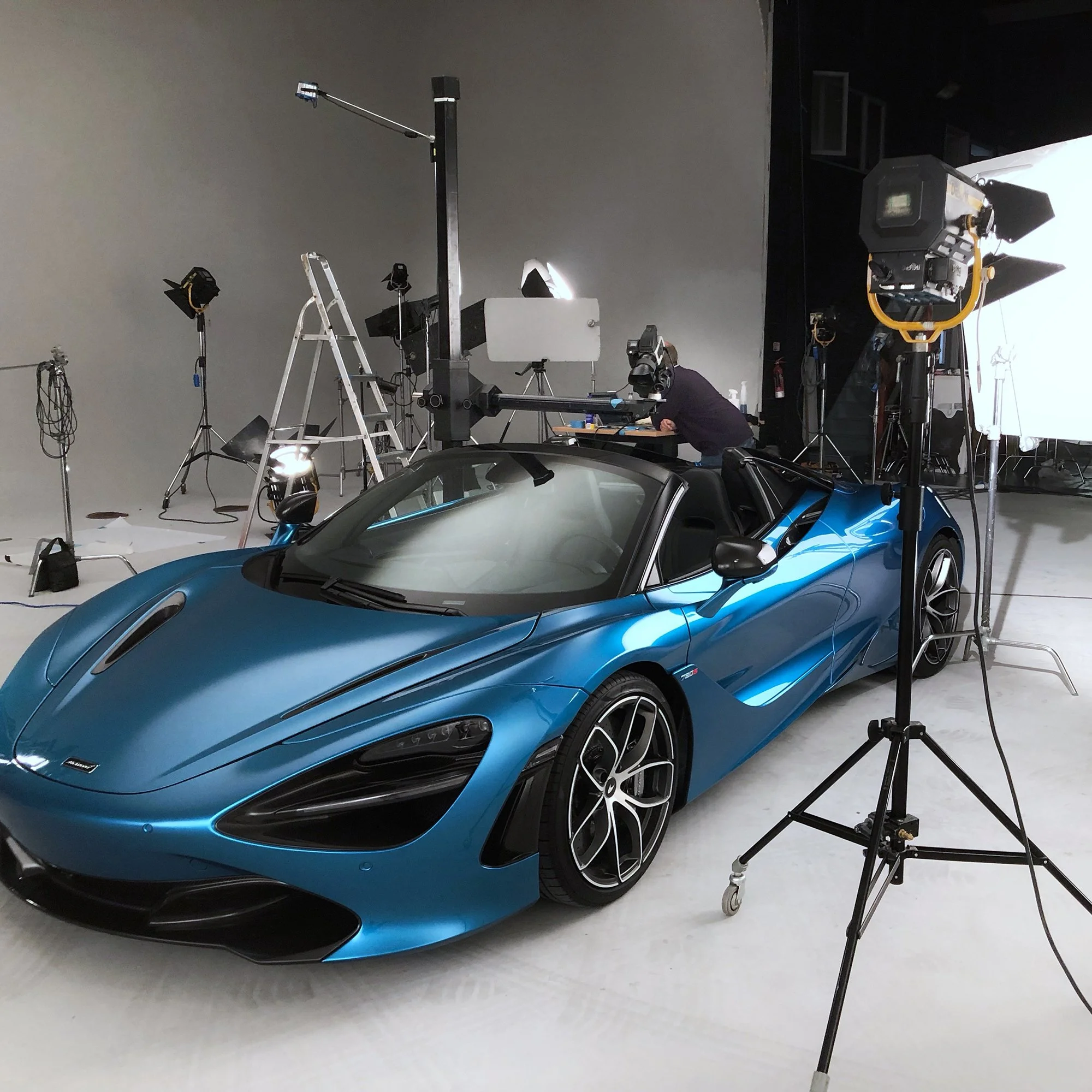
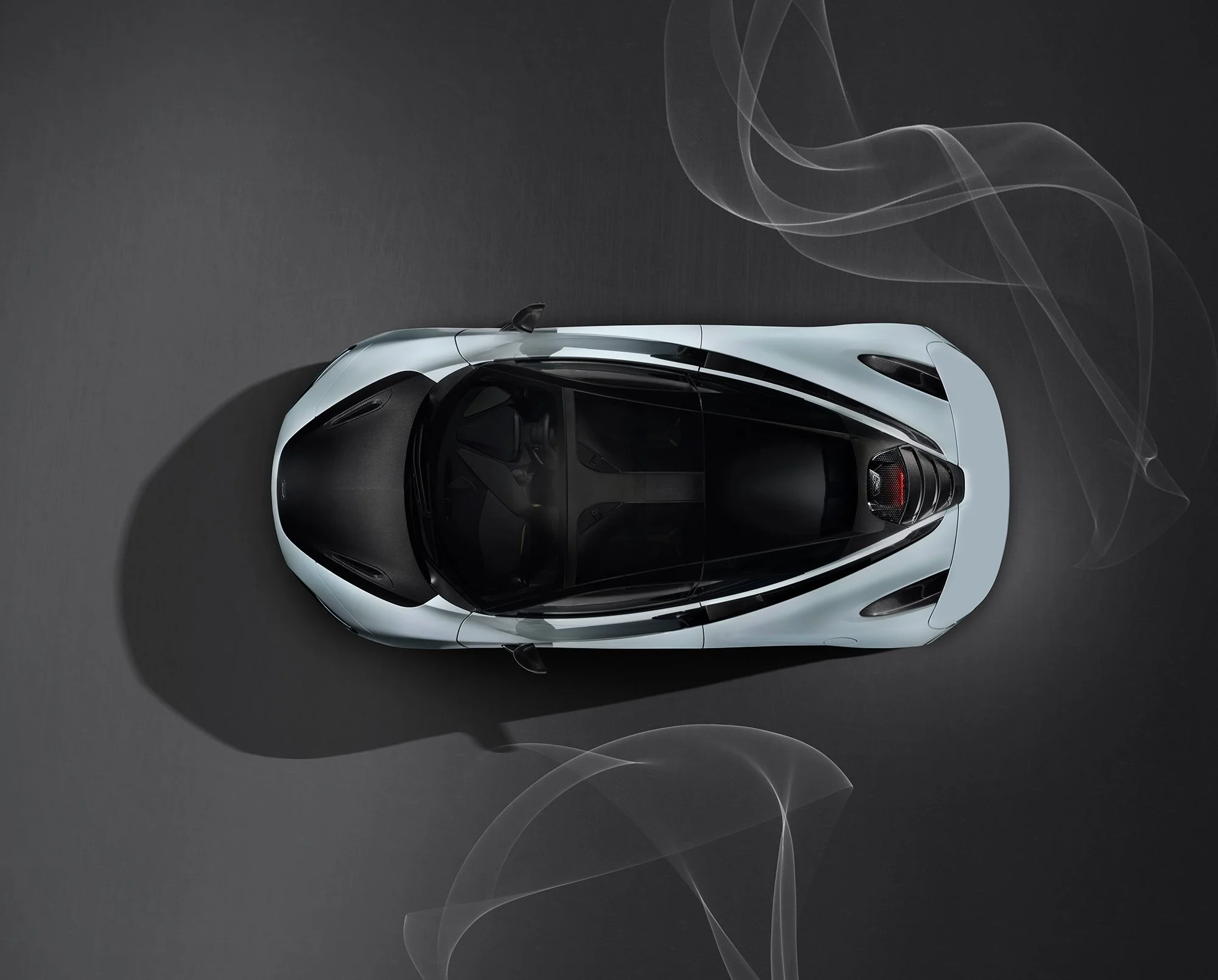
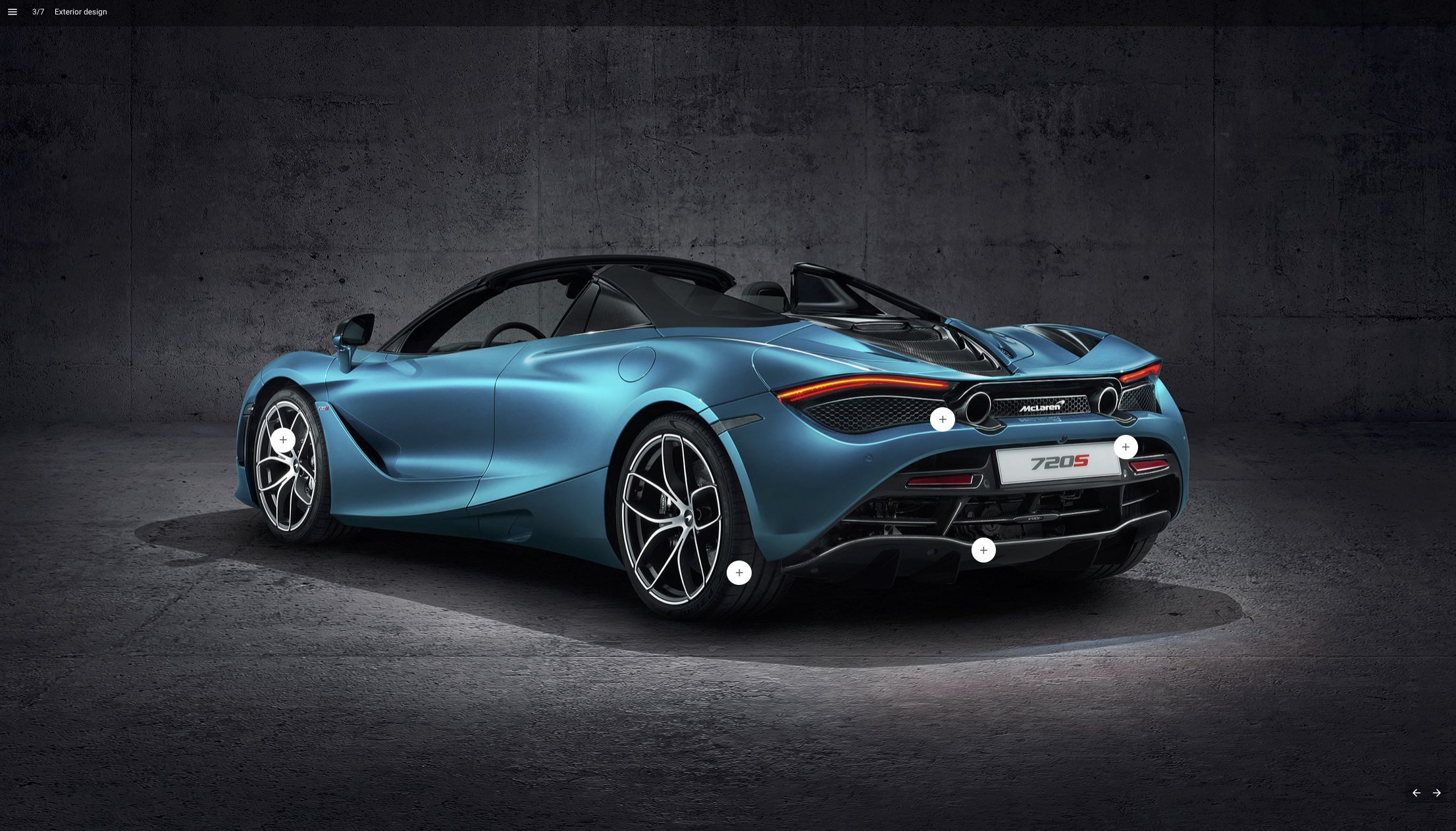
Unlike many vehicles where strong body lines naturally catch the light, the flowing surfaces of the 720S require extraordinary precision to reveal their full character. The reflections that sweep across the doors, front wings and dramatic rear haunches are not accidental; they have to be carefully created, controlled and refined until every curve is described exactly as McLaren’s designers intended. A reflection placed just a few centimetres too high or too low can flatten a surface completely, disguising the subtle transitions that make the car so visually remarkable. Achieving the perfect balance becomes less about photographing the car and more about sculpting it with light.
That challenge is one of the reasons I have always been drawn towards studio automotive photography. Every photograph becomes a collaboration between engineering and illumination, where the role of the commercial car photographer is not simply to document a vehicle but to reveal its personality through carefully controlled lighting. The camera records what is placed before it, but light determines how the viewer experiences the subject, guiding the eye across the bodywork, revealing texture within the materials and giving depth to surfaces that might otherwise appear flat.
For a commission of this significance there can be no guesswork, and certainly no improvisation. Before a single piece of camera equipment arrived at Calvert’s Studio, before the first light stand was rolled out and before the McLaren 720S was carefully positioned on the studio floor, months of preparation had already taken place between myself, McLaren and their advertising agency. Every photograph had already begun to exist on paper, carefully considered, discussed and refined until everyone involved understands precisely what is required.
Only then could the real work begin.
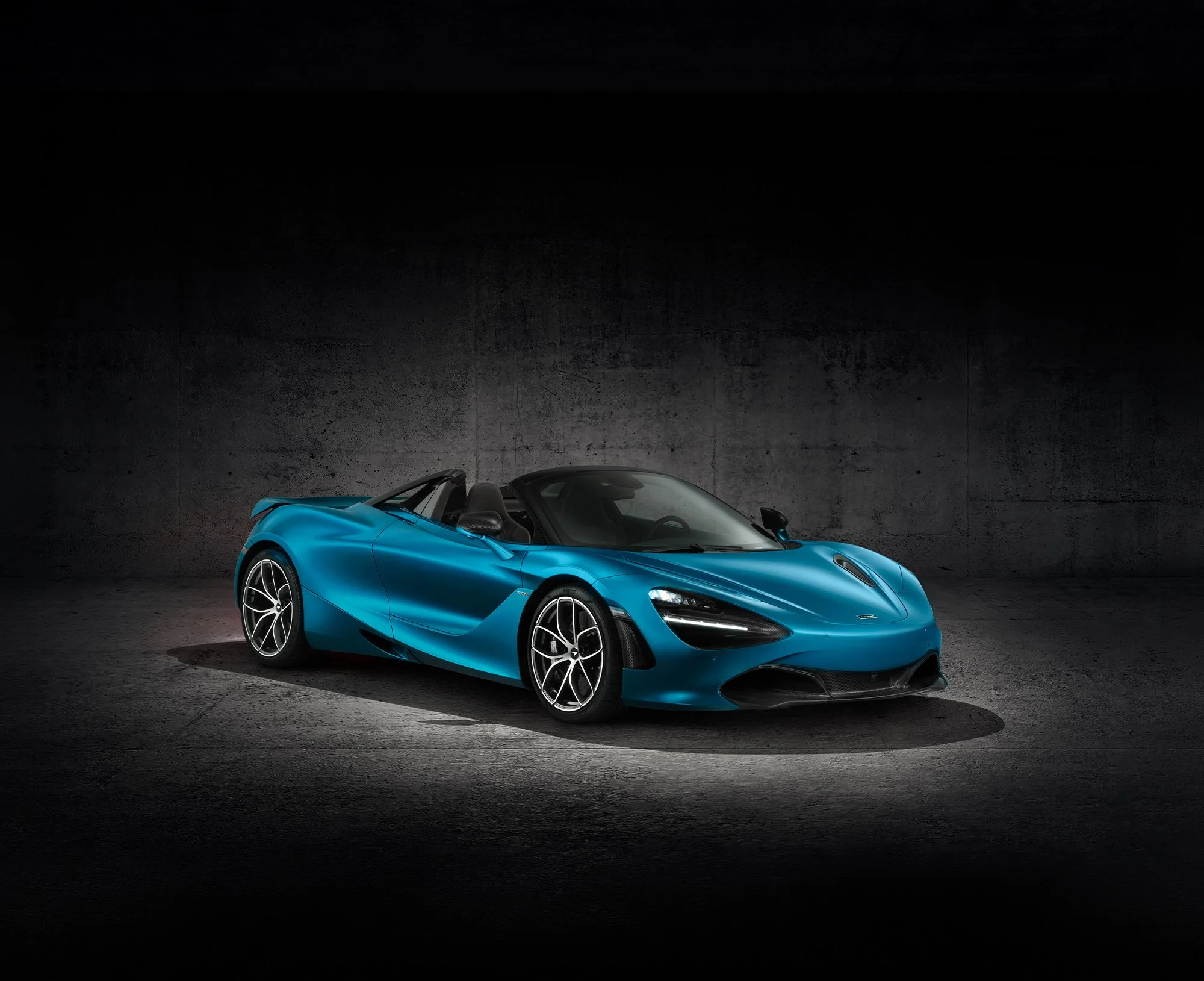
Months of Planning Before the Camera Comes Out
One of the greatest misconceptions surrounding commercial automotive photography is that the work begins when the photographer arrives at the studio. It is an understandable assumption because the finished photographs are often all that people ever see, but in reality they represent only the final stage of a process that has usually been developing for many months. By the time I walked through the doors of Calvert’s Studio to begin photographing the McLaren 720S, countless hours had already been invested by McLaren, their advertising agency and myself, ensuring that every day of the production would run with absolute precision.
Unlike an editorial feature or a magazine road test, photography commissioned directly by a manufacturer has a very clear commercial objective. Every image must communicate something specific about the car, whether that is a design feature, an engineering detail, an interior finish or one of the many bespoke options available through McLaren Special Operations (MSO). Nothing is photographed simply because it looks attractive. Every frame has a purpose, every composition has a destination and every photograph must support the wider marketing strategy for the vehicle.
That process begins with conversation, speaking to our client and understanding what their brands requirements are. Everything to come must slot seamlessly into their brand.

Long before lighting diagrams are drawn or cameras prepared, there are meetings between everyone involved in the project. McLaren understands the story they want the car to tell, while their advertising agency knows how those images will eventually be used across brochures, international marketing campaigns, exhibition displays, digital advertising and the global McLaren website. My role as the commercial car photographer is to translate those creative and marketing objectives into a practical photographic production, ensuring that every image can be achieved to the standard expected of one of the world’s leading performance car manufacturers.
These discussions are incredibly detailed because they have to be. It is not simply a case of deciding that the front of the car needs photographing or that an interior detail should be included. Every image is considered individually, with attention given to the angle, the lighting style, the orientation of the composition and even the amount of negative space required for designers to incorporate headlines, technical specifications or marketing copy. A photograph may eventually appear quite simple on the printed page, but behind that simplicity often sits weeks of careful planning.
For a full brochure production such as this, the completed photography would ultimately consist of around fifty four carefully crafted images, each one forming part of a much larger visual language that would introduce the McLaren 720S to customers around the world. Looking at that number in isolation might not sound particularly daunting, but every one of those photographs has to be created to an exceptional standard. There are no secondary images, no photographs that are merely ‘good enough’. Every frame must be capable of representing one of the most prestigious automotive brands in the world. Also, it is an important factor here to mention that each and every image has to be signed off by McLaren senior management following the shoot. If it is not up to standard, then there is a problem and as a professional photographer this is something you need to make sure does not happen. A long time ago a picture editor told me, ‘you’re only as good as your last image’ and that statement has always stayed with me to this day.
As the shot list gradually develops, attention turns towards building the most efficient workflow possible. This becomes one of the most important stages of the entire production because time inside the studio is both valuable and finite. Although the photography would ultimately occupy a full working week, with days regularly stretching to twelve hours, careful organisation before the shoot allows that time to be used creatively rather than solving avoidable logistical problems.
Rather than treating each photograph as an entirely separate production, we look for opportunities to build a logical sequence that reduces unnecessary changes whilst maintaining complete consistency throughout the brochure. If several images require the same lighting approach or the same area of the vehicle, those photographs are grouped together before moving on to the next stage. It is a process that demands both flexibility and discipline because, although every day follows a carefully prepared schedule, there must always be room to adapt should a particular image require more attention than originally anticipated, and there is always what I refer to as ‘factor x’. That is the unknown issues that ‘will’ arise during a week shooting in studio. This could be anything at all and you need to be prepared to deal with it when it does. I remember shooting manufacturer work in studio where the car has been delivered and there have only been 2 of the 4 new style wheels made, so it was necessary to keep removing them and shifting them from one side to the other for shots. Of course this is not an impossible task to carry out but it is one that adds time, and time is something that can very quickly tick away, even when you have an entire week in studio. Factor x is real.
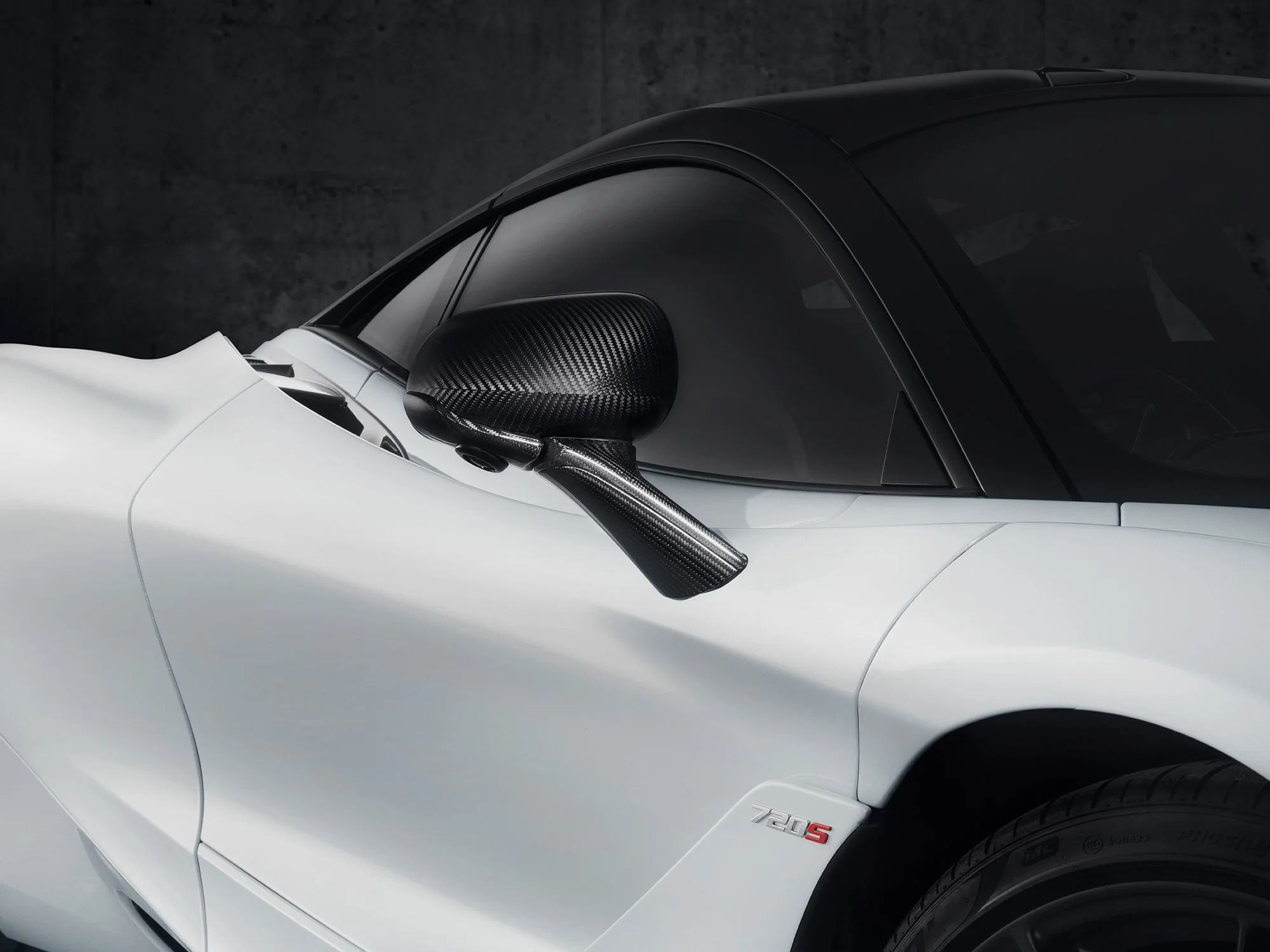
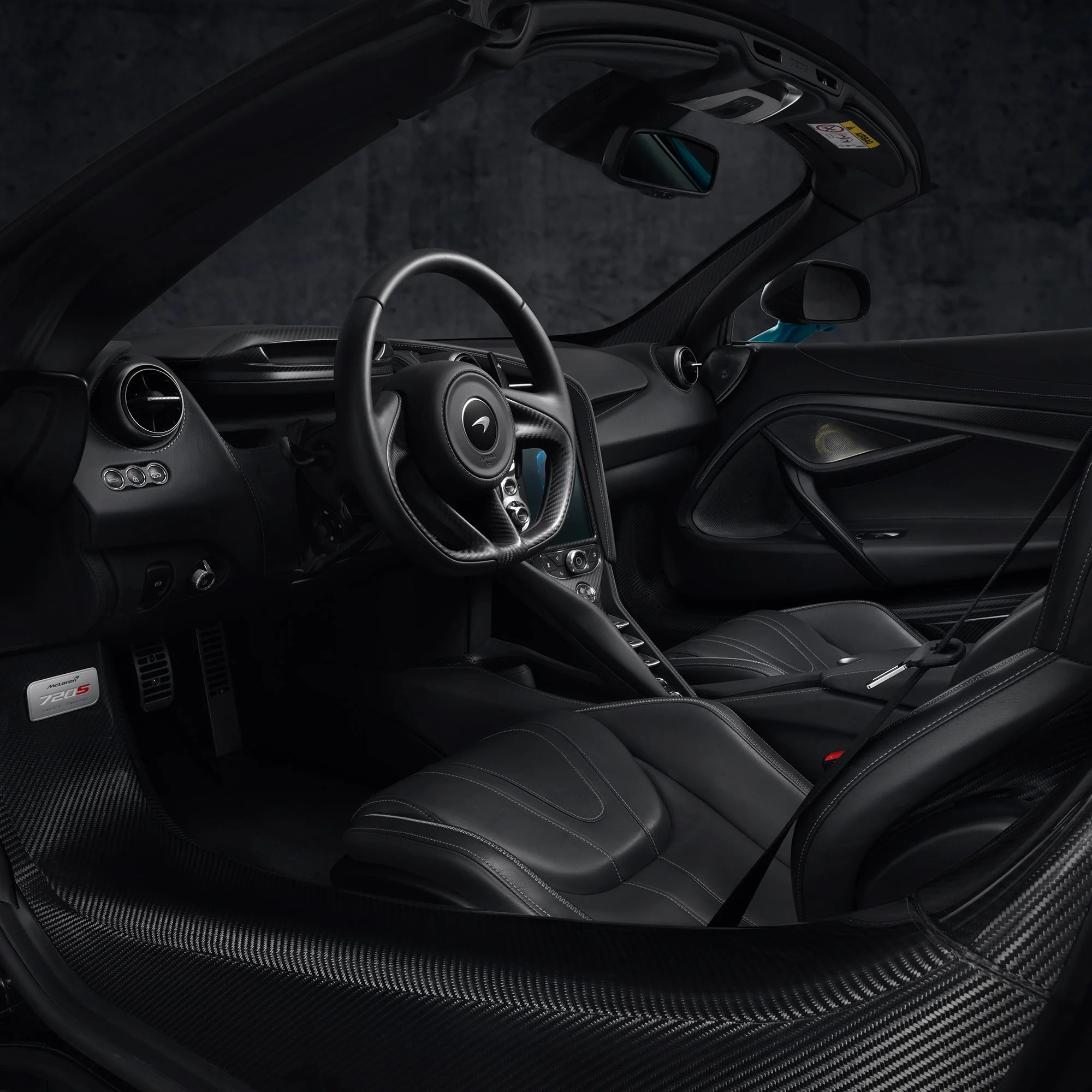
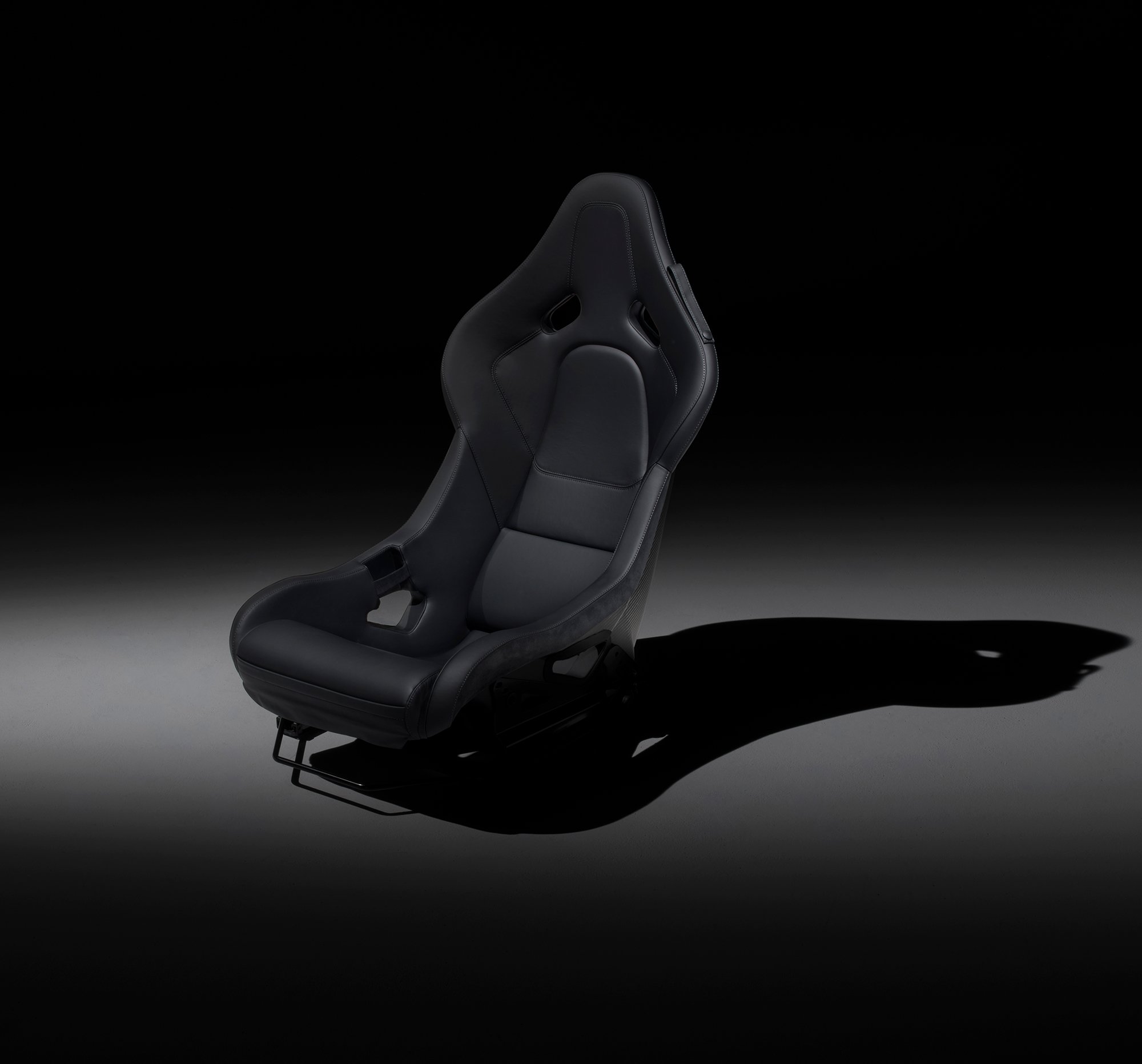
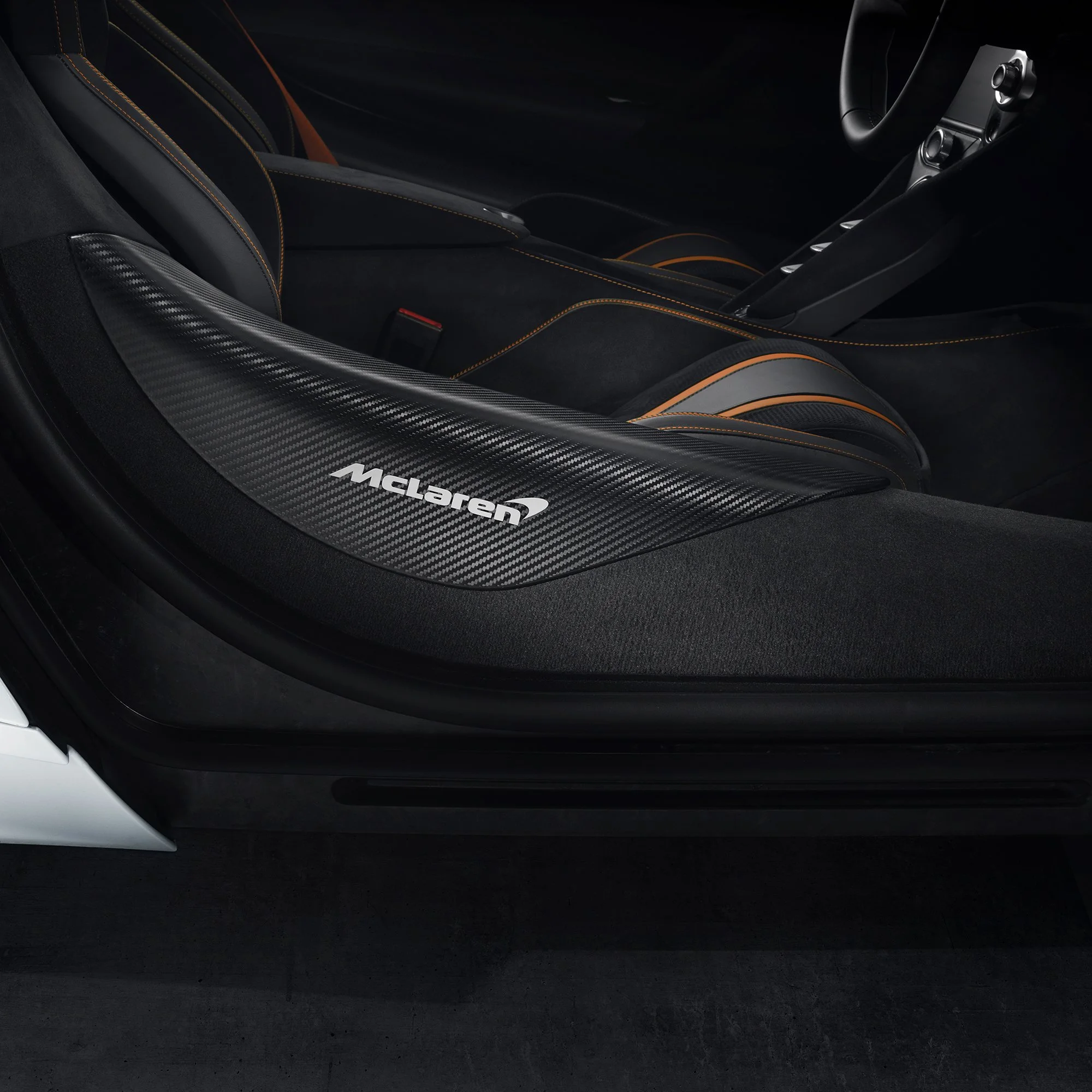
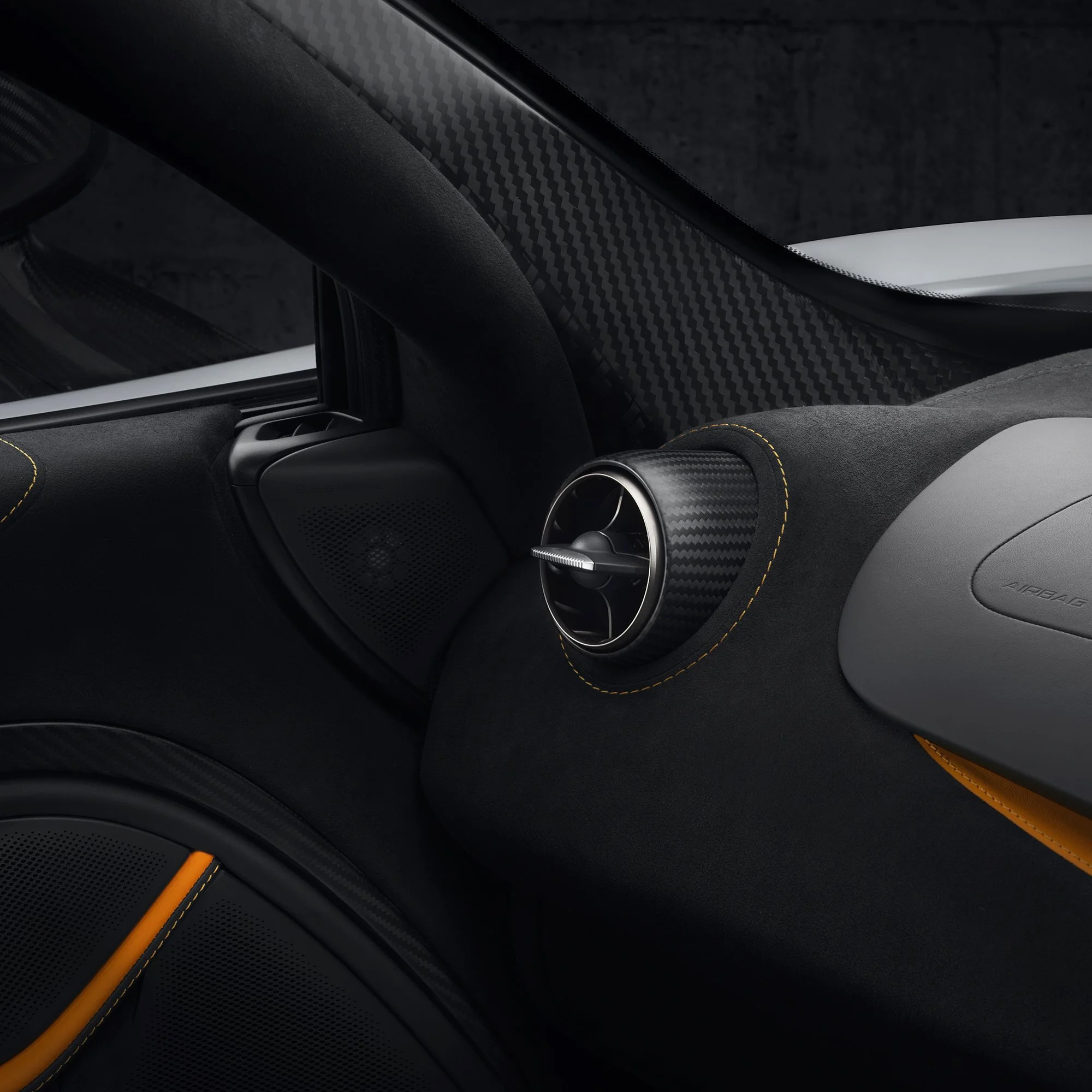
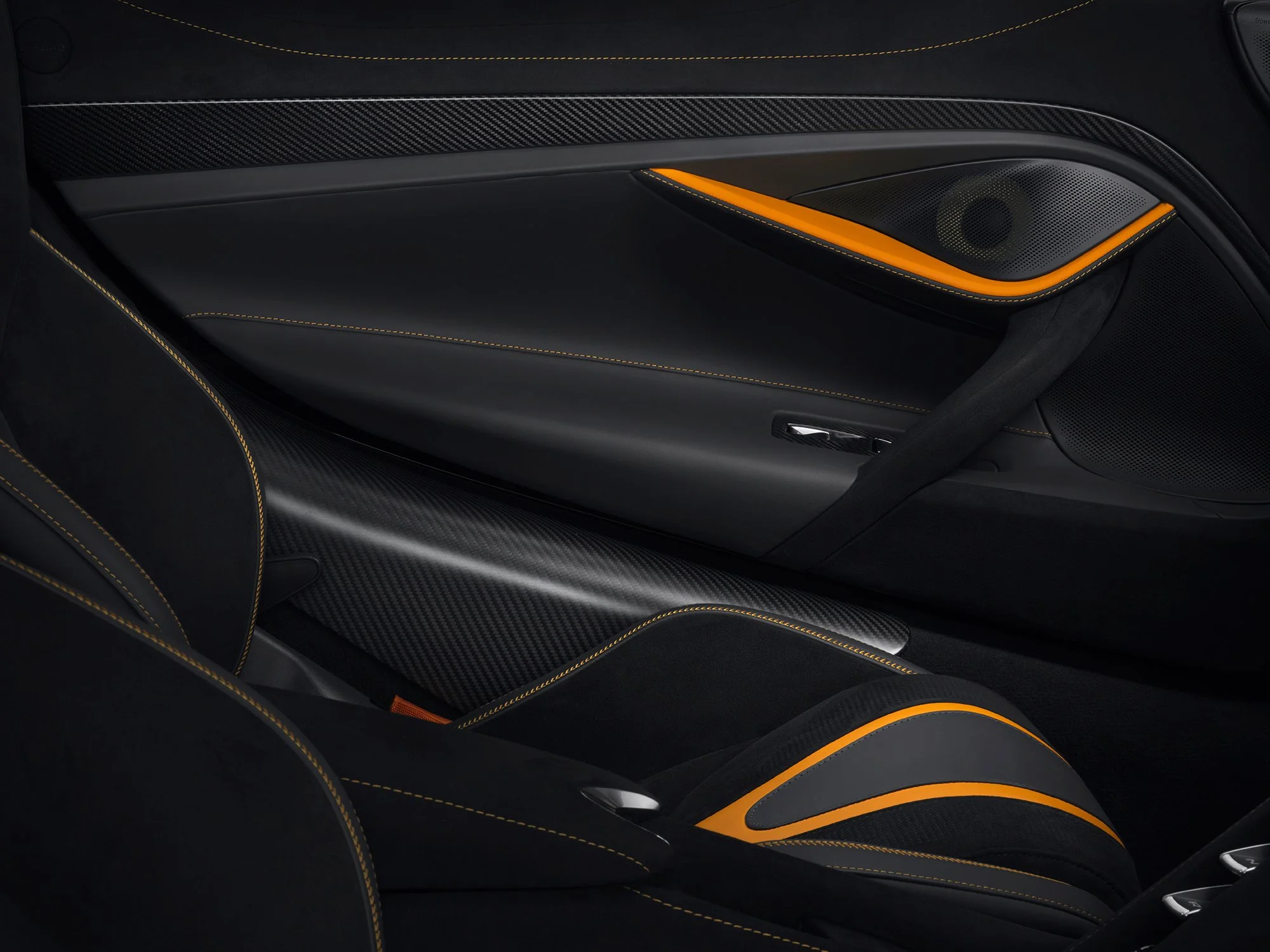
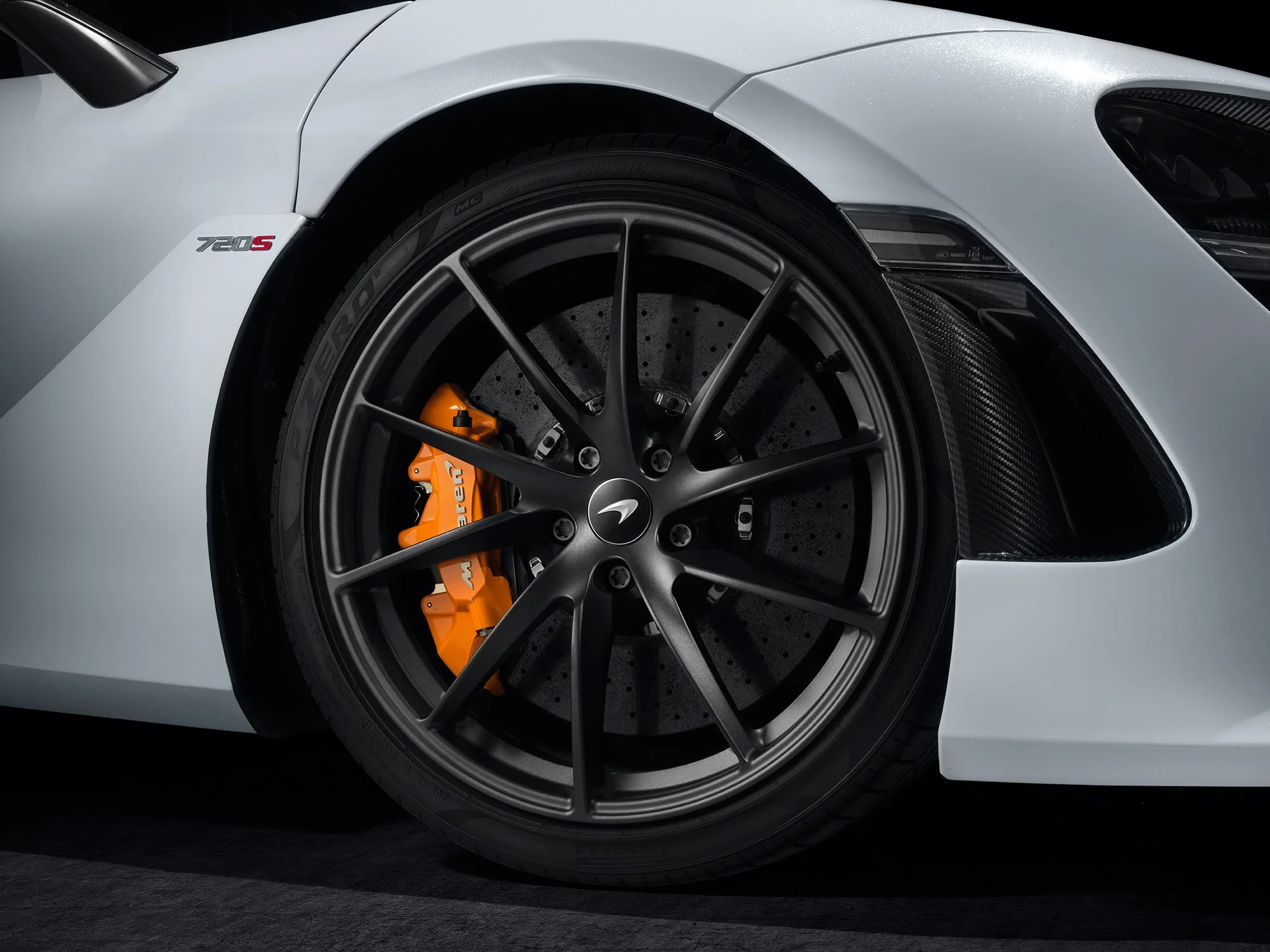
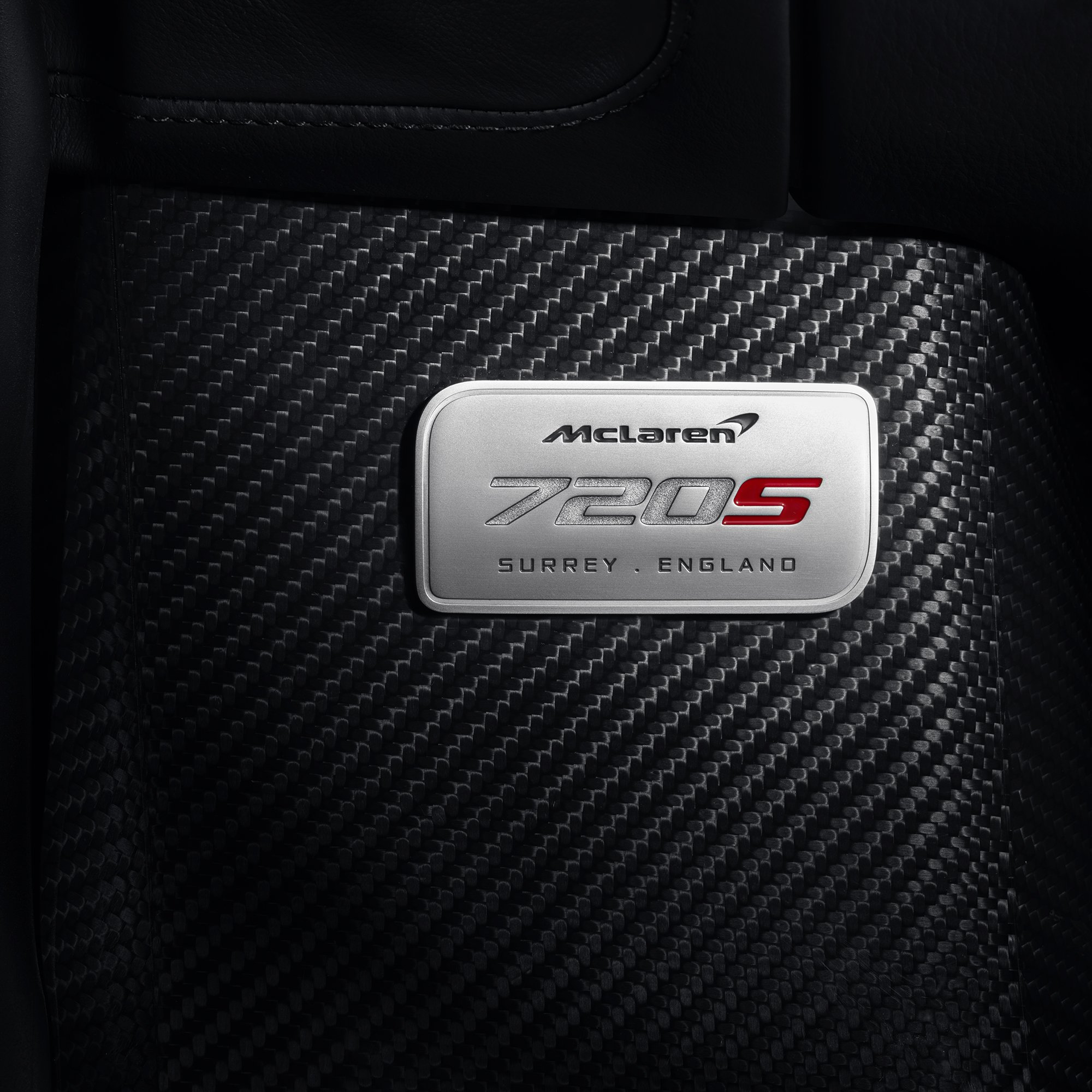
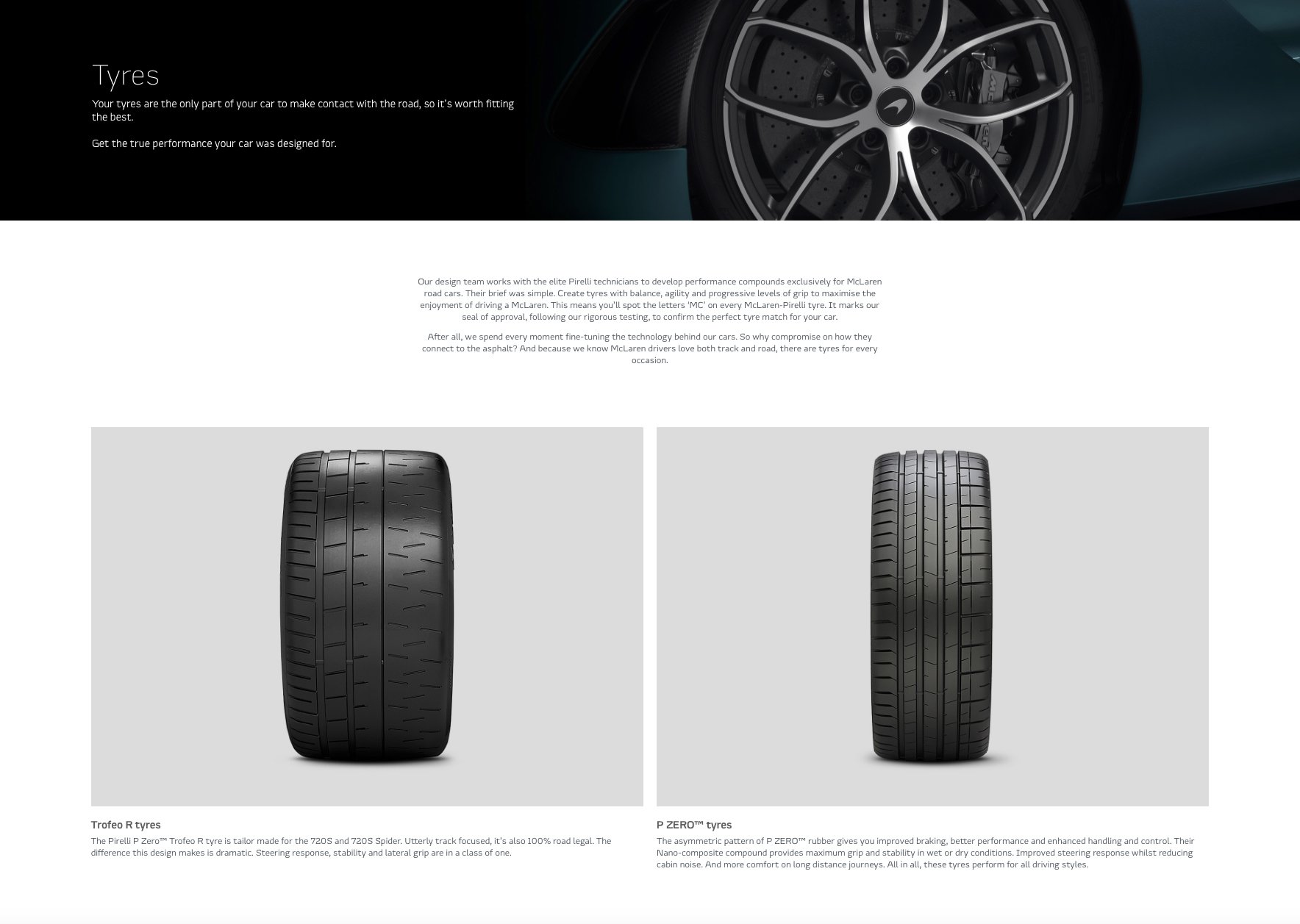
For this particular commission, one of the biggest considerations involved the extensive range of McLaren Special Operations upgrades. Better known simply as MSO, this bespoke division allows owners to personalise almost every aspect of their car, creating a level of individuality that has become one of the defining characteristics of the McLaren ownership experience. For the marketing team, however, that level of choice also creates a considerable photographic challenge because every significant option has to be documented with the same care and consistency as the vehicle itself.
At first glance some of these changes may appear relatively subtle, but in the world of premium automotive marketing they are hugely important. A customer investing in a McLaren wants to see exactly how a particular wheel design transforms the appearance of the car, how a carbon fibre exterior detail catches the light or how a different colour seat belt complements the interior. These are not insignificant details added as an afterthought; they are carefully considered personal choices that form part of the ownership experience, and the photography has to communicate that level of craftsmanship with complete accuracy.
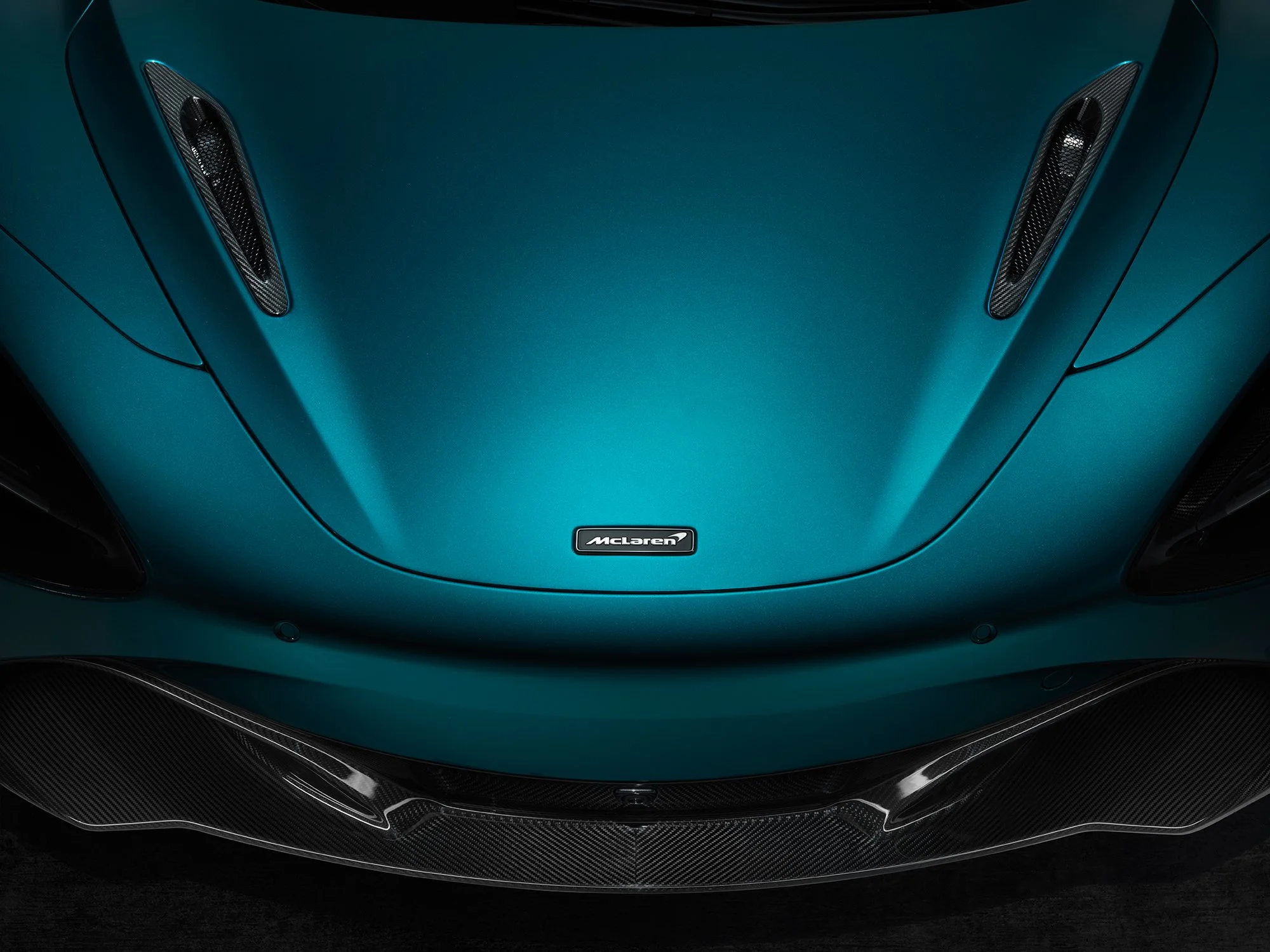
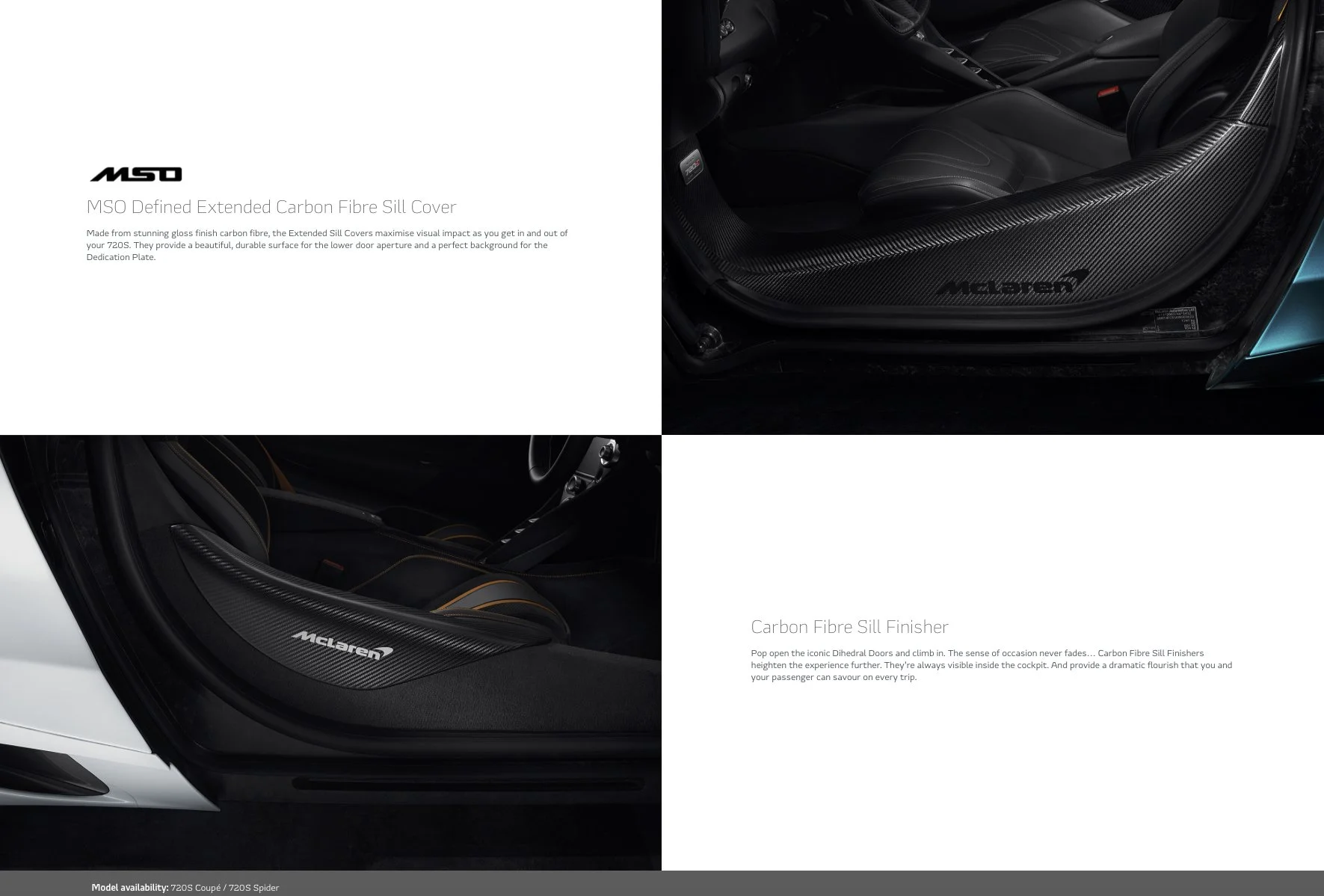
It is often these smaller details that introduce the greatest complexity into the production. A change from one alloy wheel design to another may require the car to be repositioned so that the proportions remain identical to the previous photograph. A different finish on the iconic McLaren bonnet badge has to be lit in a way that reveals its unique texture without altering the overall style of the image. Interior options such as contrasting stitching, bespoke seat designs, coloured seat belts or carbon fibre trim must all be photographed so that every variation feels entirely consistent, despite each one requiring its own subtle refinements in lighting and composition.
Consistency is one of the defining characteristics of successful commercial automotive photography, and maintaining that consistency across more than fifty carefully planned images requires meticulous preparation. Every photograph must feel as though it belongs to the same visual family, whether it is showcasing the sweeping profile of the entire vehicle or focusing on a beautifully machined aluminium switch inside the cockpit. Colours must remain accurate, reflections carefully controlled and the overall visual language must remain unmistakably McLaren from the first page of the brochure to the last.
Planning also extends beyond the photography itself. Throughout the production there is constant awareness of how the finished images will eventually be used by designers and marketing teams around the world. Some photographs will appear across full-page brochure spreads, while others may become website banners, exhibition graphics, press material or digital advertising viewed on devices ranging from mobile phones to large-format displays. Every composition therefore has to allow sufficient flexibility without compromising the visual impact of the finished image, a balancing act that is considered long before the first shutter is released.
By the time the planning process reaches its conclusion, there is very little left to chance. The creative direction has been agreed, the sequence of photography carefully organised and every member of the production team understands exactly what needs to be achieved. It is a level of preparation that may appear excessive to those outside the industry, but when the subject is a car as significant as the McLaren 720S and the client is one of the world’s most respected performance car manufacturers, anything less simply is not an option.
Only after months of discussion, preparation and collaboration does the photography finally begin, and even then the real challenge is only just about to unfold. Because while planning creates the blueprint for success, it is inside the studio, surrounded by lights, reflections and the extraordinary sculpture that is the McLaren 720S, where those plans must ultimately be transformed into the imagery that the world will see.
One Week in the Studio
With months of preparation complete and every image carefully mapped out, the production finally moved into Calvert’s Studio, where the plans that had existed only on paper would now be transformed into the finished photography. Although the schedule covered an entire working week, experience has taught me that time moves remarkably quickly on a commercial production of this scale. Every day begins with the knowledge that there is a significant amount to achieve, but there is never any temptation to rush. When photographing a car of this calibre for a client such as McLaren, speed is never the objective. Precision is.
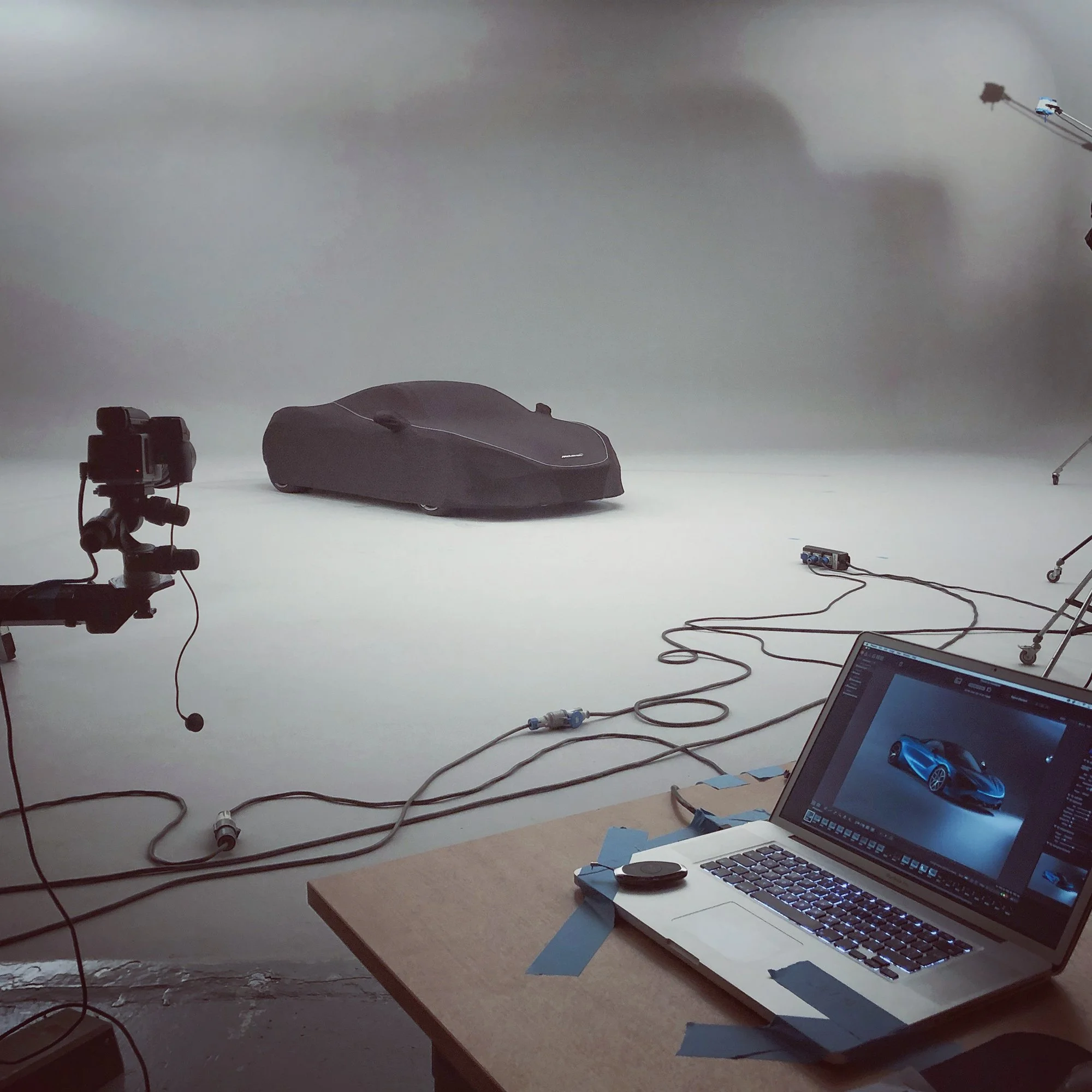
The McLaren 720S arrived on a enclosed specialist car transporter, immaculately prepared and in pristine condition, yet before a single photograph could be taken it would undergo another meticulous inspection. Under the controlled lighting of a commercial studio, even the smallest imperfection becomes visible. A fingerprint on a carbon fibre panel, a minute hand mark on the bonnet or the faintest mark on a gloss black trim piece can immediately draw the viewer’s eye once the image is enlarged for a brochure or exhibition display. The standard required is uncompromising, and quite rightly so. Every member of the team understands that the finished photographs will represent the McLaren brand across the world, and there is a shared determination to ensure that every detail is as close to perfection as possible.
Only once the vehicle had been carefully cleaned and positioned for the first shot could the creative process truly begin. Contrary to what many people imagine, I never walk into a studio, switch on a load of lights and start taking photographs. Every image is built methodically from the ground up, rather like constructing a painting one brushstroke at a time. The camera is almost secondary during these early stages because my attention is focused entirely on the way light interacts with the bodywork. The lighting is developed gradually, adding one source at a time, evaluating what it contributes and then refining its position until it reveals exactly the character, I want the viewer to experience. Years of experience lighting reflective surfaces in studio equips me with the knowledge of where a good starting point is, but every car is different, every paint type reacts differently, and it is always a ‘beautiful challenge’.
It is this process that has fascinated me throughout my career. Long before a camera records the first frame, light defines the photograph. It reveals form, creates atmosphere and guides the viewer’s eye across the subject. When photographing a vehicle as beautifully sculpted as the McLaren 720S, lighting is not simply about making the car visible; it is about revealing the design language created by McLaren’s engineers and stylists. Every flowing surface, every muscular rear haunch and every subtle contour deserves to be seen exactly as it was intended. One comment I have often been known to make is that ‘you should always shoot what it feels like, not simply what it looks like’.
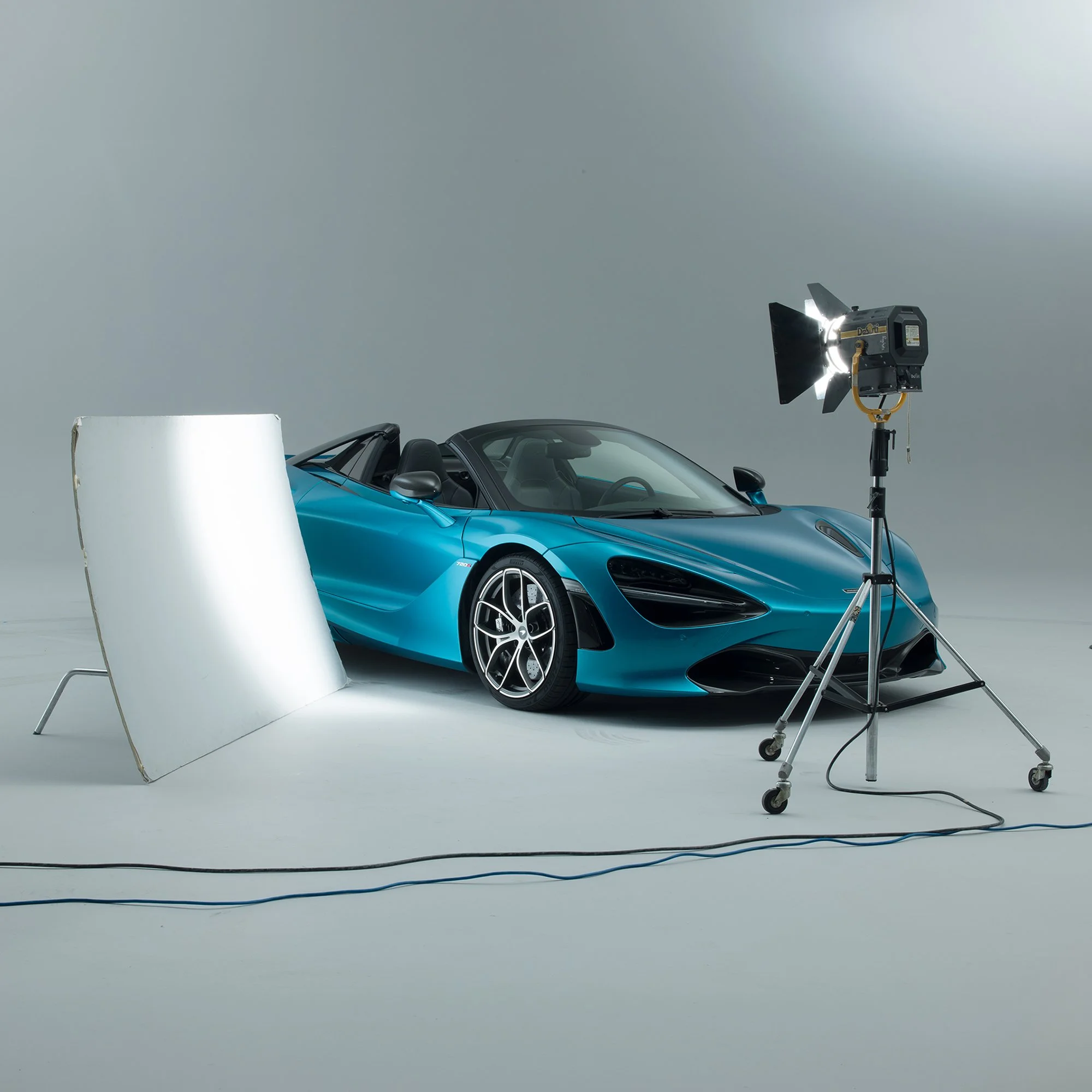
For many of the photographs created during the week, the lighting setup consisted of as many as eight individual continuous light sources of different power outputs and with different diffusion properties, each performing a very specific role within the finished image. One light might define the elegant shoulder line running from the front wing towards the rear quarter, while another introduced shape into the lower bodywork. Softer sources were used to reveal the texture of leather or Alcantara trim, while more controlled lighting would lift the intricate weave of exposed carbon fibre without creating harsh reflections. Additional lights might provide subtle separation around the wheels, reveal the depth within the front grille or gently illuminate the cabin without allowing the lighting to appear artificial. Every light had a purpose and every adjustment influenced the final balance of the photograph.
The remarkable thing is that these adjustments are often incredibly small. A light moved by only two or three centimetres can completely alter the way a reflection travels across the bodywork, changing the perception of an entire panel. A beautifully sculpted curve can suddenly appear flat, while a previously hidden contour might come alive with just the slightest repositioning of a light source. To anyone watching from outside the studio, those movements may appear insignificant, but to an experienced commercial car photographer they can make the difference between an image that is technically competent and one that truly captures the essence of the car. Few people realise that a McLaren bonnet has a very subtitle crease running down each side, but it is there and it should be seen.
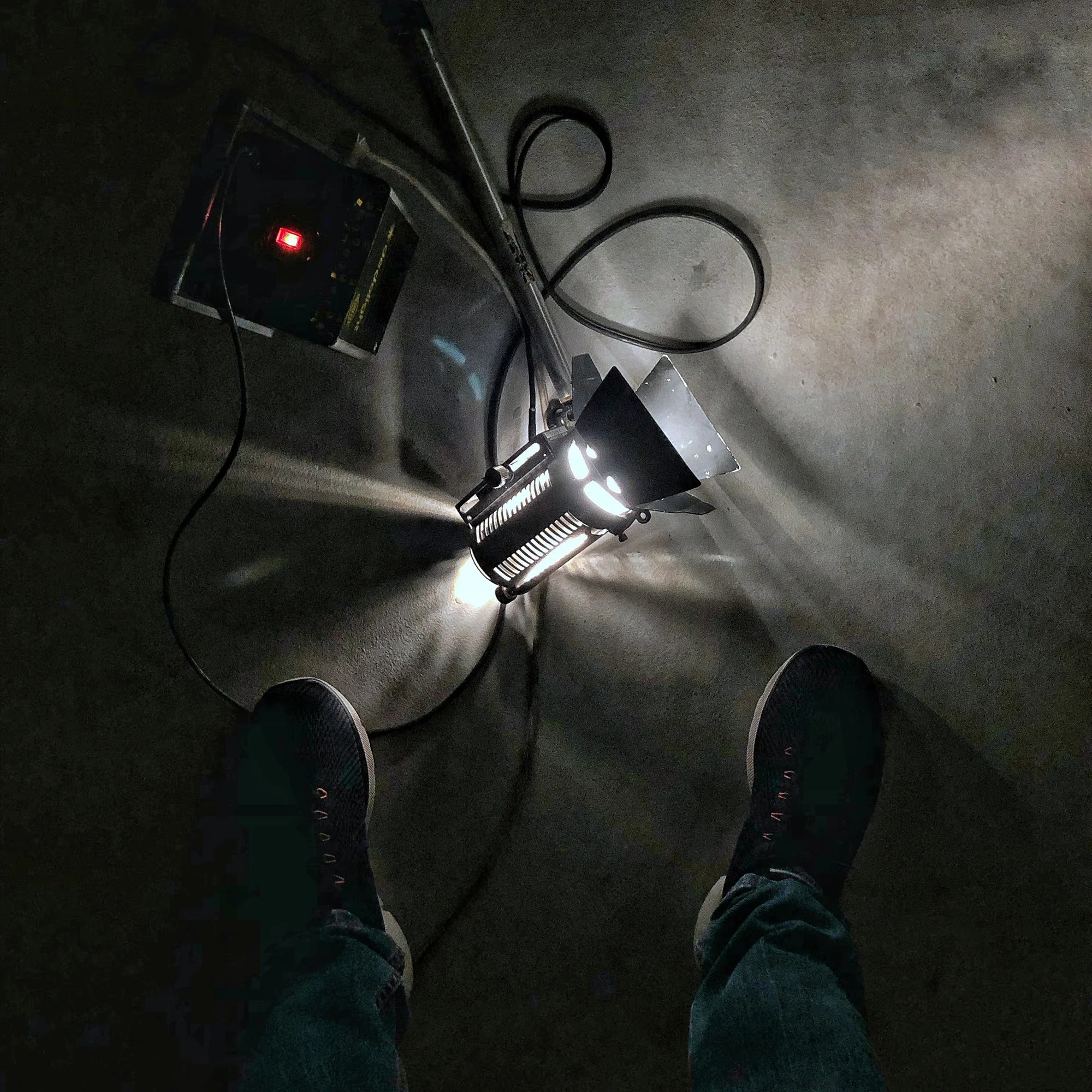
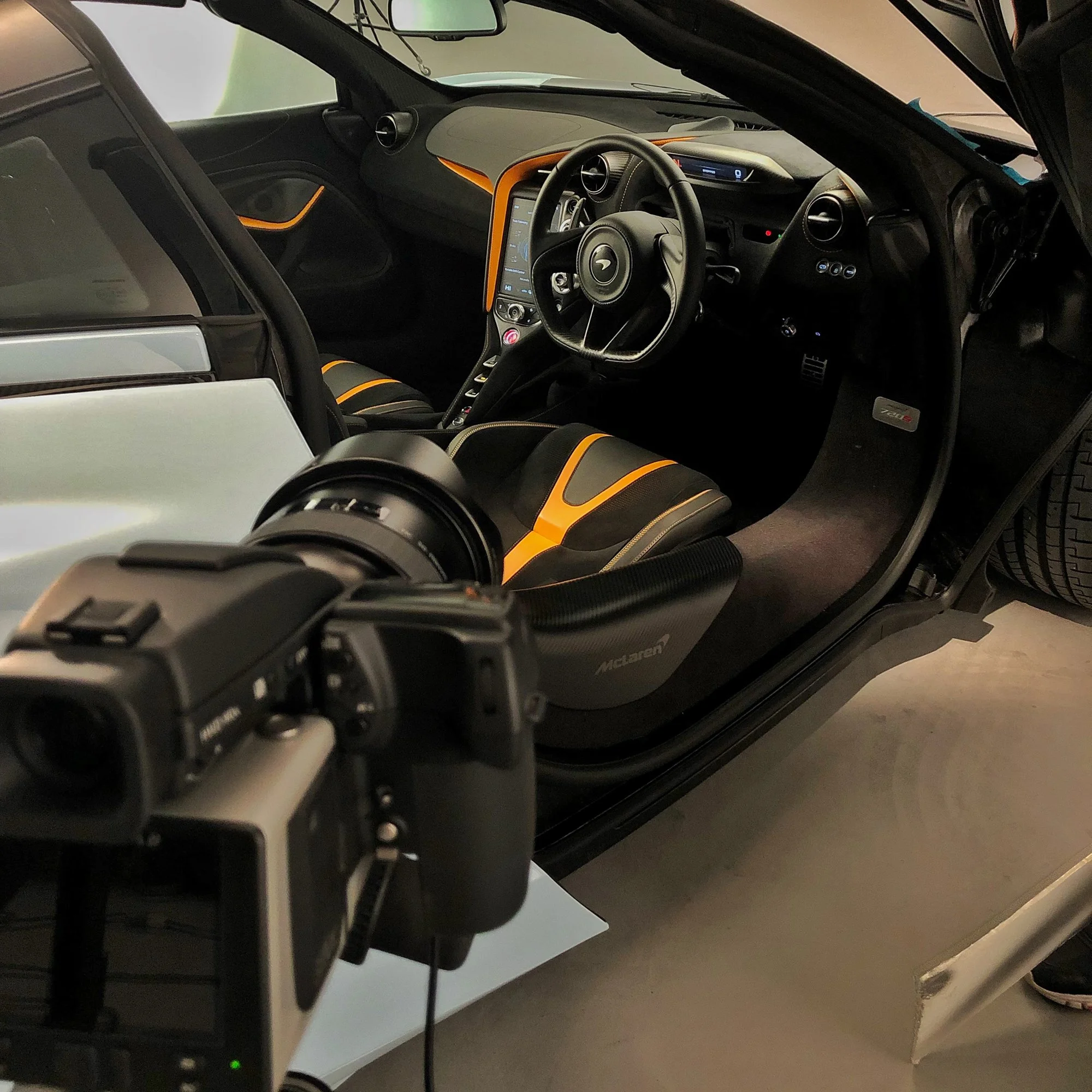
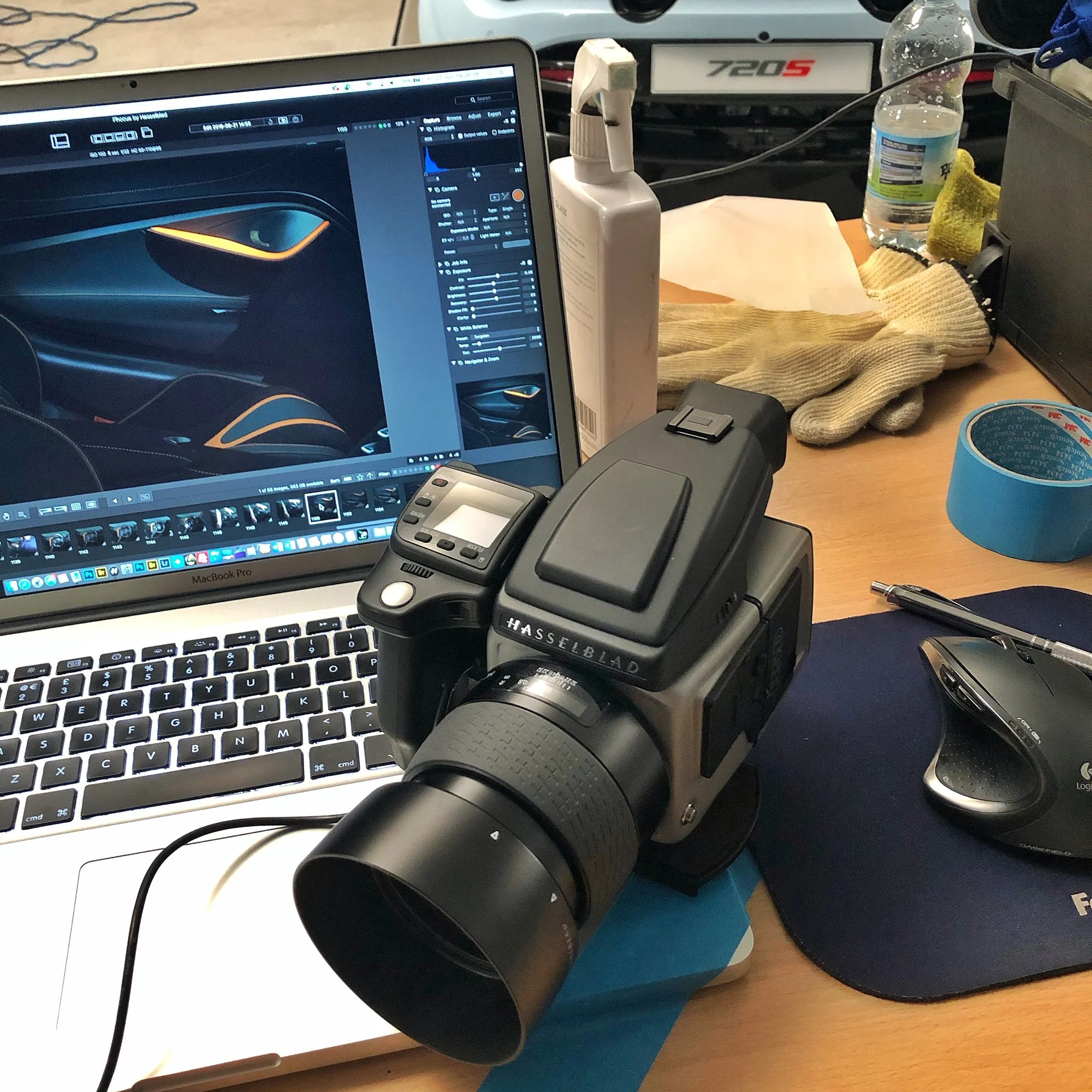

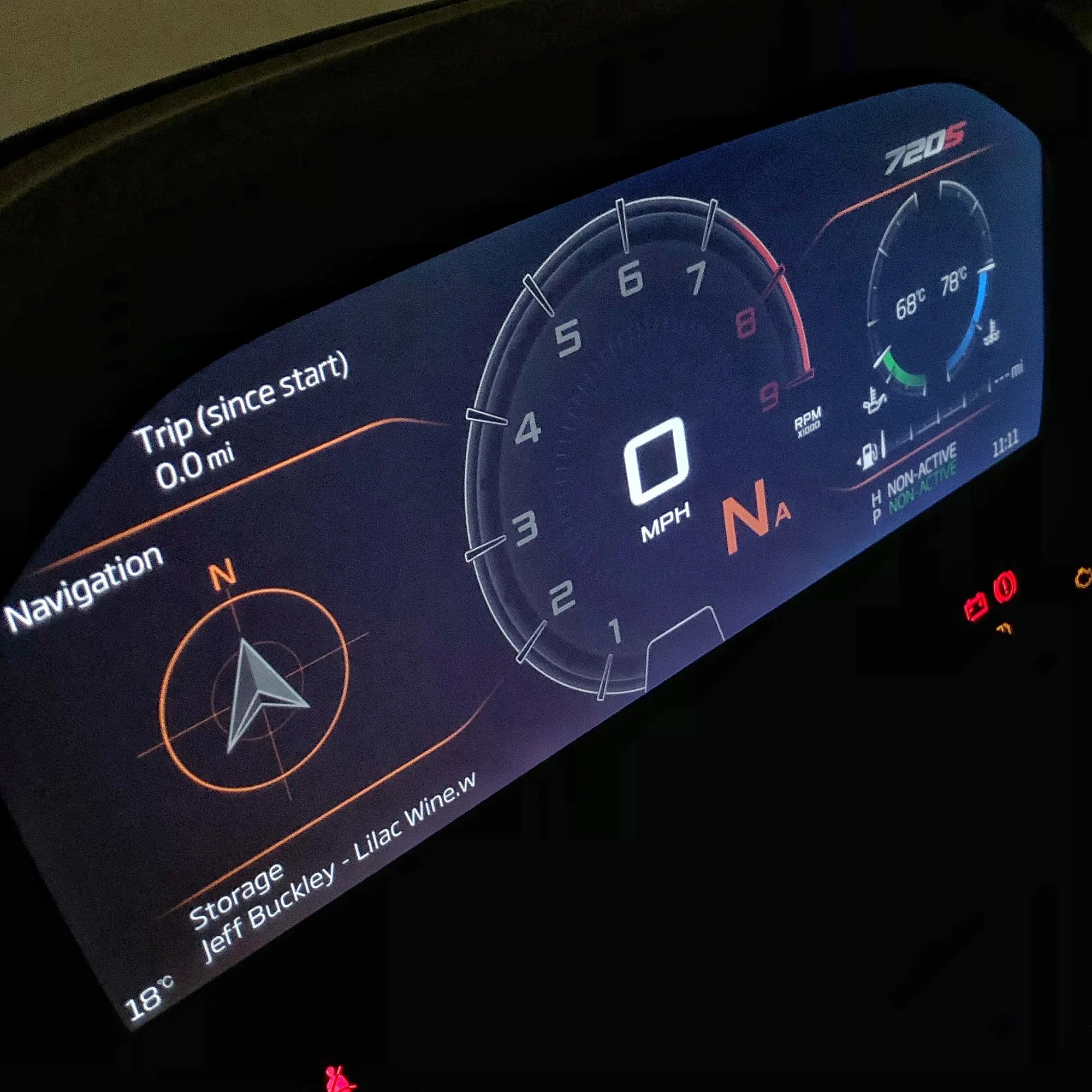
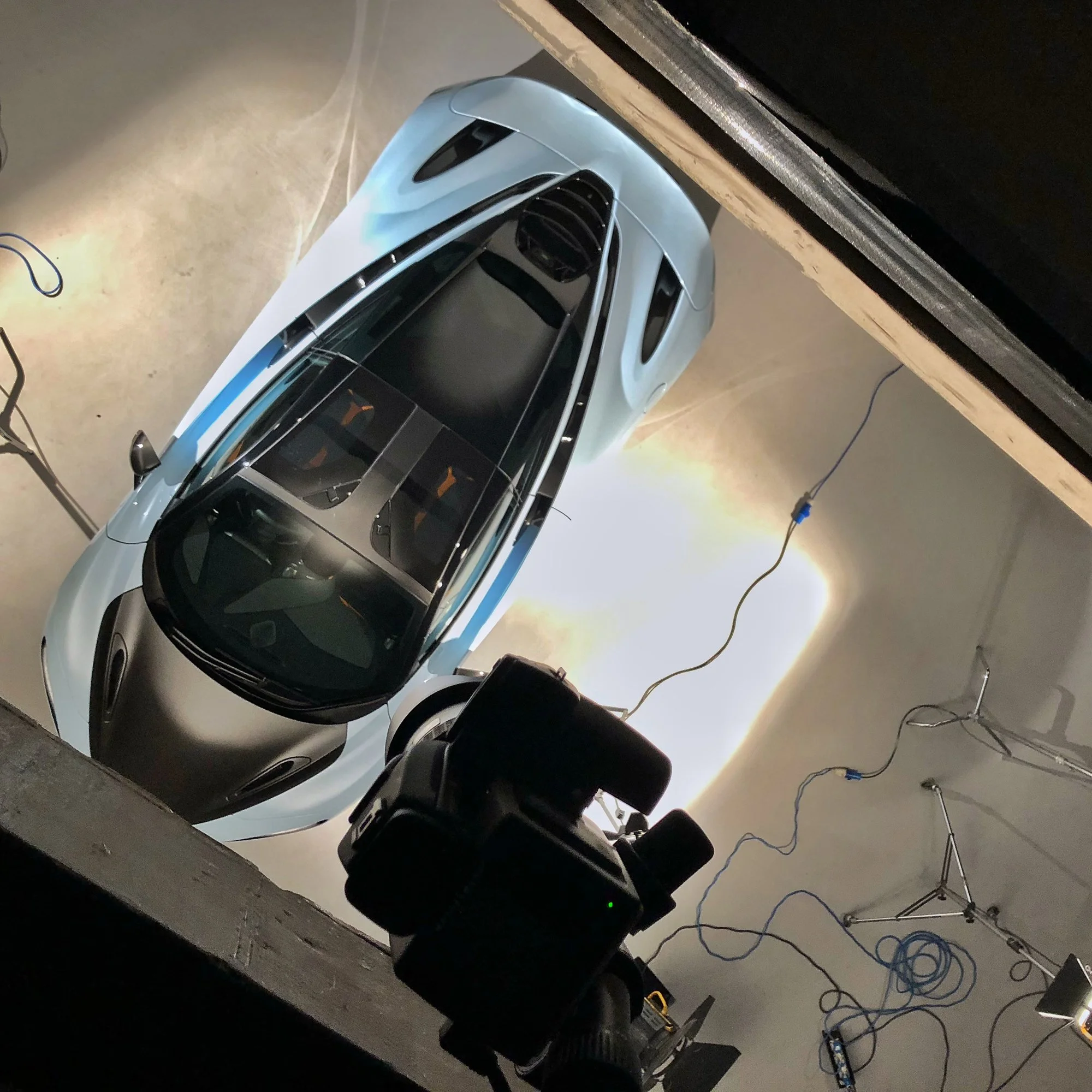
Reflections are perhaps the greatest challenge in studio automotive photography. Unlike many commercial products, a car behaves almost like a mirror, faithfully reflecting everything within its environment. Every lighting stand, every modifier, every wall and even the photographer themselves has the potential to appear somewhere within the paintwork if careful attention is not paid. Controlling those reflections is not about eliminating them; quite the opposite. Reflections are what define the shape of the vehicle. The challenge is learning how to create reflections that enhance the design rather than distract from it, allowing the eye to appreciate the flowing lines and beautifully engineered surfaces without ever becoming aware of the complex lighting that has made them possible.
The McLaren 720S presents its own unique challenges in this respect. Its bodywork is wonderfully fluid, with very few hard edges to naturally catch the light, meaning that every highlight has to be crafted with exceptional care. The distinctive doors, the dramatic air channels carved into the body and the sweeping rear haunches all rely on subtle transitions between light and shadow to communicate their shape. Achieving those transitions is rarely a quick process. It often involves making a series of tiny refinements, stepping back to assess the result before making another equally small adjustment, gradually building an image that feels effortless despite the considerable work taking place behind the scenes.
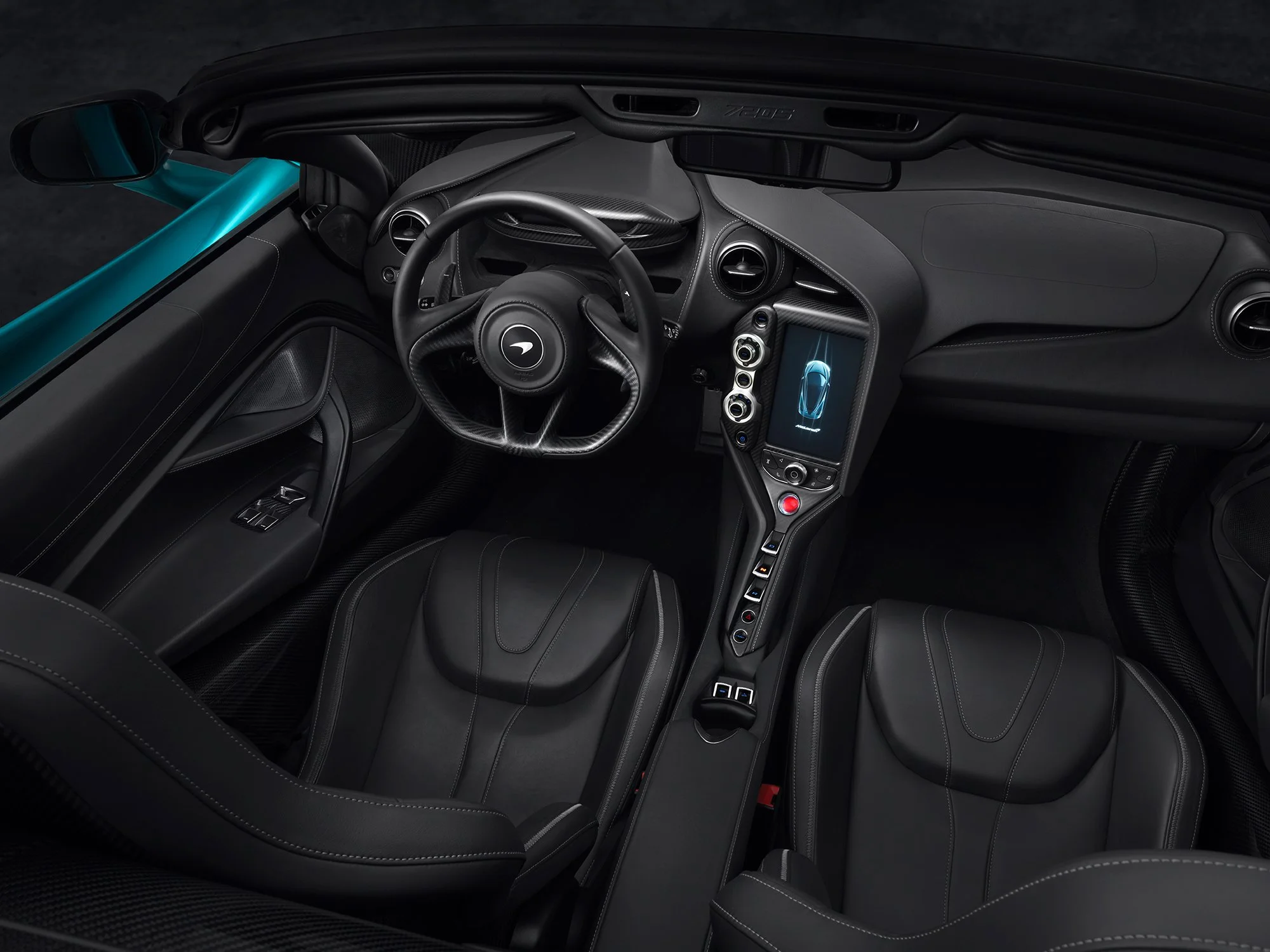
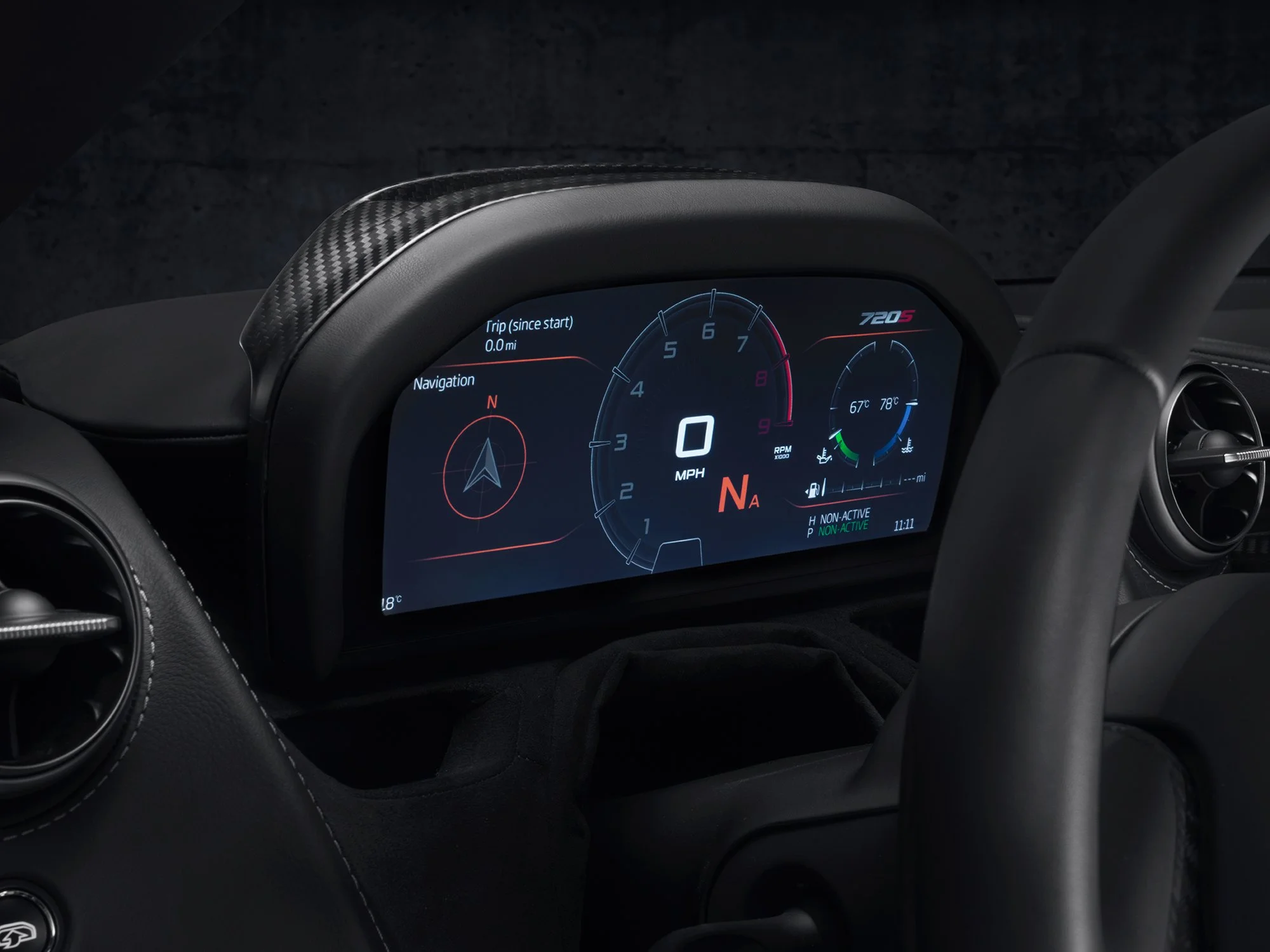
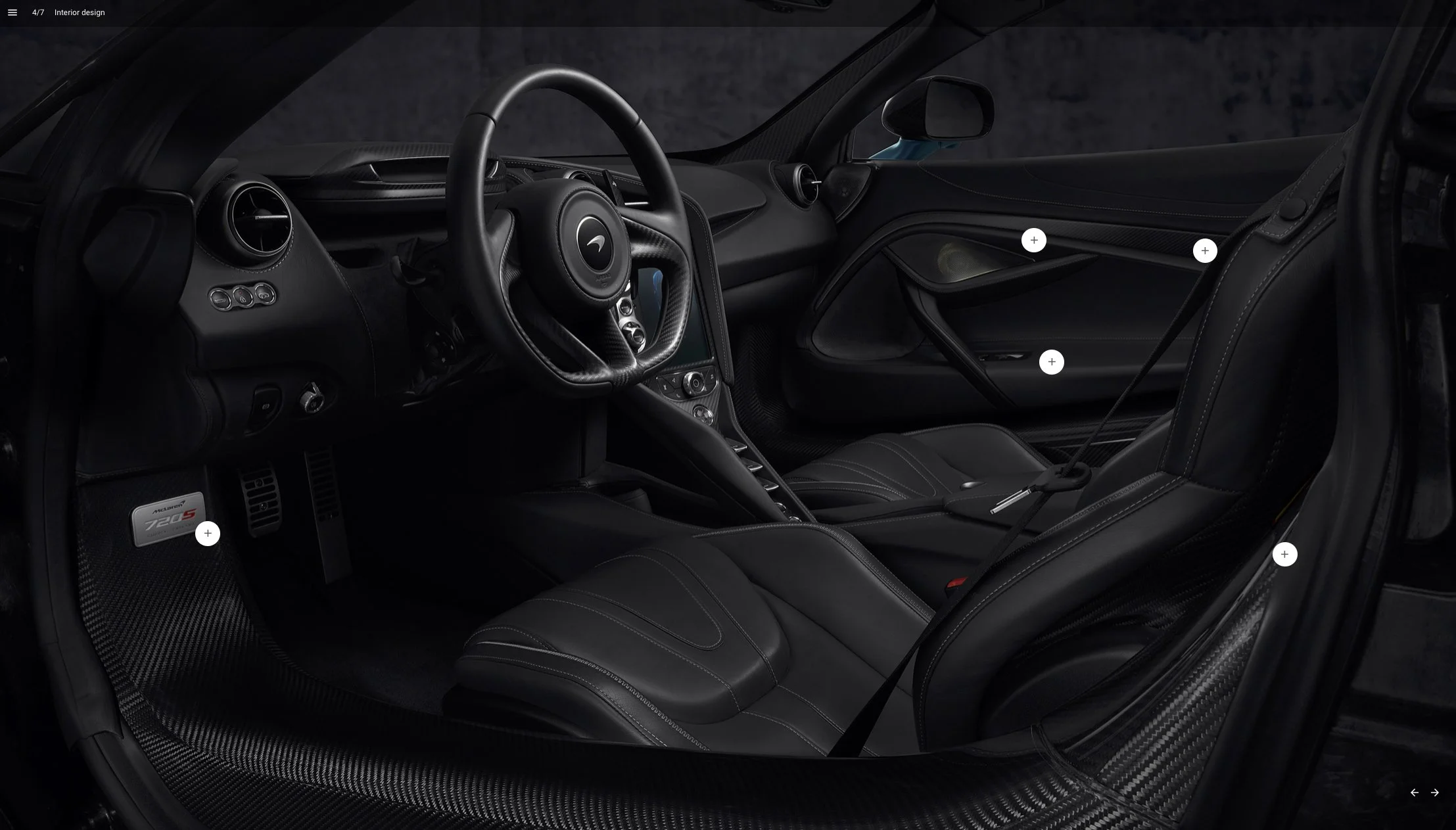
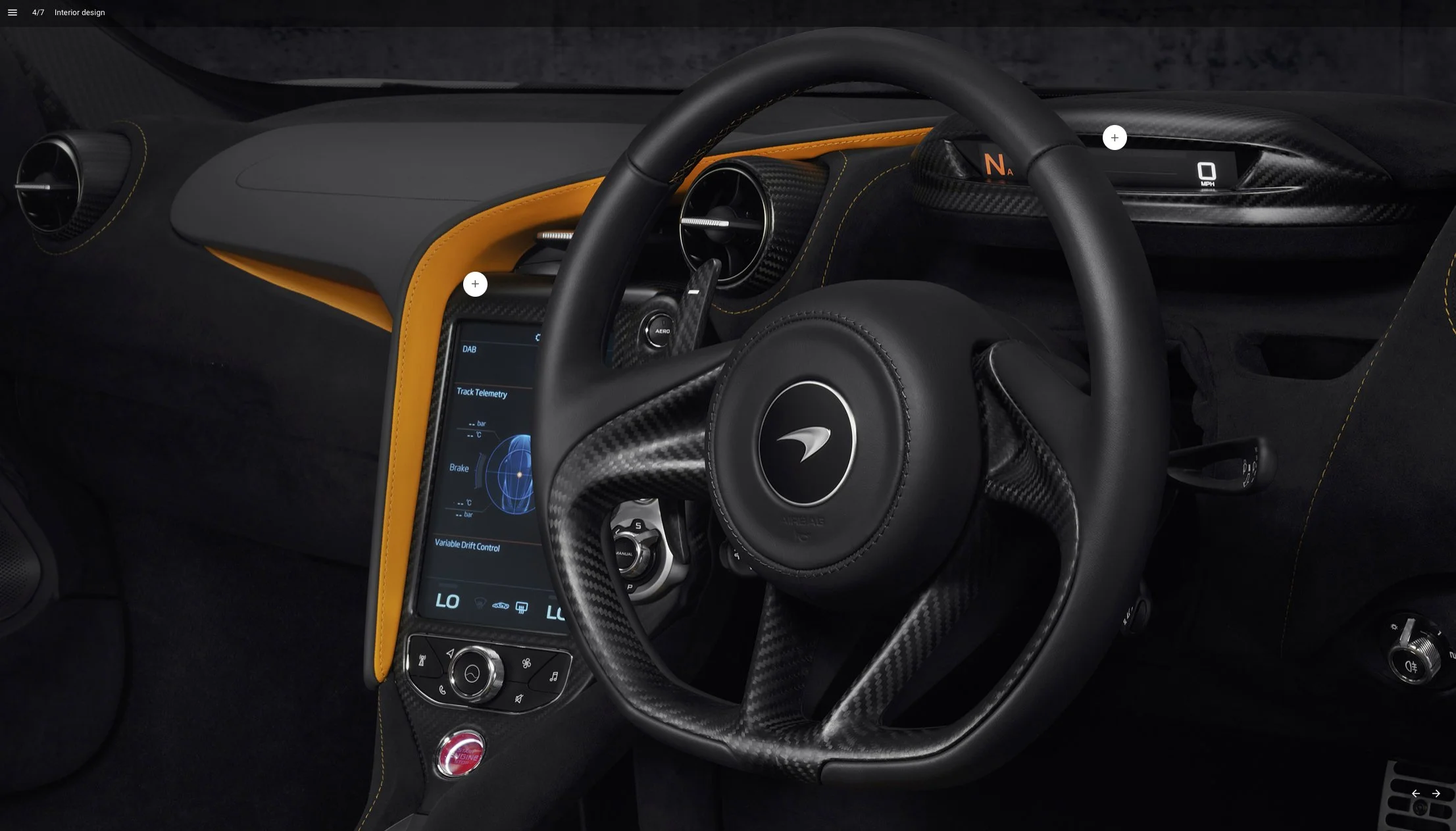
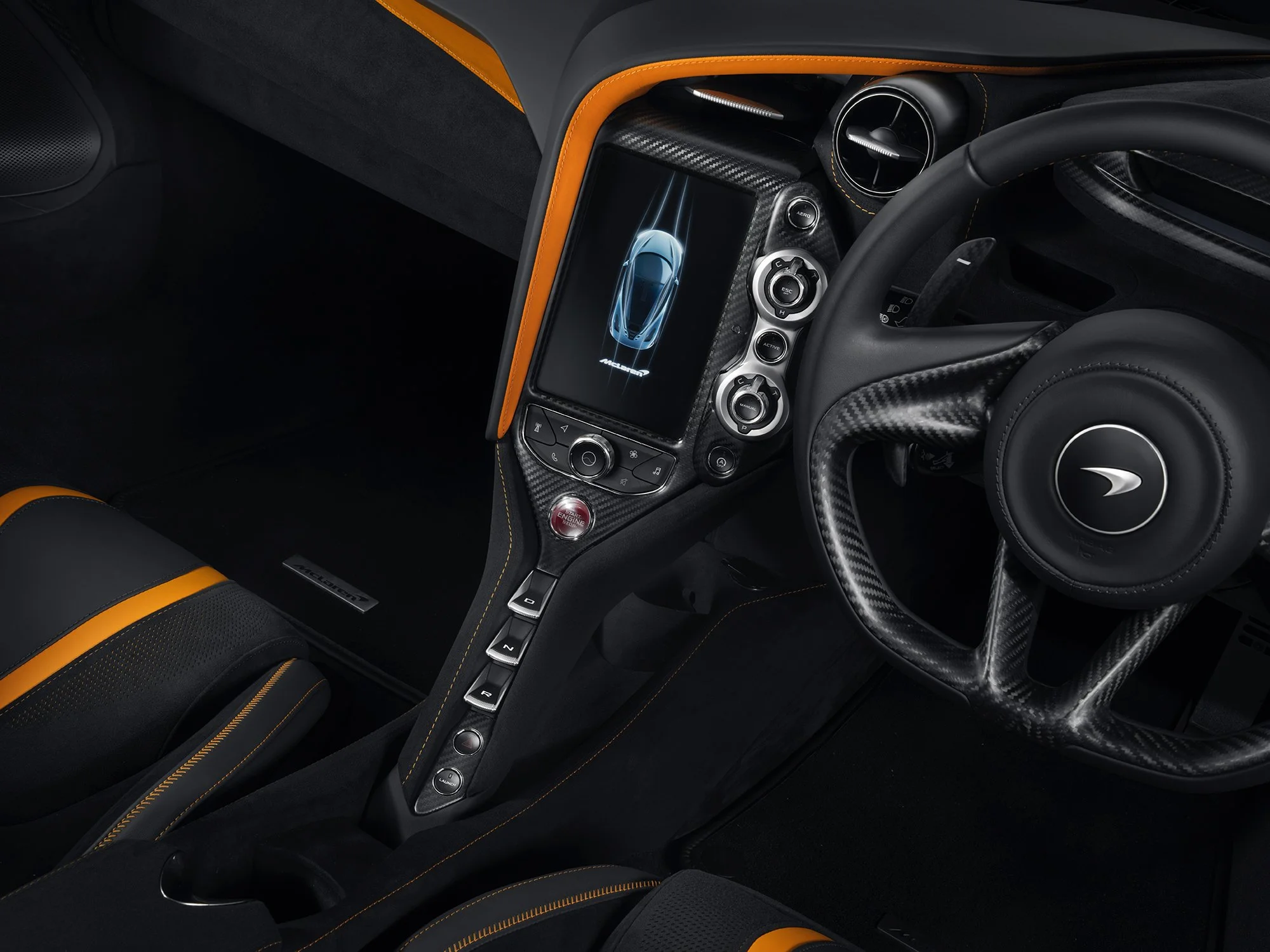
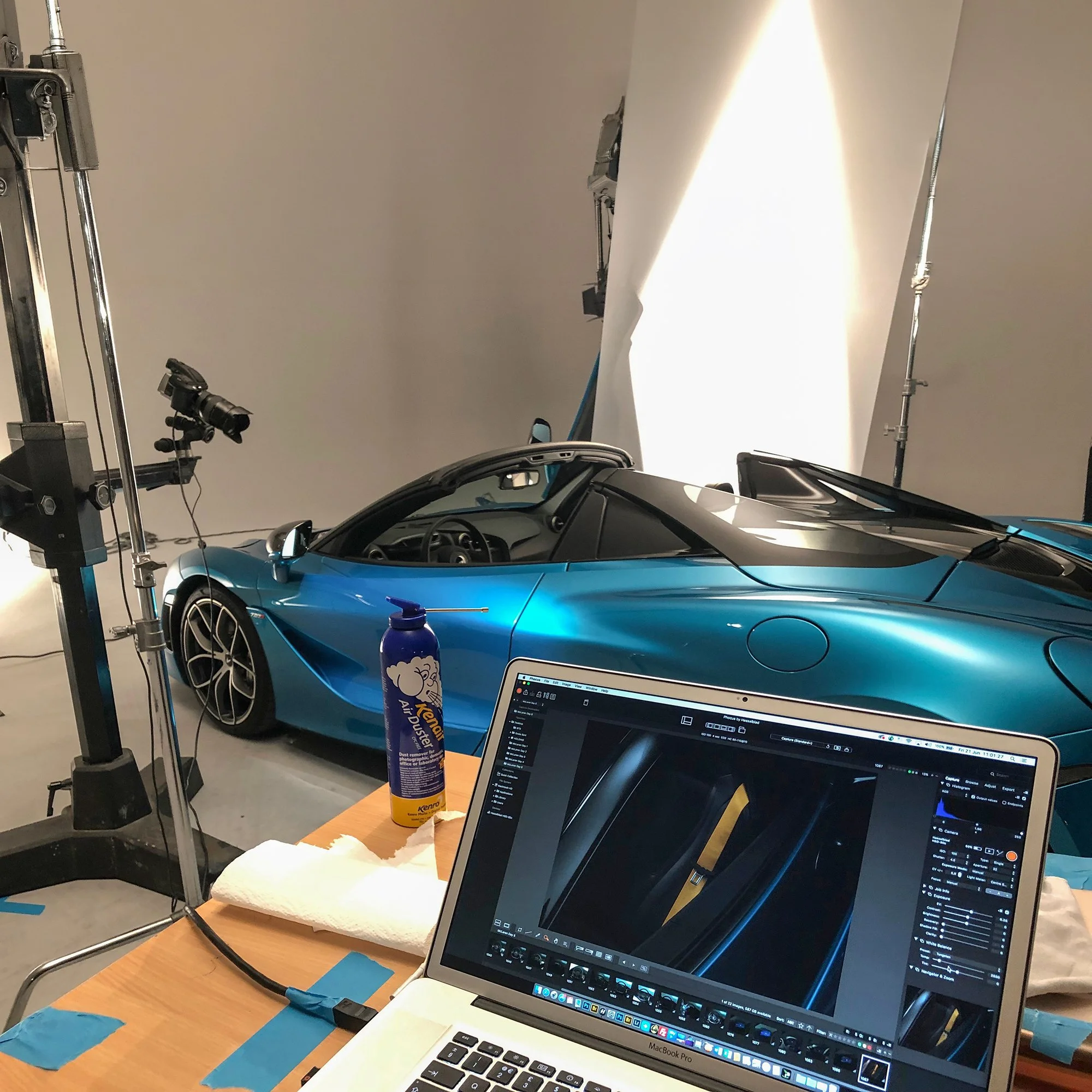
The exterior photography formed only part of the commission. Throughout the week the attention repeatedly shifted towards the cabin, where the same level of precision was required to showcase the craftsmanship that defines a McLaren interior. Leather, Alcantara, polished aluminium, satin finishes and exposed carbon fibre all react to light in entirely different ways, and understanding those differences is essential if each material is to retain its natural appearance. The objective is never to overwhelm the viewer with dramatic lighting but instead to allow every surface to appear exactly as it would if they were sitting inside the car themselves, appreciating the quality of the materials for the first time. The cars are often coming into studio that early on in their manufacture that the digital displays have not been finalised yet so engineers visit studio during the shoot and run through current display options, generally the final choice will be dropped digitally into place during the edit process. Not so difficult but that soft sheen of light that will be required to be seen falling across the display itself will still need to be shot and still need to be present in the final edit.

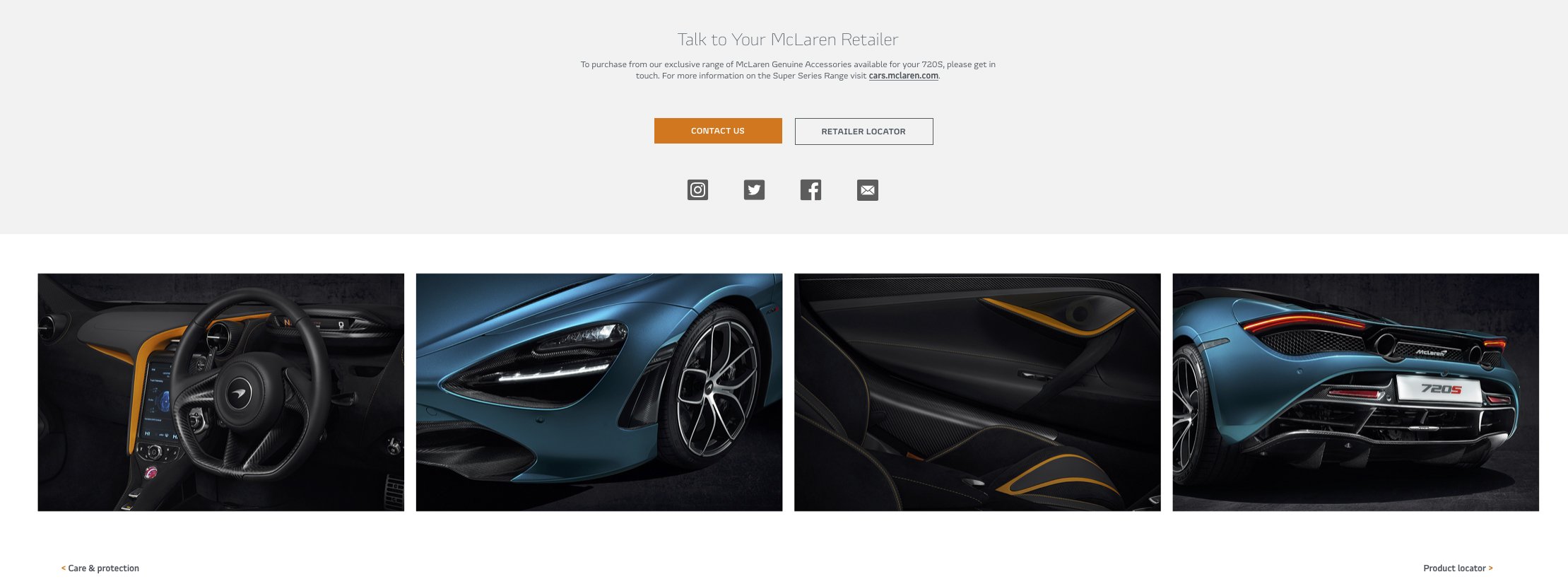
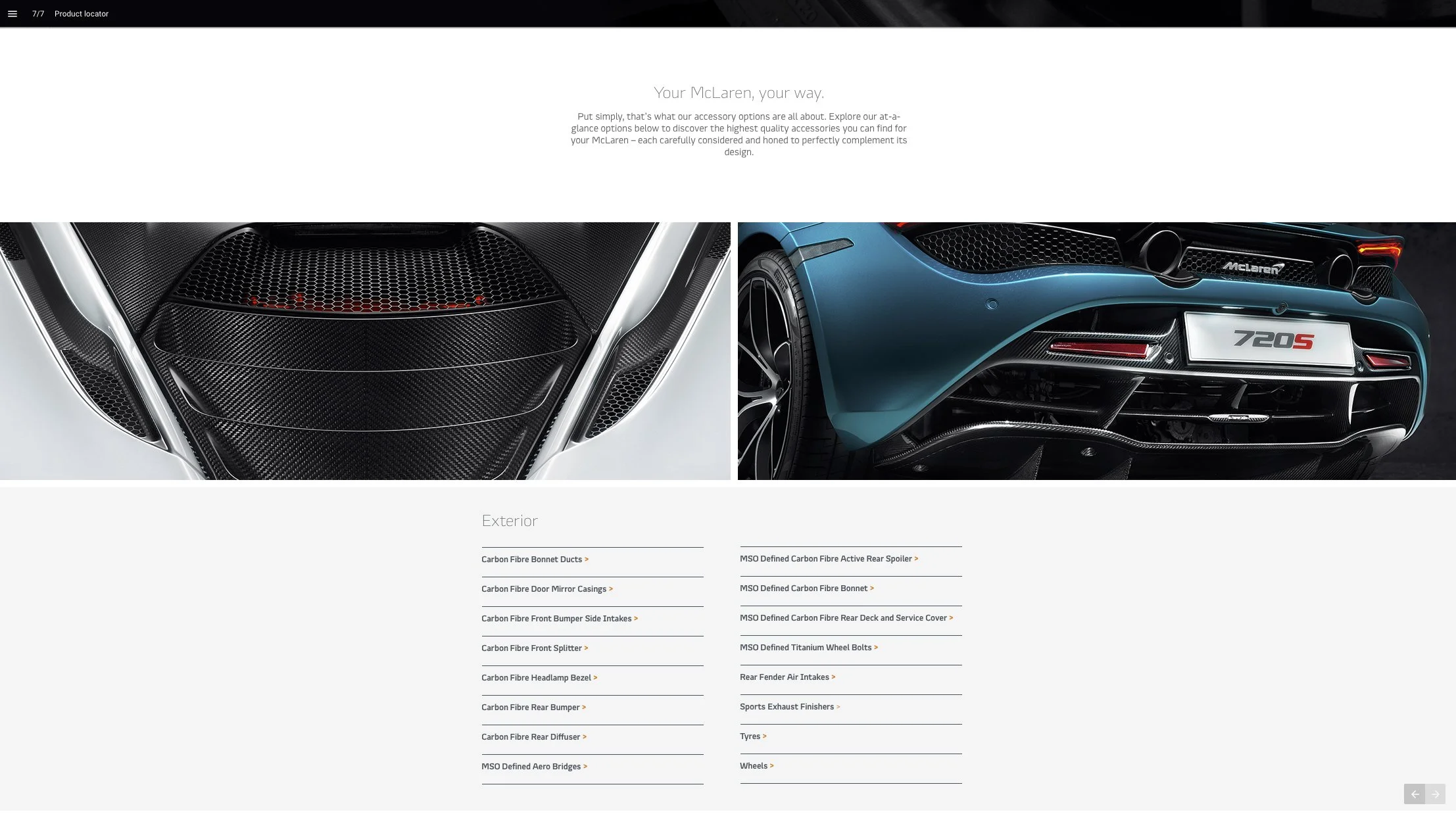
Photographing the McLaren Special Operations options added another fascinating dimension to the production. Every bespoke component, whether it was a unique wheel design, an alternative bonnet badge, carbon fibre detailing or a beautifully crafted interior finish, deserved the same level of attention as the vehicle itself. These are the details that transform an already exceptional car into something deeply personal for its owner, and the photography has to celebrate that individuality. It is remarkable how a seemingly modest change can influence the character of the car, and equally remarkable how much care is required to ensure those differences are communicated accurately through a single photograph.
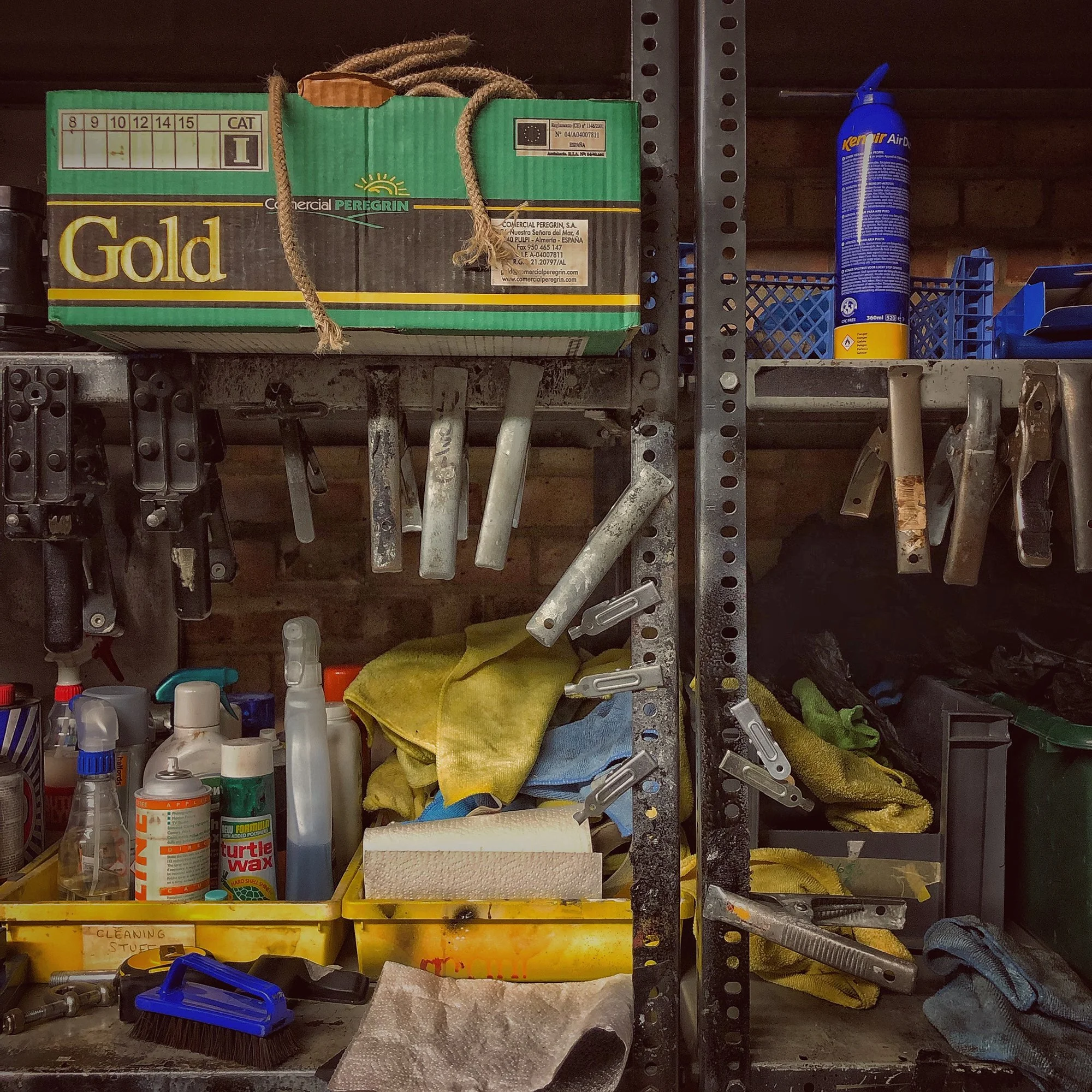
People are often surprised by how little time is actually spent pressing the shutter. The vast majority of the working day is devoted to observation, refinement and problem-solving. It involves studying reflections, adjusting lighting, cleaning surfaces that have attracted the tiniest speck of dust, reviewing compositions on screen and discussing each image with the team before moving on to the next stage of the production. The camera itself may only record a fraction of a second, but reaching that fraction of a second can take hours of careful preparation.
At the end of each long day there is naturally a sense of satisfaction in seeing another collection of finished images come together, yet there is never an opportunity to become complacent. The following morning begins with a large strong mug of tea and another carefully planned sequence of photography, another collection of details to capture and another opportunity to refine the work even further. Maintaining consistency across more than fifty or so final images requires absolute concentration from the first morning to the final evening, because every photograph has to feel as though it belongs to the same visual story.
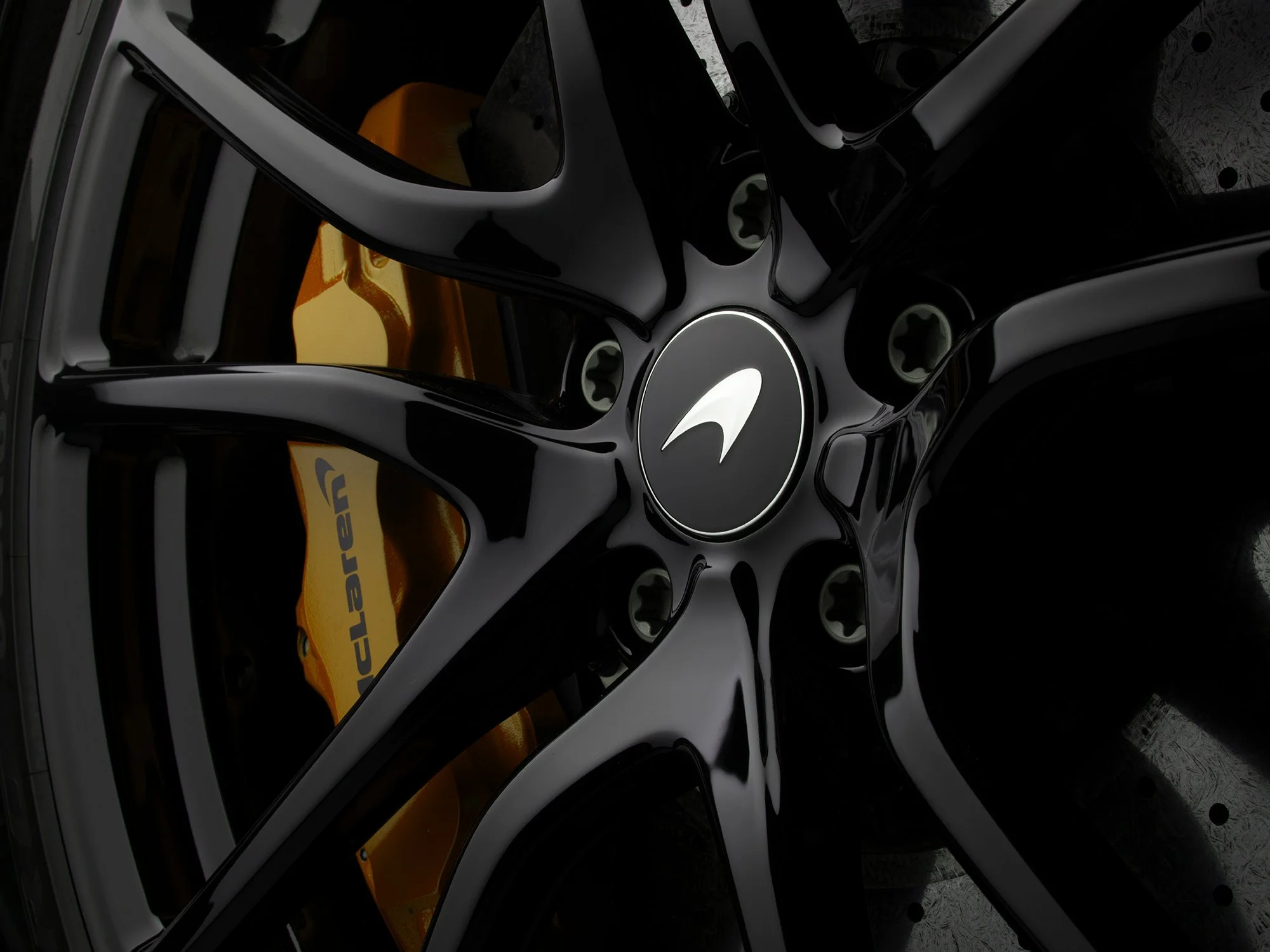
Looking around the studio during those twelve-hour days, surrounded by lighting equipment, cameras, laptops and one of the world’s most beautifully engineered supercars, I am often reminded how fortunate I am to do this for a living. Commercial automotive photography combines two passions that have shaped my entire career: an appreciation for exceptional engineering and an enduring fascination with light. It is demanding, technically challenging and often physically exhausting, yet there are very few places I would rather be than standing quietly in a studio, studying the way a single highlight flows across the bodywork of a remarkable car.
The images created during that week would eventually appear in McLaren’s global marketing and on the company’s worldwide website, where they would help introduce the 720S and its McLaren Special Operations programme to customers across the world. For me, however, the greatest satisfaction had already arrived long before the photographs were published. It came in those quiet moments inside the studio when the lighting came together, the reflections settled perfectly into place and the extraordinary design of the McLaren 720S revealed itself exactly as I had imagined. Those are the moments that remind me why, after more than two decades working as a commercial and automotive photographer, I remain just as passionate about creating these images as I was when I first picked up a camera aged 11.
A Career Shaped by Light
When people see the finished photographs from a project like this, it is easy to assume that the camera is the most important part of the process. Questions often revolve around the equipment that was used, the lenses chosen or the technical settings behind each image. While those things undoubtedly have their place, they are only tools. The real skill lies in understanding light, because long before a camera records an image, light has already determined how that photograph will make people feel.
For me, that fascination with light has been at the heart of my career for more than two decades. Throughout those years I have been fortunate to work with manufacturers, global brands and businesses across many different industries, but automotive photography has always held a special place. Cars combine artistry and engineering in a way that very few products ever can, and photographing them presents a challenge that I have never grown tired of solving.
Every vehicle has its own personality.
Some are all about aggressive performance and dramatic lines, while others express elegance through subtle curves and beautifully restrained design. The role of a professional commercial car photographer is to understand that personality before a single light is positioned. My responsibility is not to impose my own style upon the vehicle but to reveal the character that already exists, using light to celebrate the countless hours of design, engineering and craftsmanship invested by the people who created it.
That understanding does not arrive overnight.
Like any profession, commercial automotive photography is built upon experience, and much of that experience comes from making mistakes, learning from them and gradually developing an instinct for seeing what others might overlook. During the early years of my career I spent countless hours experimenting with lighting, studying reflections and learning how different materials respond under carefully controlled conditions. Those lessons could never have been learned by reading a book alone. They came through patience, repetition and an unwavering determination to keep improving.
Studio automotive photography is often regarded as one of the most technically demanding disciplines within commercial photography, and with good reason. Unlike portrait photography or landscape work, where light can often be embraced as it naturally exists, photographing a car inside a studio means creating every highlight, every shadow and every reflection from scratch. Nothing is left to chance. Every panel has to retain its shape, every curve must be defined and every surface needs to communicate the quality of the engineering beneath it.
It is also a discipline that rewards precision.
Throughout a typical production I can spend several hours refining a single lighting arrangement before pressing the shutter with complete confidence that everything is exactly where it needs to be. To someone looking in from the outside, moving a light by only a few centimetres may appear insignificant, but those tiny adjustments are often what transform a technically competent photograph into an image that genuinely captures the spirit of the vehicle. They are the difference between simply recording a car and presenting it in a way that inspires people to stop, look again and appreciate the extraordinary level of design before them.
That pursuit of perfection is one of the reasons I continue to enjoy commercial photography as much today as I did when I first began my career. Every assignment presents a new challenge, every vehicle demands a fresh approach and every client places their trust in my ability to communicate their product through imagery that strengthens their brand. Whether I am photographing a McLaren supercar, an Aston Martin, a commercial vehicle or highly specialised industrial machinery, the principles remain remarkably similar. The subject may change, but the objective never does. Create photography that is visually engaging, technically exceptional and commercially effective.
Trust is an important word in commercial photography.
Manufacturers do not simply commission images; they place part of their reputation in the hands of the photographer. The photographs created during a project such as the McLaren 720S shoot may appear across international advertising campaigns, product brochures, exhibition graphics, digital marketing and websites viewed by millions of people around the world. Those images become part of the brand’s identity, helping customers form their very first impression of the product. That responsibility is something I have always regarded as both a privilege and an obligation, and it is one I never take lightly.
Looking back on the week spent photographing the McLaren 720S, what remains with me is not simply the satisfaction of seeing the finished images published across McLaren’s global marketing. It is the collaborative spirit of the project, the months of preparation that made the production possible and the shared determination between McLaren, their advertising agency and myself to create imagery that reflected the extraordinary quality of the car itself. Commercial photography at this level is never the work of one individual. It is the result of talented people bringing together their respective expertise to achieve a common goal.
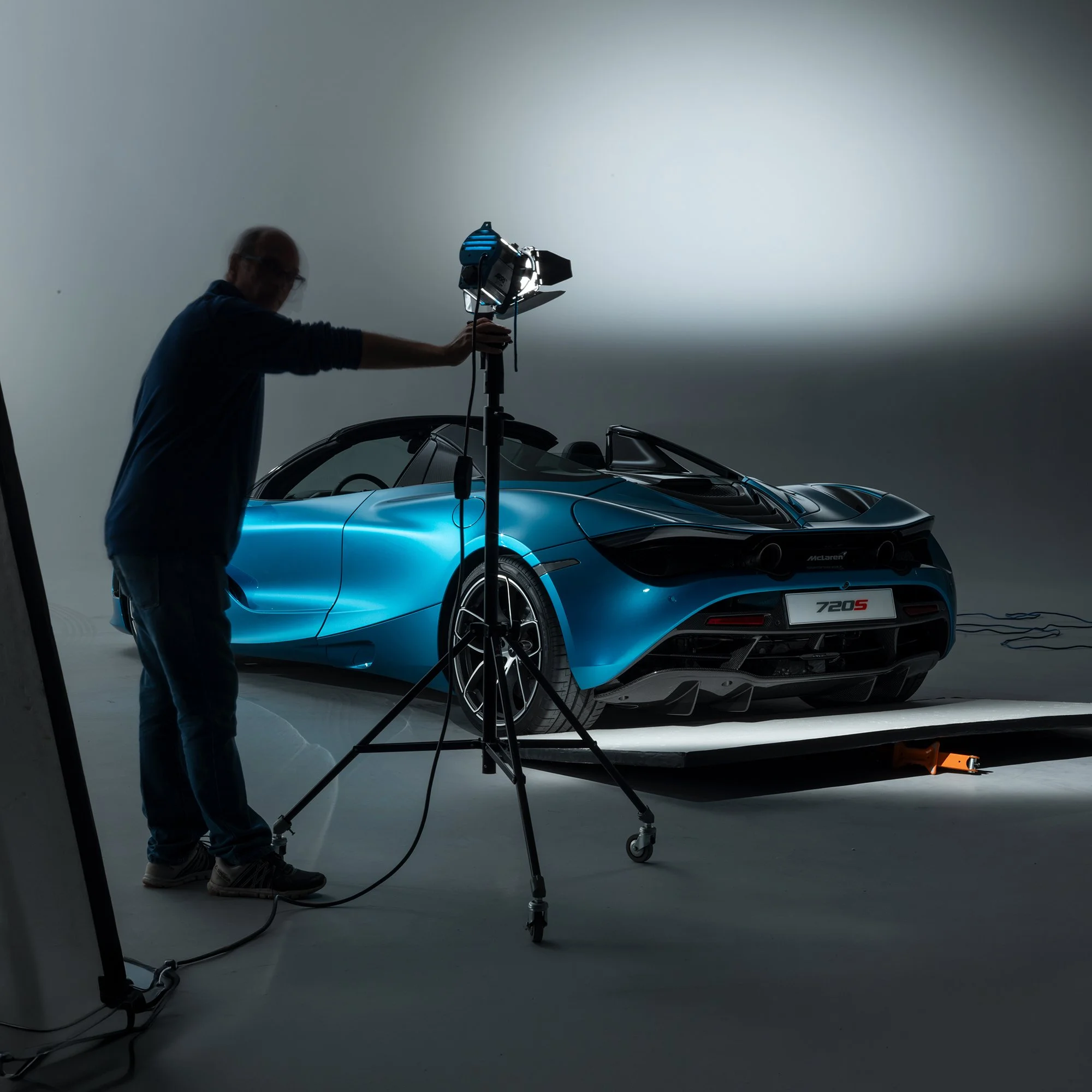
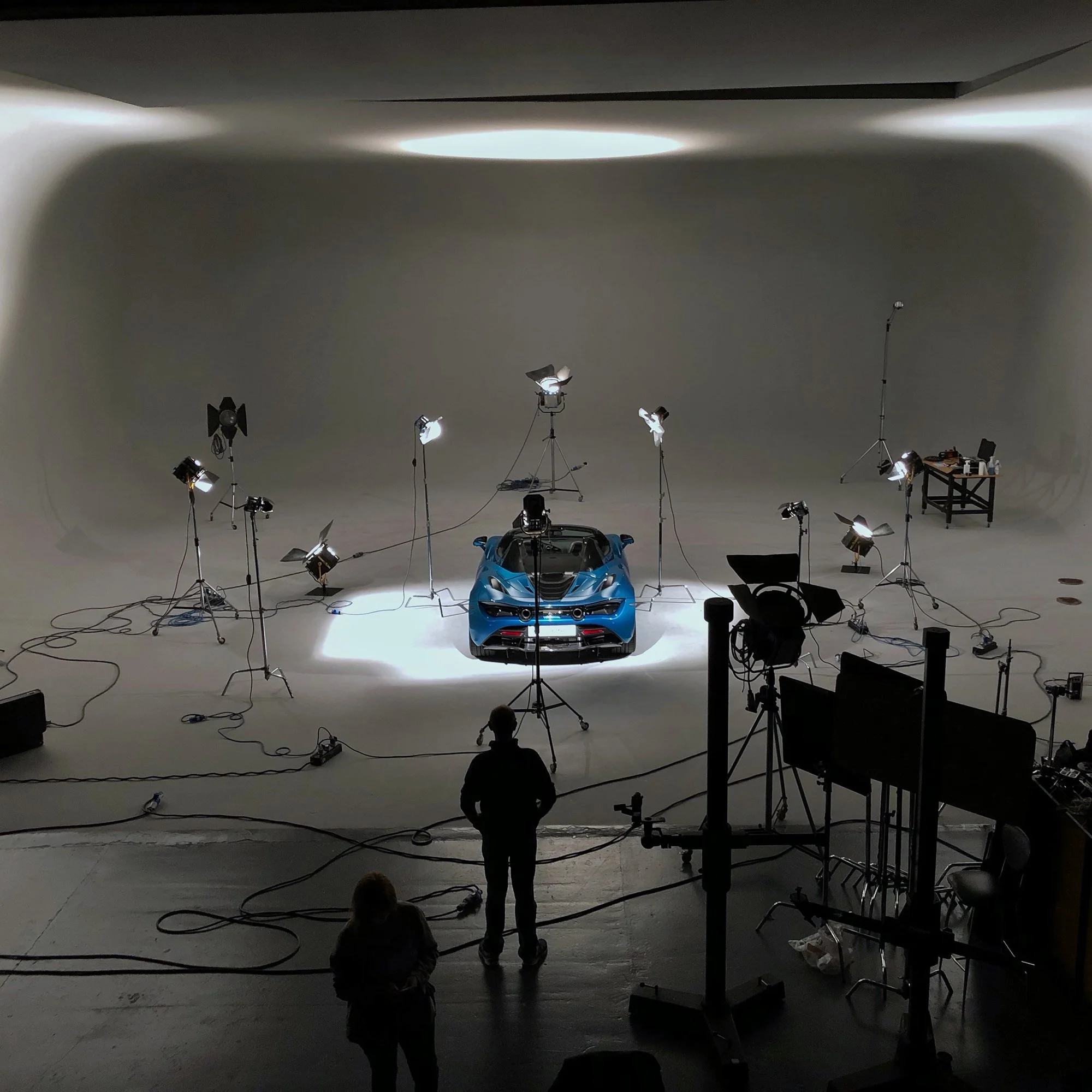
As a commercial car photographer, I still experience the same sense of anticipation every time a studio door closes behind me and the first light is switched on. Even after more than twenty years behind the camera, there is something immensely satisfying about watching a beautifully engineered vehicle slowly emerge from darkness as each carefully positioned light begins to reveal another line, another curve and another piece of craftsmanship. It is a process that demands patience, precision and complete concentration, but it is also one that continues to inspire me every single time.
People occasionally ask what keeps that enthusiasm alive after so many years.
The answer is remarkably simple.
I have never stopped being fascinated by light.
It is the one constant that connects every commission I undertake, whether I am photographing a world-renowned supercar, a commercial fleet, an aircraft or a piece of industrial equipment. Light has the power to reveal form, create emotion and transform engineering into something that resonates with the viewer. It is the silent language that exists within every successful photograph, and it remains the most powerful creative tool any photographer possesses.
Over the years I have often found myself returning to one simple thought that perfectly sums up my approach to photography. It is a philosophy that has guided me throughout my career and one that felt especially appropriate during my week photographing the McLaren 720S.
Light is my paint, give me a car and a studio, and I will push to paint you a masterpiece.
Looking back at the finished images from this remarkable commission, I still feel the same sense of pride that I felt when the final shutter was released. Not because the photographs carry my name, but because they represent the combined efforts of an exceptional team and celebrate one of the most beautifully engineered performance cars of its generation. To have those images become part of McLaren’s global marketing and appear on the company’s worldwide website was an honour, but perhaps even more rewarding was the opportunity to tell the story of an extraordinary car through the medium I have dedicated my professional life to mastering.
That, ultimately, is what commercial automotive photography means to me. It is far more than creating attractive images of exceptional cars. It is about understanding the vision behind every vehicle, working alongside the people who brought it to life and using experience, precision and carefully crafted light to reveal that vision in a way that inspires others. For a commercial car photographer, there are few greater privileges than being trusted with that responsibility, and it is one that continues to motivate me every time I step into the studio.
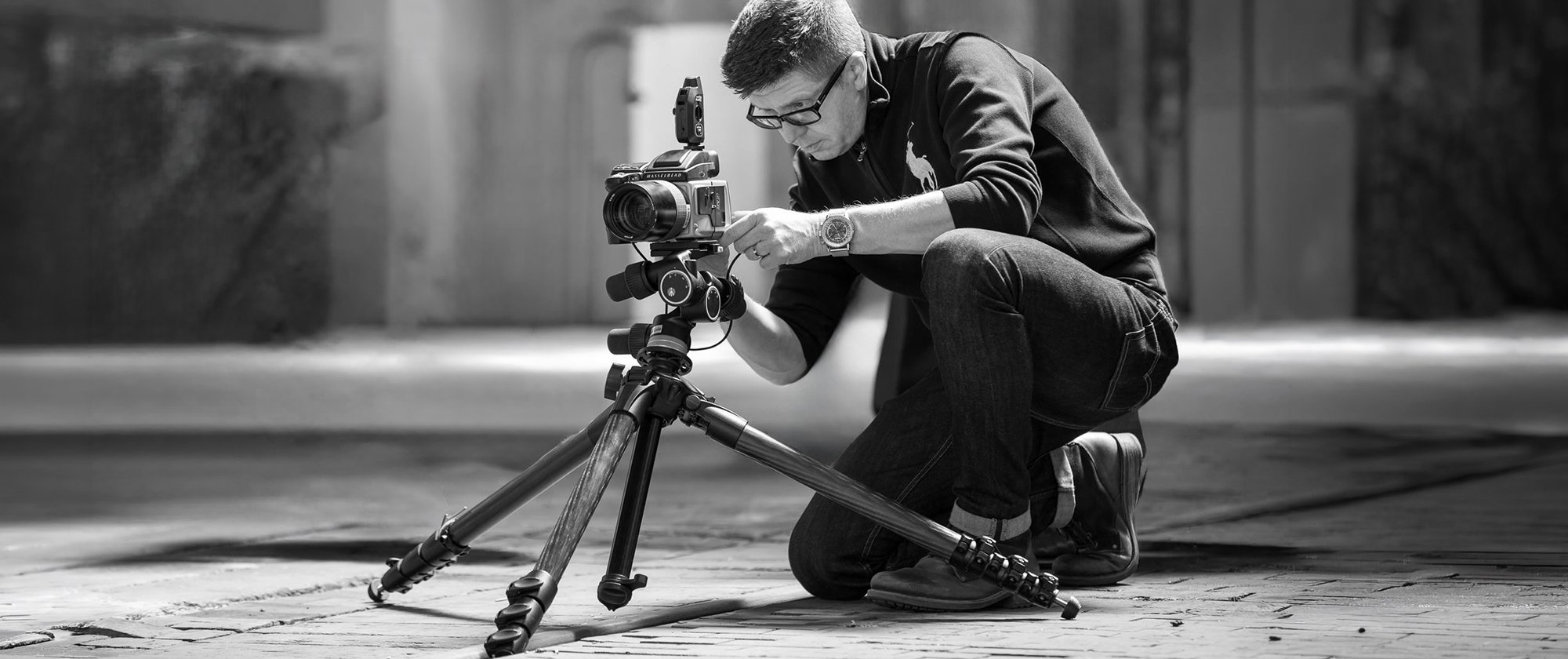
Tim Wallace is an award-winning commercial car photographer with more than 20 years' experience creating photography for leading automotive manufacturers and global brands.
His work has been commissioned by McLaren, Aston Martin, Lexus, Peugeot and many others, producing imagery for worldwide marketing campaigns, advertising and editorial publications.