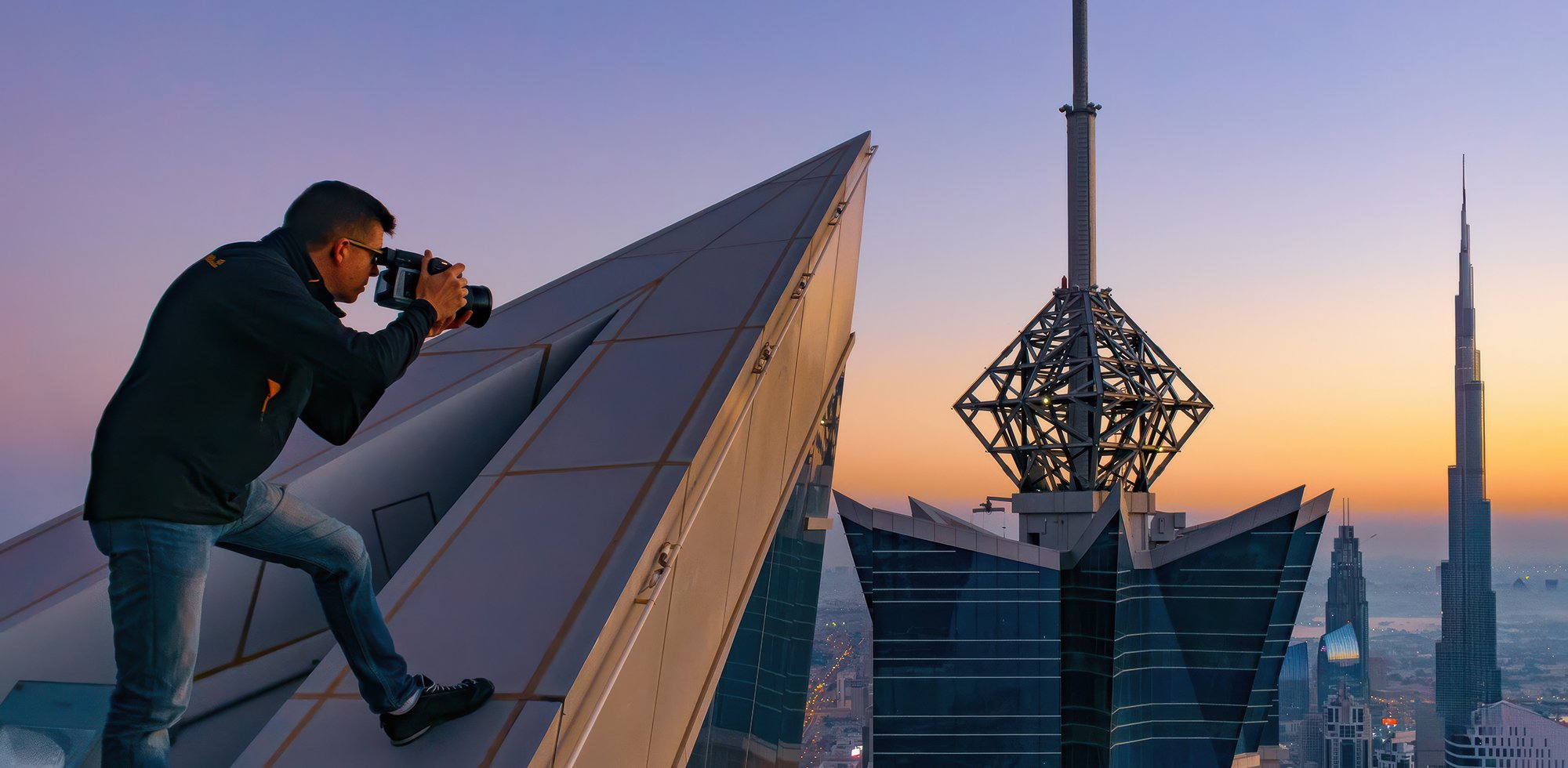
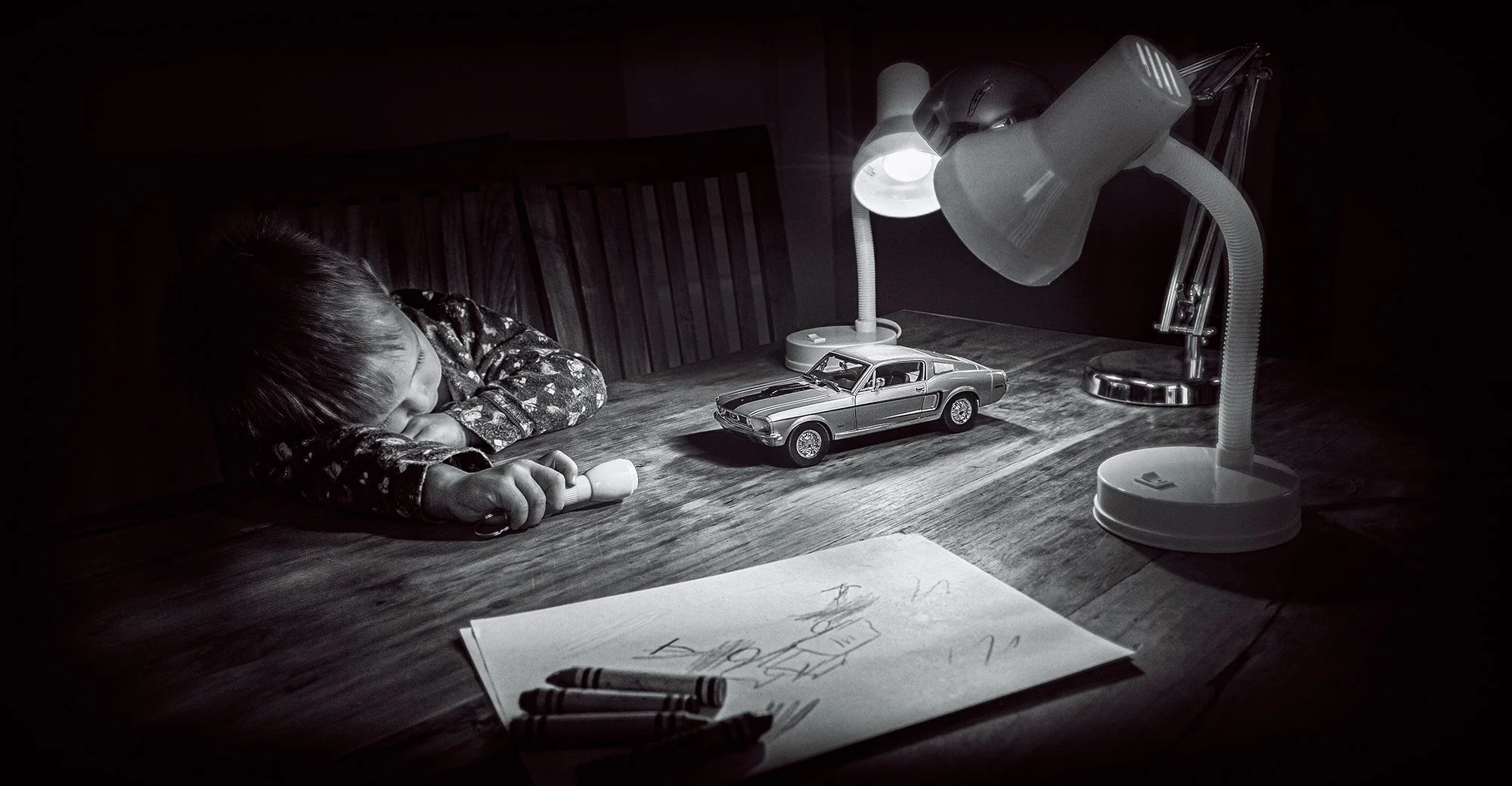
Why learning to see better will always matter more than the camera in your hands
This week saw the publication of a special 10 page feature article by Commercial Photographer Tim Wallace discussing why developing your photographic eye is far more valuable than constantly upgrading equipment, and why observation, light, composition and storytelling remain the foundations of exceptional photography.
It is always a genuine privilege when your work is recognised by your peers, so I was delighted to have another article published in The PHOTOGRAPHER magazine, the official publication of the British Institute of Professional Photography (BIPP). Having previously written a 8 page article entitled ‘Bringing Design to Life with Light’ for the Institute, being invited back for a second feature is a real honour and one that means a great deal to me as a professional commercial photographer.
This latest article, Seeing Before Shooting, explores something that I believe sits at the very heart of great photography. In a world where new cameras, lenses and technology dominate so many conversations, it is easy to forget that the most important piece of equipment any photographer owns is their ability to truly see. Throughout more than two decades working in commercial photography, photographing everything from automotive campaigns and aviation to industrial machinery and global advertising projects, I have learned that creative vision will always have a greater impact than the camera you happen to be holding. Whether you are just starting your photography journey or have years of experience behind the camera, learning to see differently will improve your photography far more than buying the latest piece of kit.
I hope it encourages photographers of every level to spend a little less time thinking about equipment and a little more time looking at the world around them.
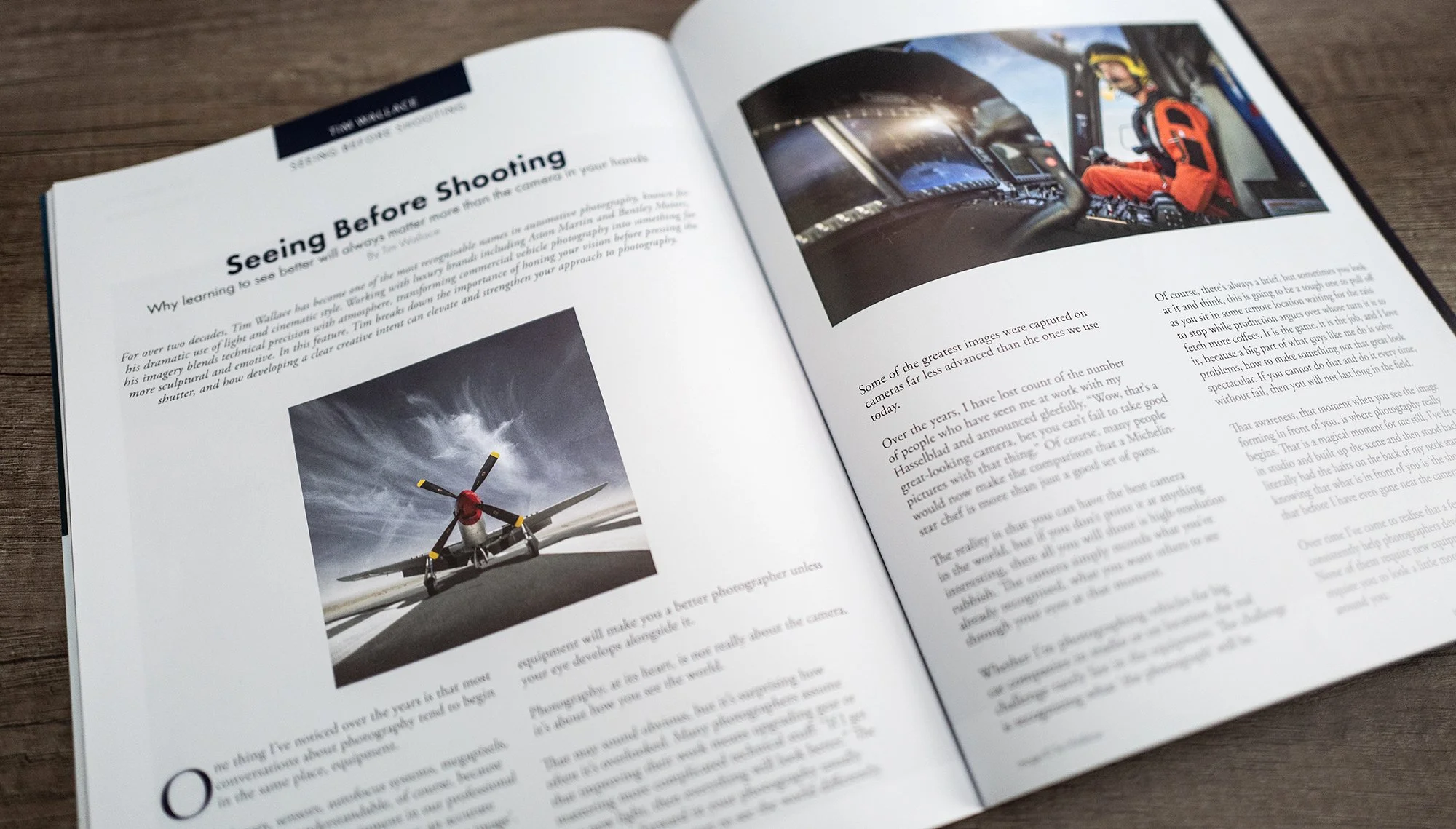
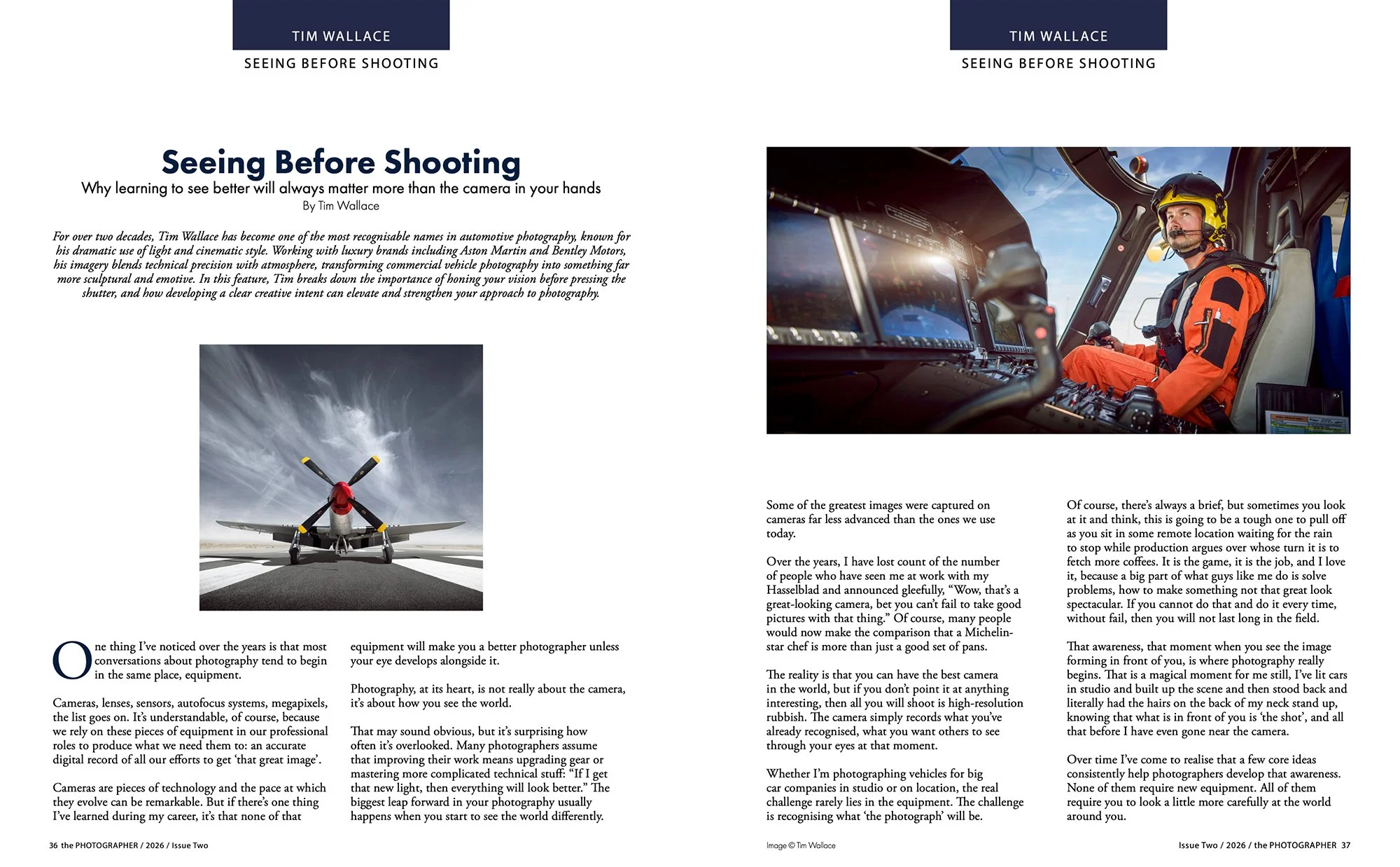
Seeing Before Shooting
By Tim Wallace
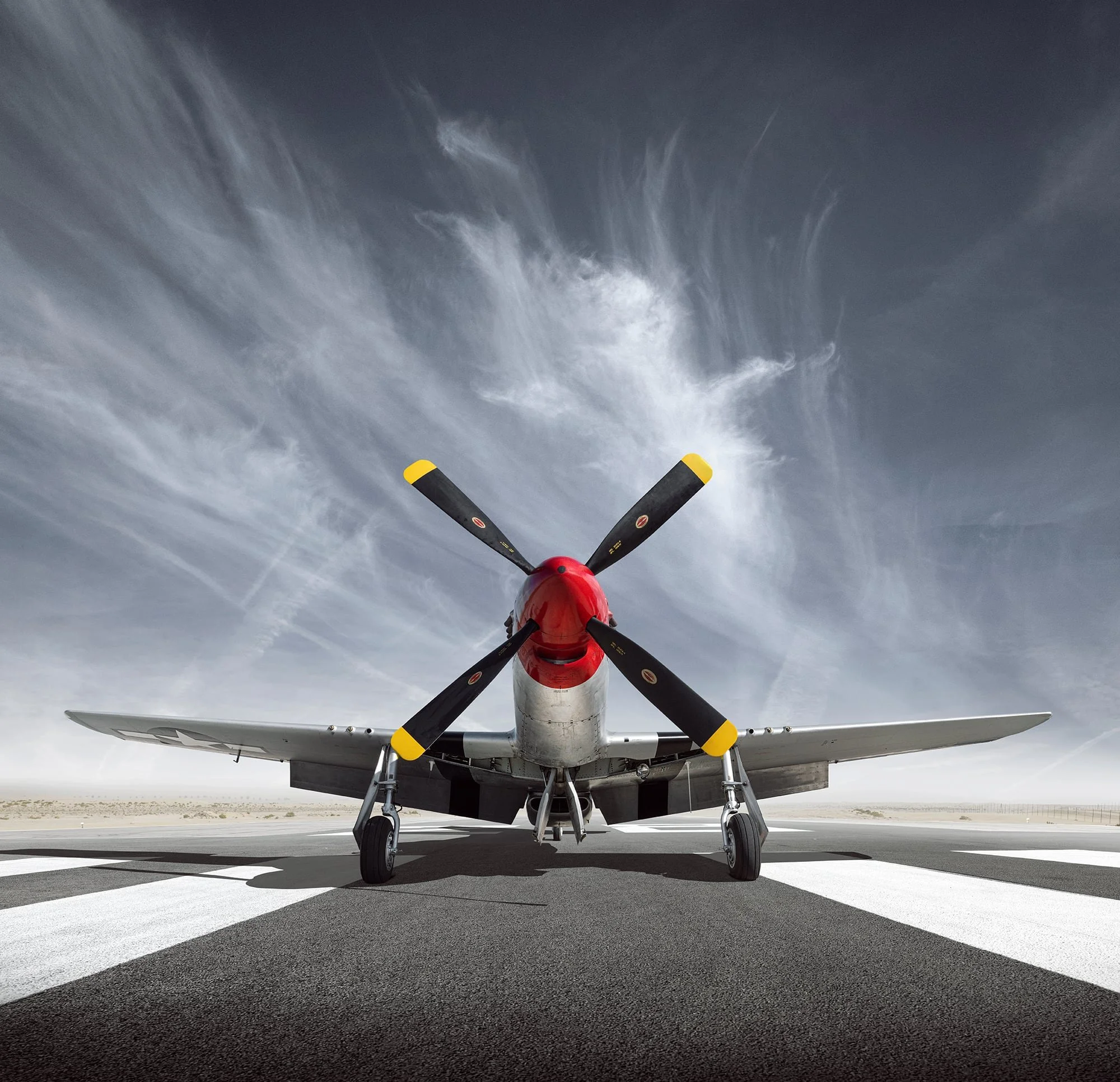
One thing I’ve noticed over the years is that most conversations about photography tend to begin in the same place, equipment.
Cameras, lenses, sensors, autofocus systems, megapixels, and the list goes on. It’s understandable, of course, we rely on these pieces of equipment in our professional roles to produce what we need them to, make an accurate digital record of all our efforts to get ‘that great image”.
Cameras are pieces of technology and the pace at which they evolve can be remarkable. But if there’s one thing I’ve learned during my career, it’s that none of that equipment will make you a better photographer unless your eye develops alongside it.
Photography, at its heart, is not really about the camera, it’s about how you see the world.
That may sound obvious, but it’s surprising how often it’s overlooked. Many photographers assume that improving their work means upgrading gear or mastering more complicated technical stuff, “if I get that new light then everything will look better, and to some extent the equipment manufacturers often voice this point in their advertising. In reality, the biggest leap forward in your photography usually happens when you start to see the world differently, and with better eyes. Some the greatest images man has ever captured were on much lesser camera’s than we tend to all use now.
Over the years I have lost count of the amount of people who have seen me at work with my Hasselblad and announced gleefully, “wow that’s a great looking camera, bet you can’t fail to take good pictures with that thing”. Of course, it’s right about now that many would feel the need to make comment about how a Michelin Star chef is more than just a good set of pans, but you get my drift.
The reality is that you can have the best camera in the world, but if you don’t point it at anything interesting with it then all you will shoot is high resolution rubbish.
The camera simply records what you’ve already recognised, what you want others to see through your eyes at that moment.
In my own work, whether I’m photographing vehicles for big car companies in studio or on location, the real challenge rarely lies in the equipment. The challenge lies in recognising what ‘the photograph’ will be. Of course there is always a brief, just sometimes you look at that and think, yeah so that is going to be a tough one to pull out of the hat as your sat at some remote location somewhere waiting for the rain to stop while production argue about who’s turn it is to go and fetch more coffees. It is the game, it is the job, and I love it, because a big part of what guys like me do is solve problems, how to make something not that great look spectacular. If you cannot do that and do it each and every time, without fail, then you will not last long in the field.
That awareness, that moment when you see the image forming in front of you, is where photography really begins. That is a magical moment for me still, I’ve lit cars in studio and built the up the scene and then stood back and literally had the hairs on the back of my neck stand up, knowing that what is in front of you is ‘the shot’, and all that before I have even gone near the camera.
Over time I’ve come to realise that a few core ideas consistently help photographers develop that awareness.
None of them require new equipment.
All of them require you to look a little more carefully at the world around you.
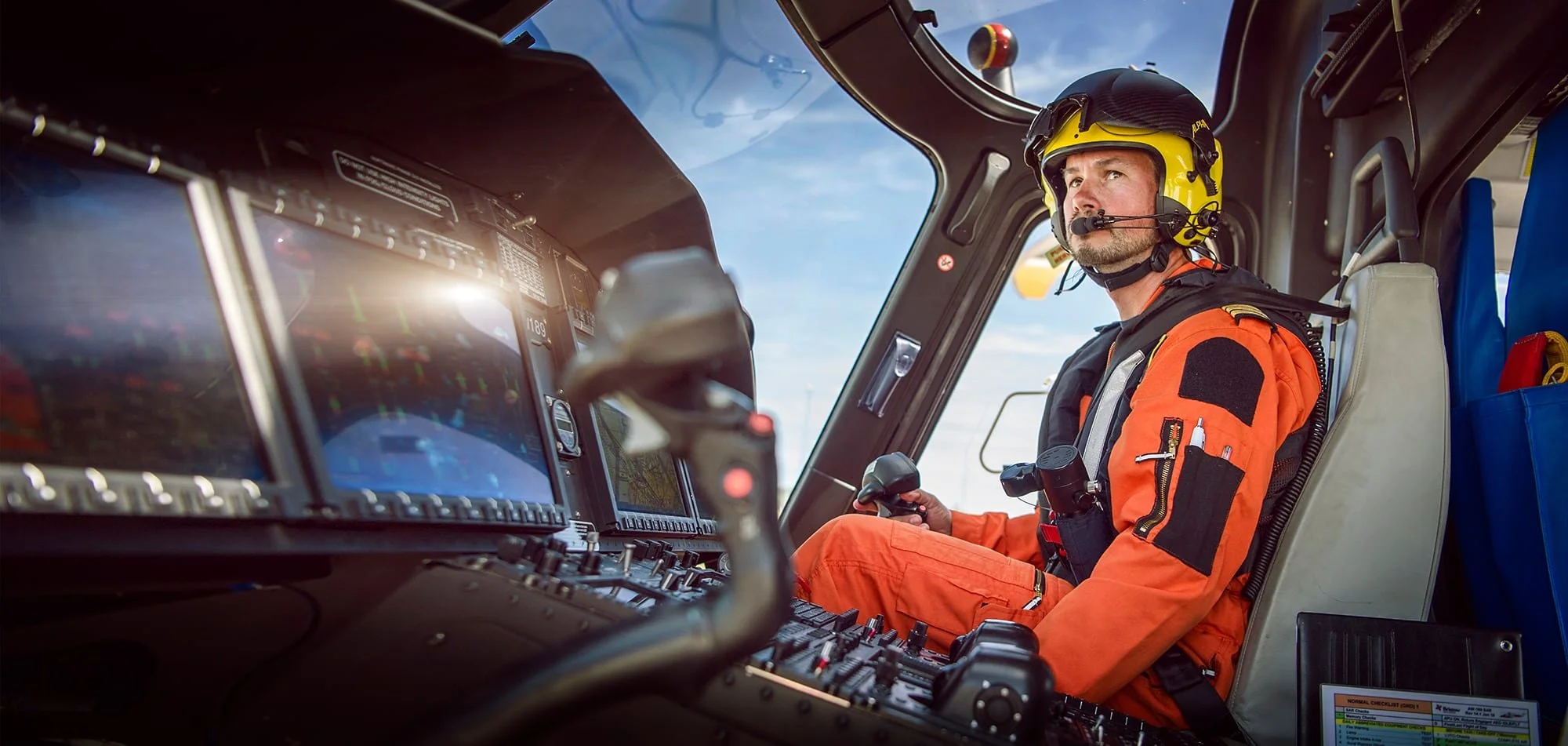
1. Learn to See Light, Not Just Subjects
One of the biggest shifts in my own photography happened when I stopped looking for just subjects and started looking for good light.
When we first begin taking photographs we naturally search for interesting things, a car, a building, a person, a landscape. The subject becomes the starting point, but after a while you realise that a great subject alone doesn’t guarantee a great photograph. Light is what gives an image life.
It defines shape, reveals texture, and creates mood. Without interesting light, even the most remarkable subject can appear dull. With beautiful light, the ordinary suddenly becomes compelling. So rather than asking myself, “What should I photograph?”, I tended to ask a slightly different question: “Where is the light doing something interesting?”
It might be a shaft of sunlight breaking through cloud. It might be soft window light falling across a surface. Sometimes it’s simply a subtle reflection that creates a highlight exactly where it’s needed. Once you find that light, don’t immediately rush off searching for a subject. Instead, stay there and observe. Eventually something will move through that light, a person, a vehicle, a shadow, and the photograph begins to reveal itself.
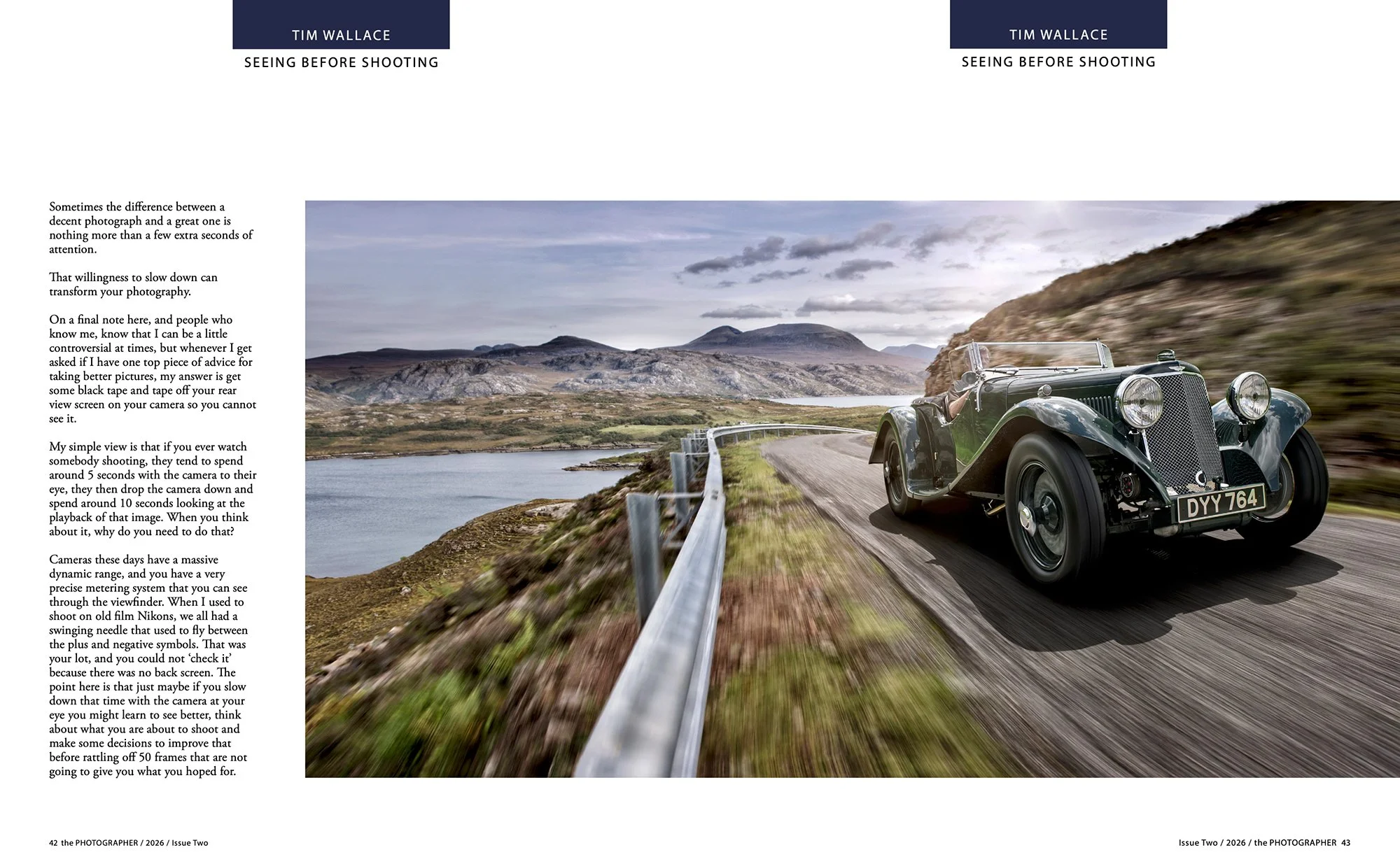
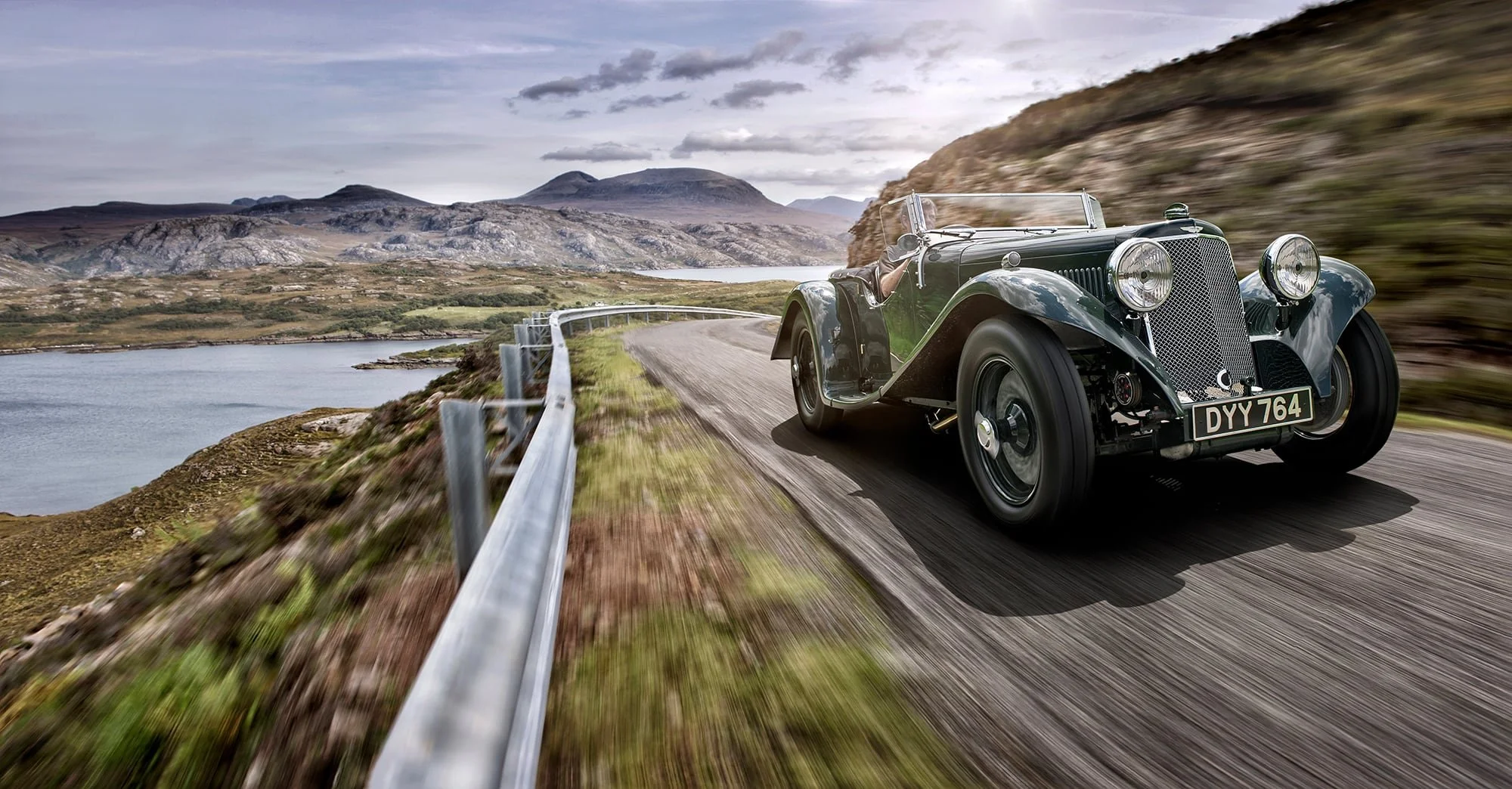
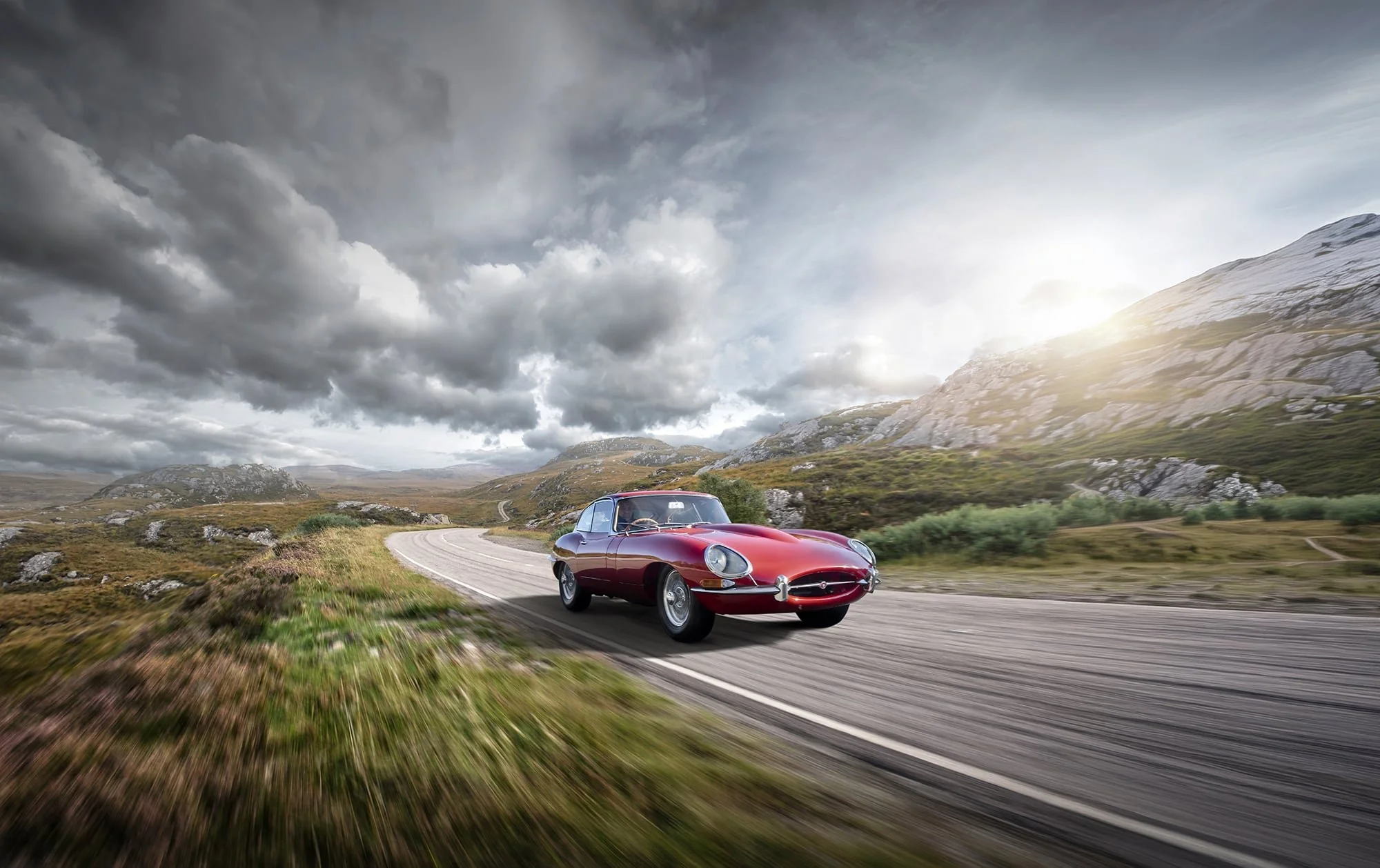
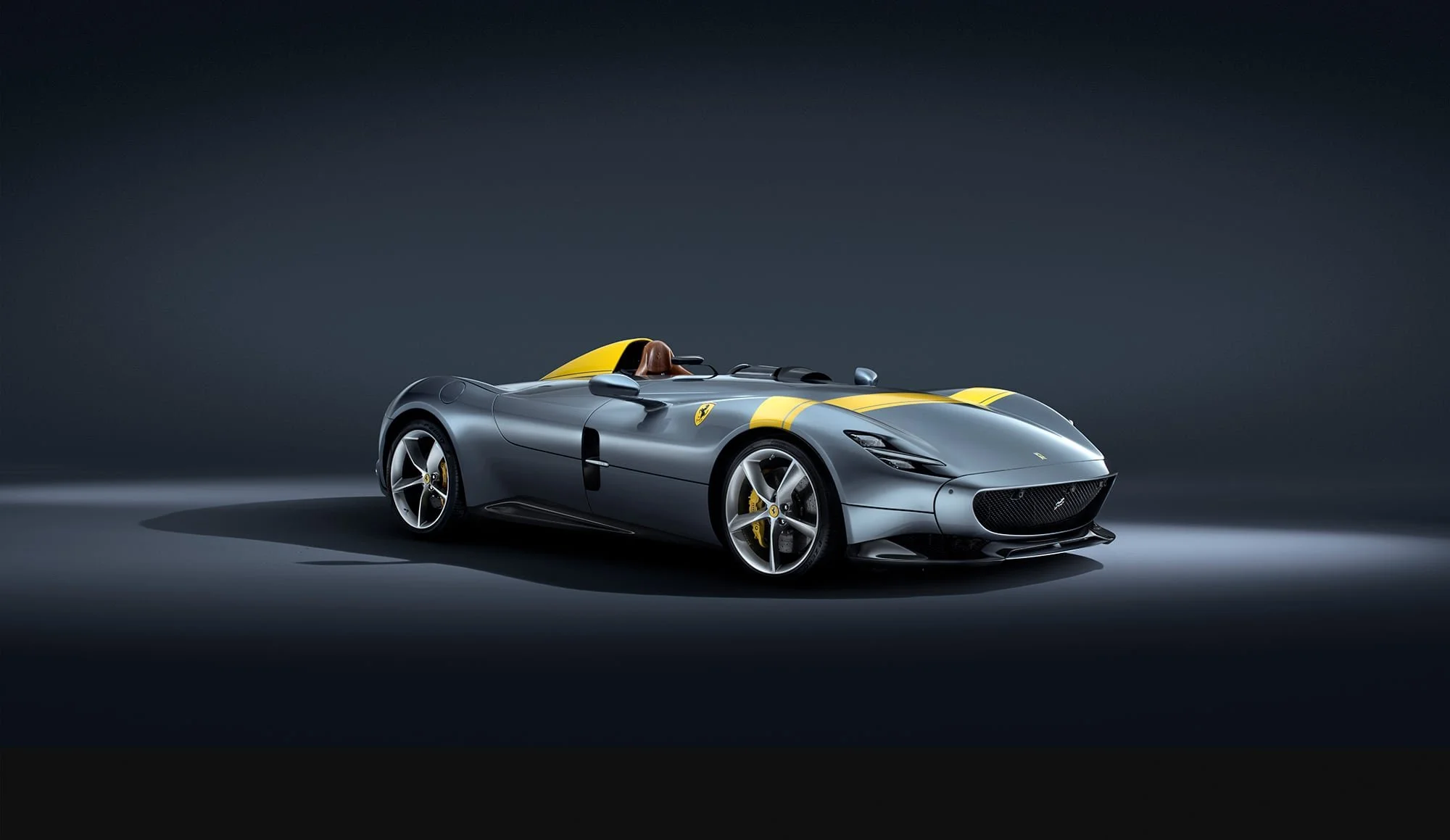
This approach is particularly important in automotive photography. When I’m photographing a beautifully designed car, what I’m really doing is sculpting light across its surfaces. The curves of a vehicle from Aston Martin or the flowing lines of a Jaguar only truly come alive when light moves across them in the right way.
In many respects, the car itself is just the canvas. Light is what brings the design to life.
It’s something I often remind myself of, you’re not really photographing objects, you’re photographing how light describes those objects. You could say, don’t shoot what it looks like, shoot how it makes you feel in that moment.
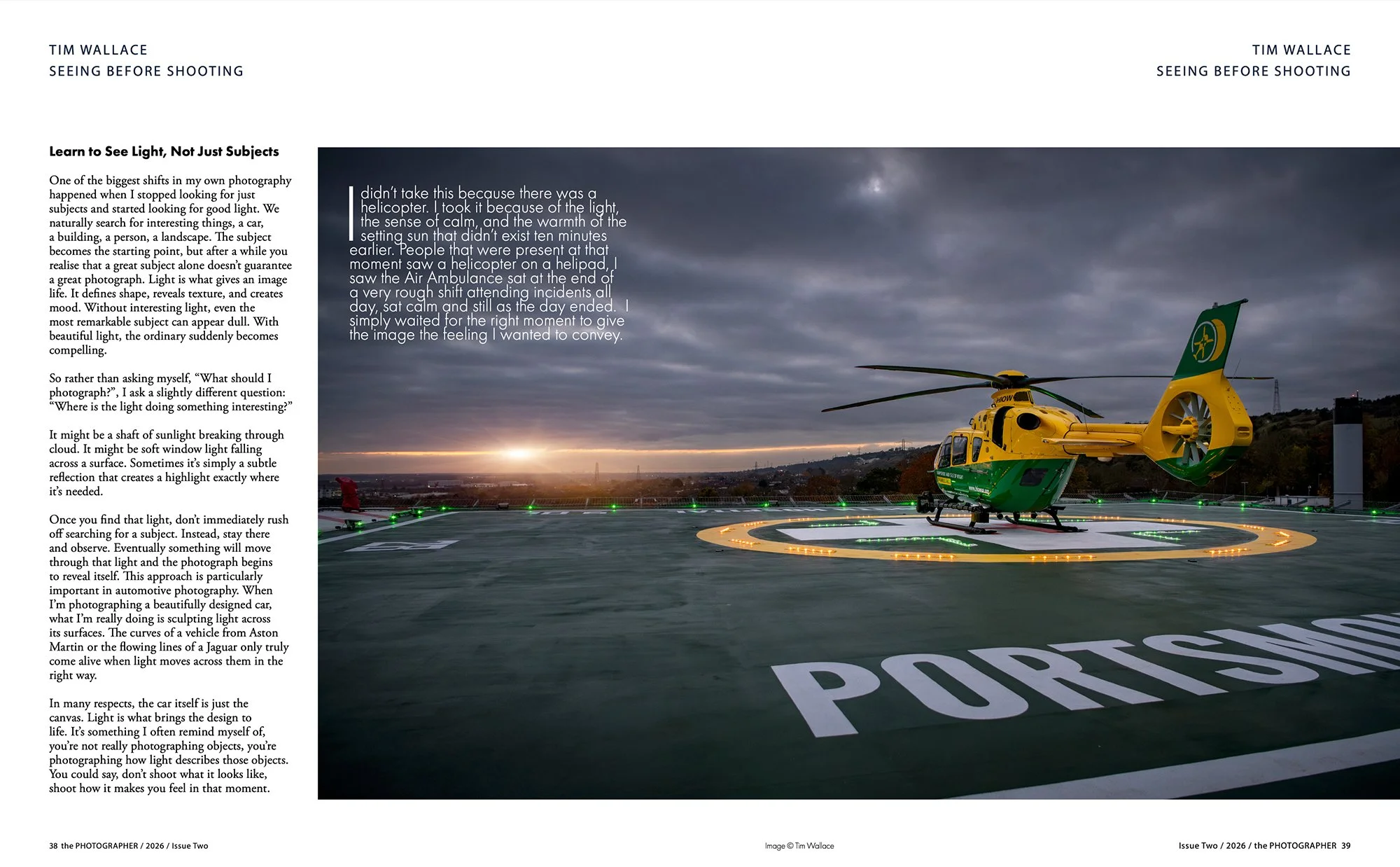
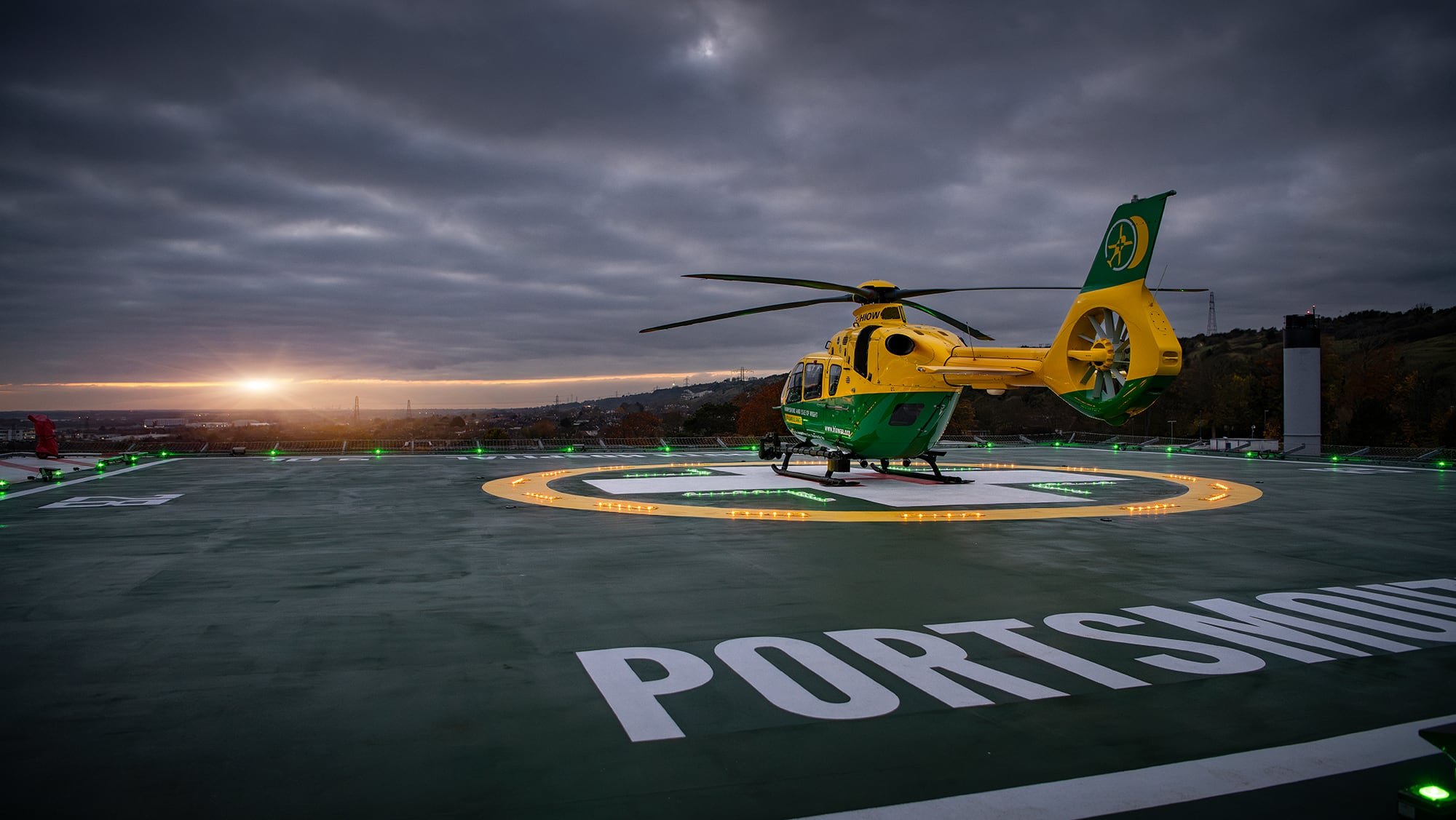
“I didn’t take this because there was helicopter. I took it because of the light, the sense of calm, and the warmth of the setting sun that didn't exist ten minutes earlier. People that were present at that moment saw helicopter on a helipad, I saw the Air Ambulance sat at the end of a very rough shift attending incidents all day, sat calm and still as the day ended. I simply waited for the right moment to give the image the feeling I wanted to convey.”
2. Take Responsibility for the Frame
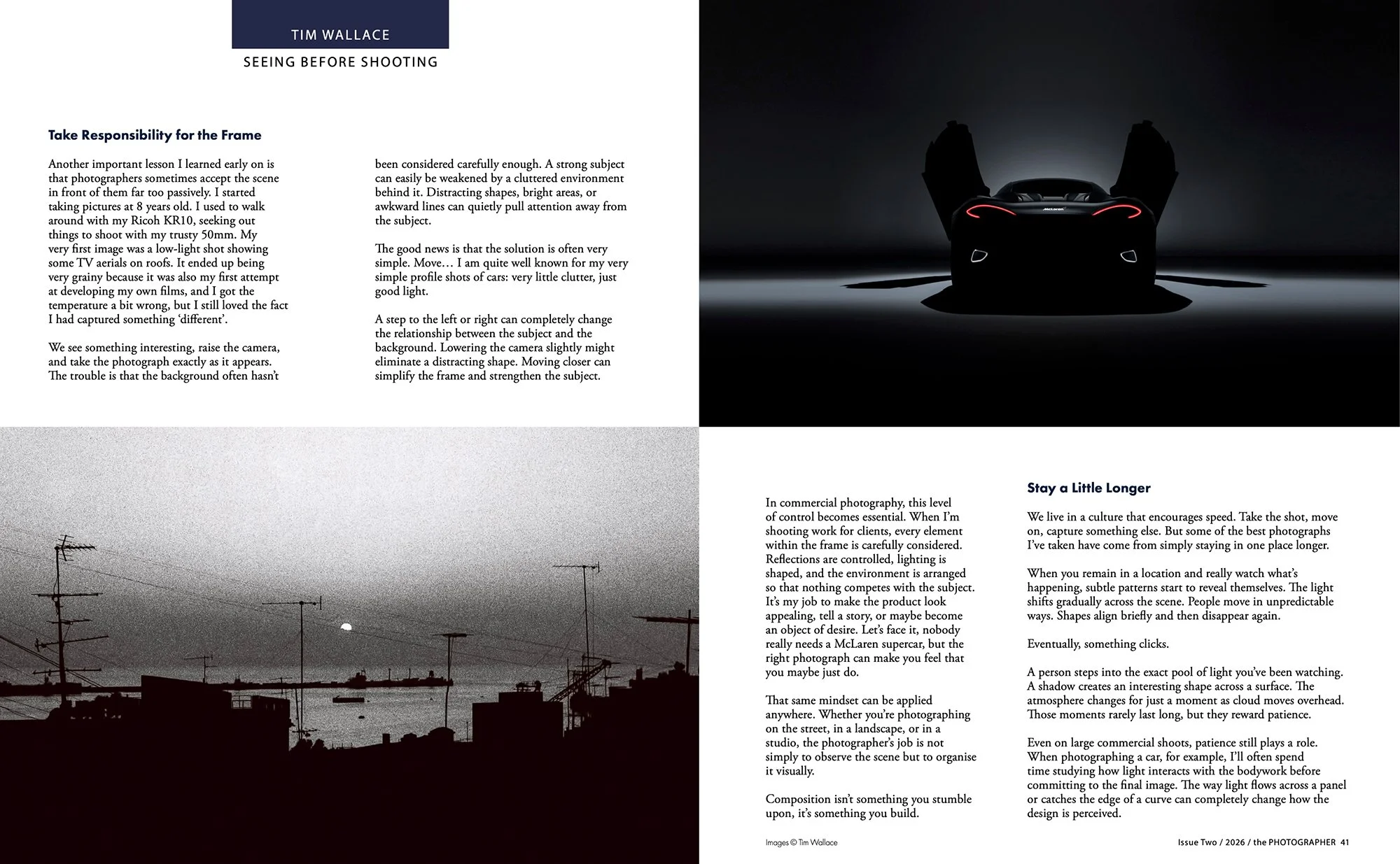
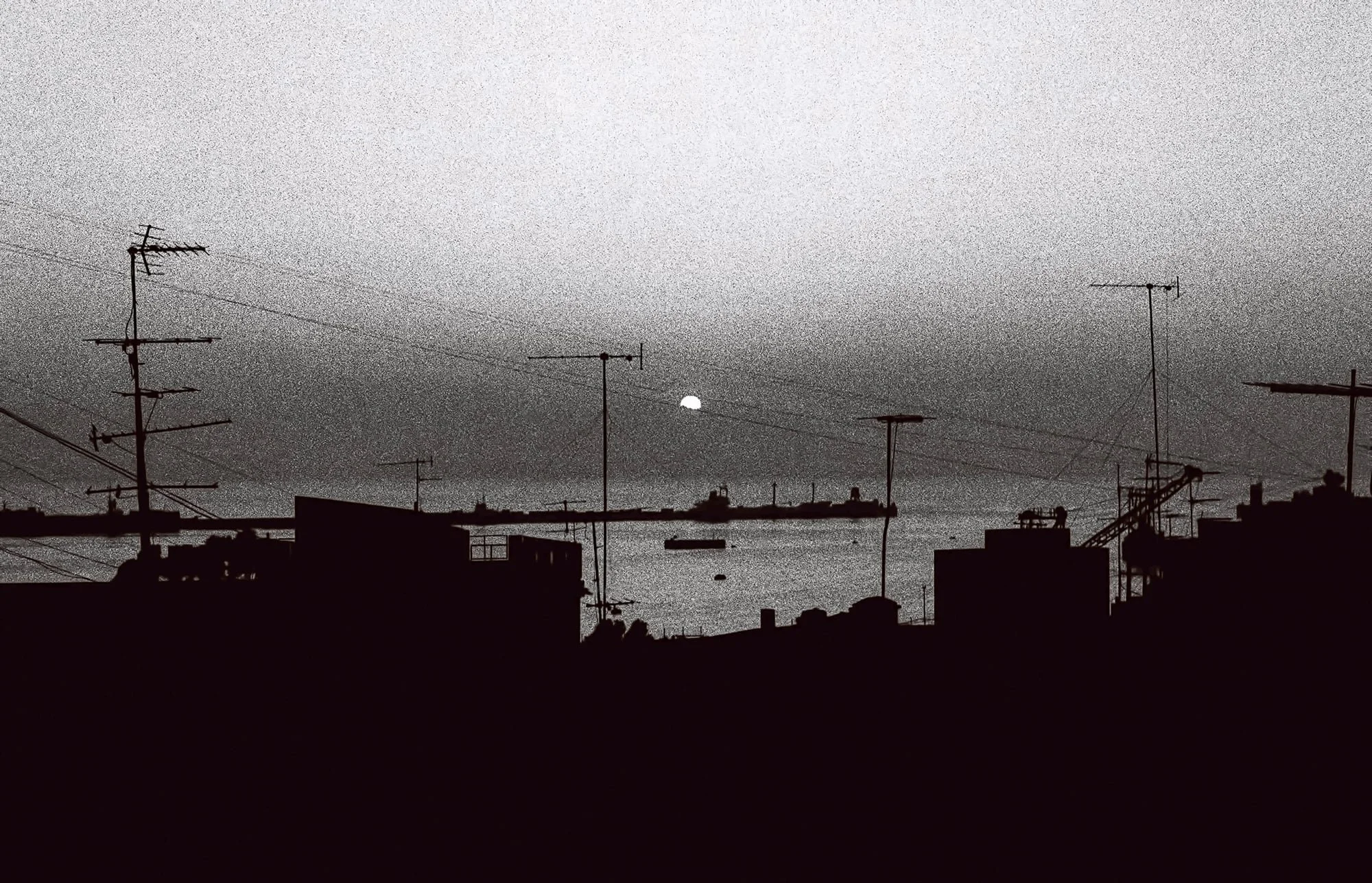
Another important lesson I learned fairly early on is that photographers sometimes accept the scene in front of them far too passively. I started taking pictures at the tender age of 8 years old. I used to walk around with my Ricoh KR10, I wanted the KR10 Super but didn’t have the money, anyway, I would seek out things to shoot with my trusty 50mm. My very first image was a low light shot showing some TV aerials on roofs, it ended up being very grainy because it was also my first attempt and developing my own films and I think I got the temperature a bit wrong, but I still loved the fact that I had captured something ‘different’.
We see something interesting, raise the camera, and take the photograph exactly as it appears. The trouble is that the background often hasn’t been considered carefully enough. A strong subject can easily be weakened by a cluttered environment behind it. Distracting shapes, bright areas or awkward lines can quietly pull attention away from the subject without us even realising.
The good news is that the solution is often very simple. Move…
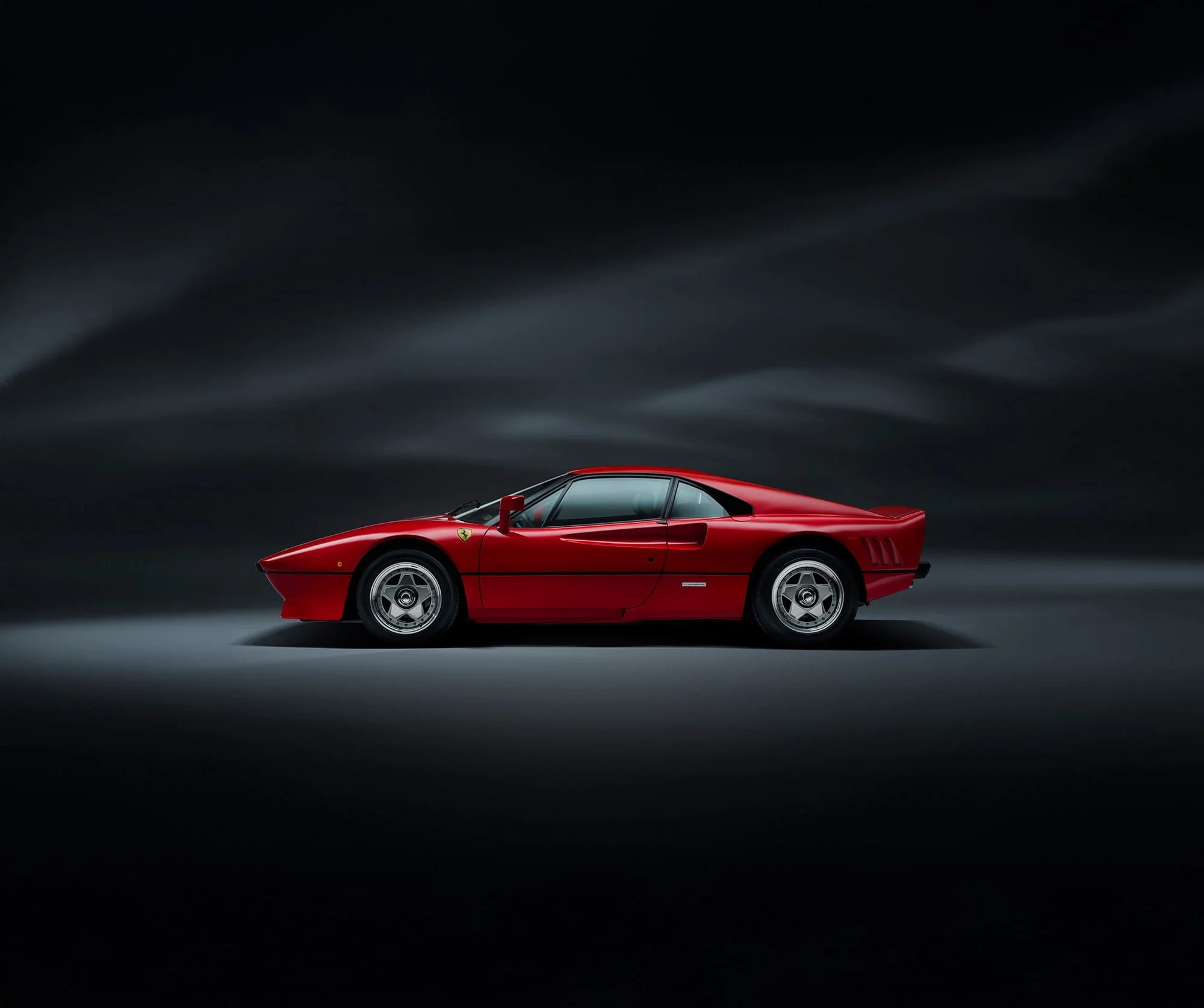
I am quite well known for my very simple profile shots of cars, very little clutter, just good light.
A step to the left or right can completely change the relationship between the subject and the background. Lowering the camera slightly might eliminate a distracting shape. Moving closer can simplify the frame and strengthen the subject.
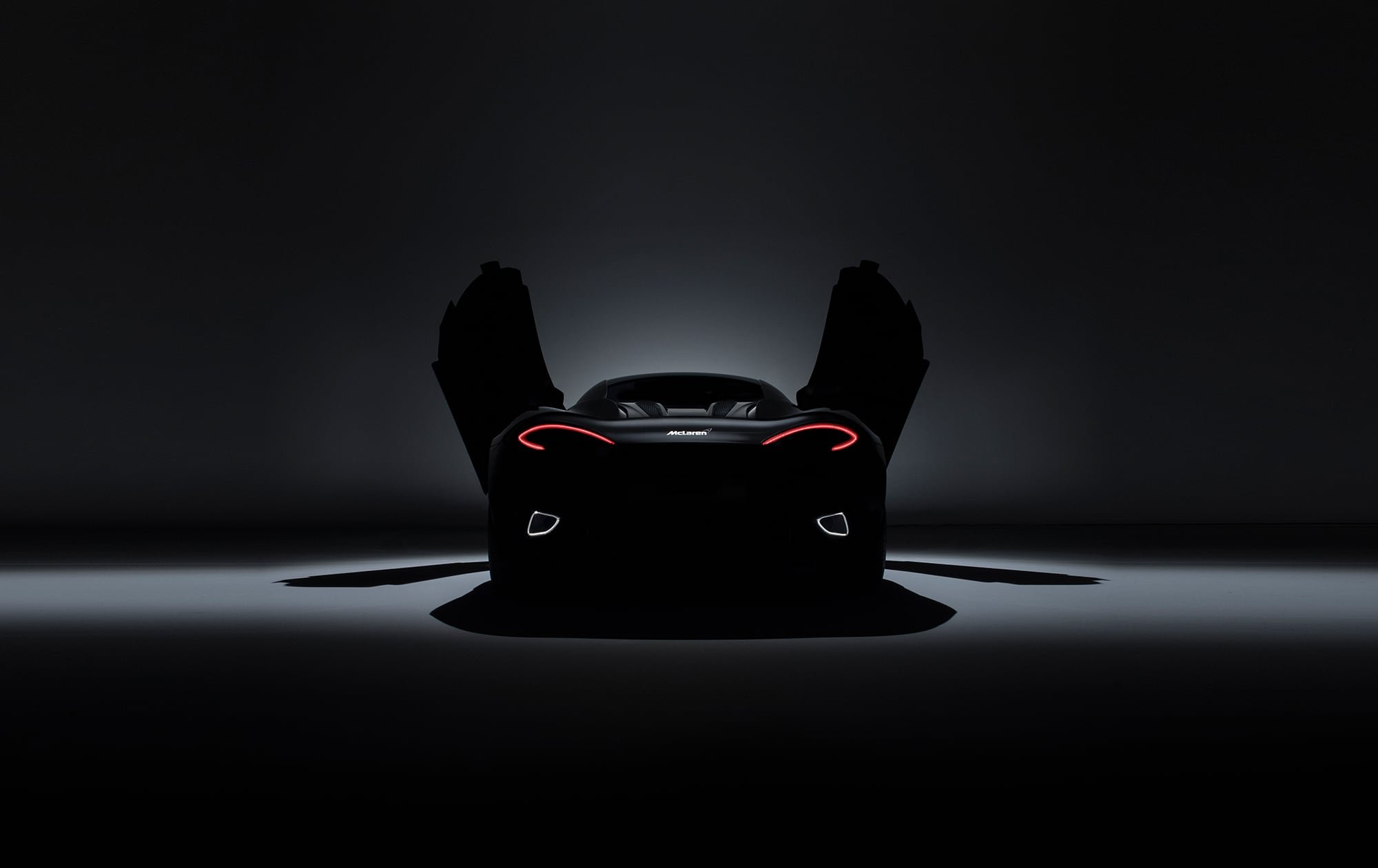
In commercial photography this level of control becomes essential. When I’m shooting work for clients, every element within the frame is carefully considered. Reflections are controlled, lighting is shaped, and the environment is arranged so that nothing competes with the subject. At the end of the day it’s my job to make the product look appealing, tell a story, or maybe become an object of desire. Let’s face it nobody really needs a McLaren supercar, but the right photograph can make you feel that you maybe just do.
That same mindset can be applied anywhere. Whether you’re photographing on the street, in a landscape, or in a studio, the photographer’s job is not simply to observe the scene but to organise it visually.
Composition isn’t something you stumble upon, it’s something you build.
3. Stay a Little Longer
We live in a culture that encourages speed. Take the shot, move on, capture something else. But some of the best photographs I’ve taken have come from simply staying in one place longer. When you remain in a location and really watch what’s happening, subtle patterns start to reveal themselves. The light shifts gradually across the scene. People move in unpredictable ways. Shapes align briefly and then disappear again. Eventually, something clicks.
A person steps into the exact pool of light you’ve been watching. A shadow creates an interesting shape across a surface. The atmosphere changes for just a moment as cloud moves overhead. Those moments rarely last long, but they reward patience.
Even on large commercial shoots, patience still plays a role. When photographing a car, for example, I’ll often spend time studying how light interacts with the bodywork before committing to the final image. The way light flows across a panel or catches the edge of a curve can completely change how the design is perceived.
Sometimes the difference between a decent photograph and a great one is nothing more than a few extra seconds of attention.
That willingness to slow down can transform your photography.
On a final note here, and people who know me, know that I can be a little controversial at times, but whenever I get asked if I have one top piece of advice for taking better pictures, my answer is get some black tape and tape off your rear view screen on your camera so you cannot see it.
My simple view is that if you ever watch somebody shooting, they tend to spend around 5 seconds with the camera to their eye, they then drop the camera down and spend around 10 seconds looking at the playback of that image. When you think about, why do you need to do that?
Camera’s these days have a massive dynamic range, and you have a very precise metering system that you can see through the viewfinder. When I used to shoot on old film Nikons, we all had a swinging needle that used to fly between the plus and negative symbols. That was your lot, and you could not ‘check it’ because there was no back screen. The point here is that just maybe if you slowdown that time with the camera at your eye you might learn to see better, think about what you are about to shoot and make some decisions to improve that before rattling off 50 frames that are not going to give you what you hoped for.
4. Embrace Limitations
It might seem logical that having more equipment would make photography easier. In my experience, the opposite is often true. Too many options can dilute your vision.
When photographers carry multiple cameras and a full case of lenses, it becomes easy to solve problems by switching gear rather than thinking more carefully about composition or perspective.
I know people out there will say that it’s all ‘poppycock’ (being polite here) but the same people will rave about photographs taken by some of the great photographers of our past, not really appreciating that many of them worked with a single rangefinder camera and one lens their entire working career.
Their strength came from a consistent way of seeing rather than from a vast collection of gear.
I often encourage photographers to work with a single lens for extended periods of time. Doing so forces you to move your feet, explore different angles, and engage more deeply with the subject.
My 18 year old son is at college currently and one of the subject he is studying is photography, who would have thought that would be the case, lol
He has a 28-70mm lens and that’s it, but we have shot things together where I have given him a 50mm lens and he has spent the whole day just using that. He describes it as easier because he adjusts his view of the world to get the shot he is after rather than try to decide what focal length he should use. I think the basic point is that sometimes keeping it simple can make you think more and open your eyes to ways of shooting that you maybe had not explored before.
For anybody out there who might be wondering right now, I shoot a lot of stuff just for me and when I do I shoot on a little Leica rangefinder with just a 28mm lens, nothing more, why?, because I love shooting even though I do it for my work, it’s also for enjoyment when there is no client, there is no brief, and I can just shoot what I want and how I want.
Even in commercial environments where we have access to a wide range of tools, each piece of equipment is chosen deliberately. Different lenses create different visual relationships within the frame, and those choices affect how the final image feels.
The important thing is not how many tools you have, but how clearly you understand why you’re using them.

5. Learn What to Leave Out
Perhaps the most important skill a photographer can develop is the ability to simplify.
Every element inside a frame competes for attention. If too many things are happening at once, the viewer’s eye becomes distracted, and the image loses its clarity.
Strong photographs often feel simple and calm. That simplicity rarely happens by accident.
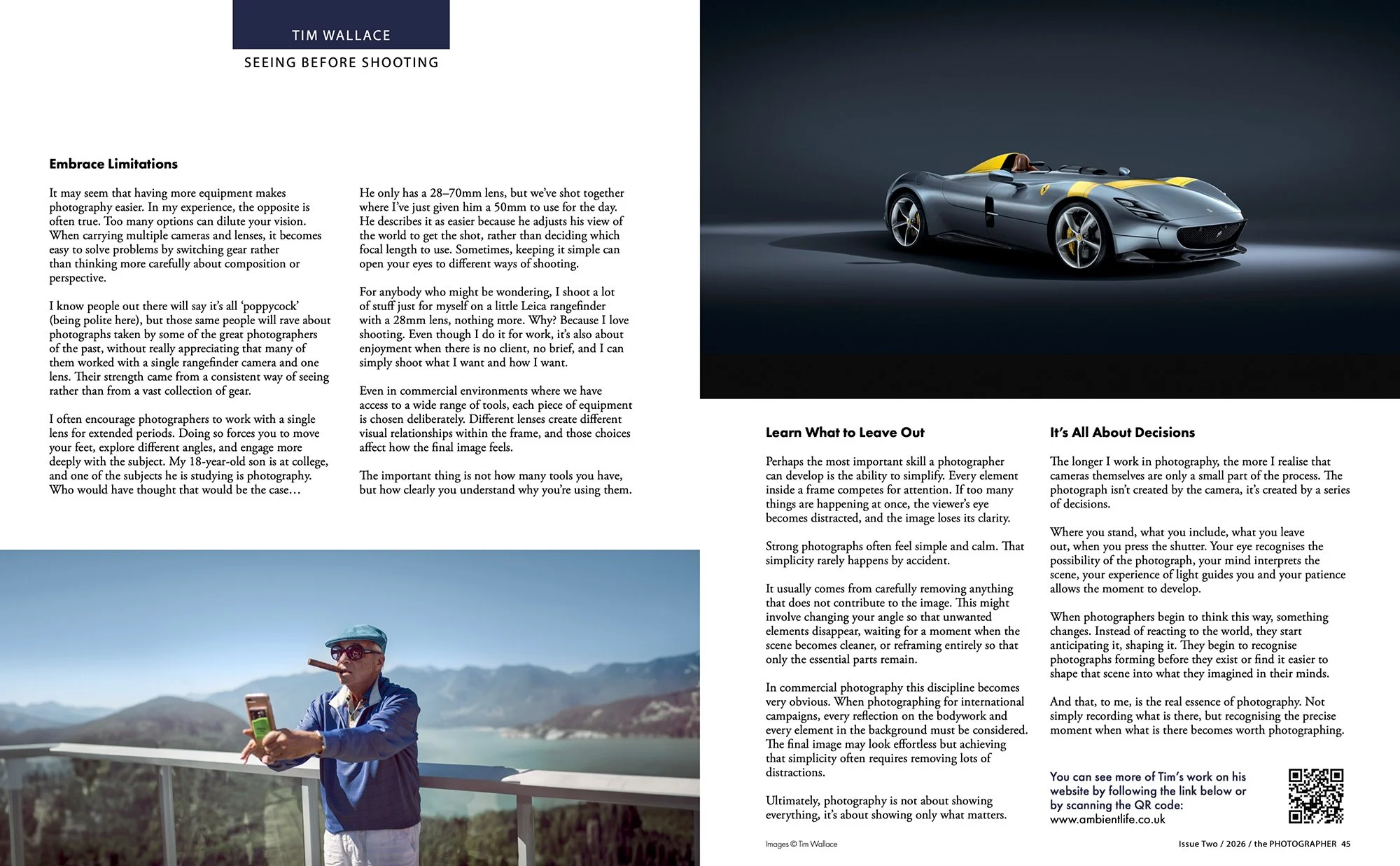
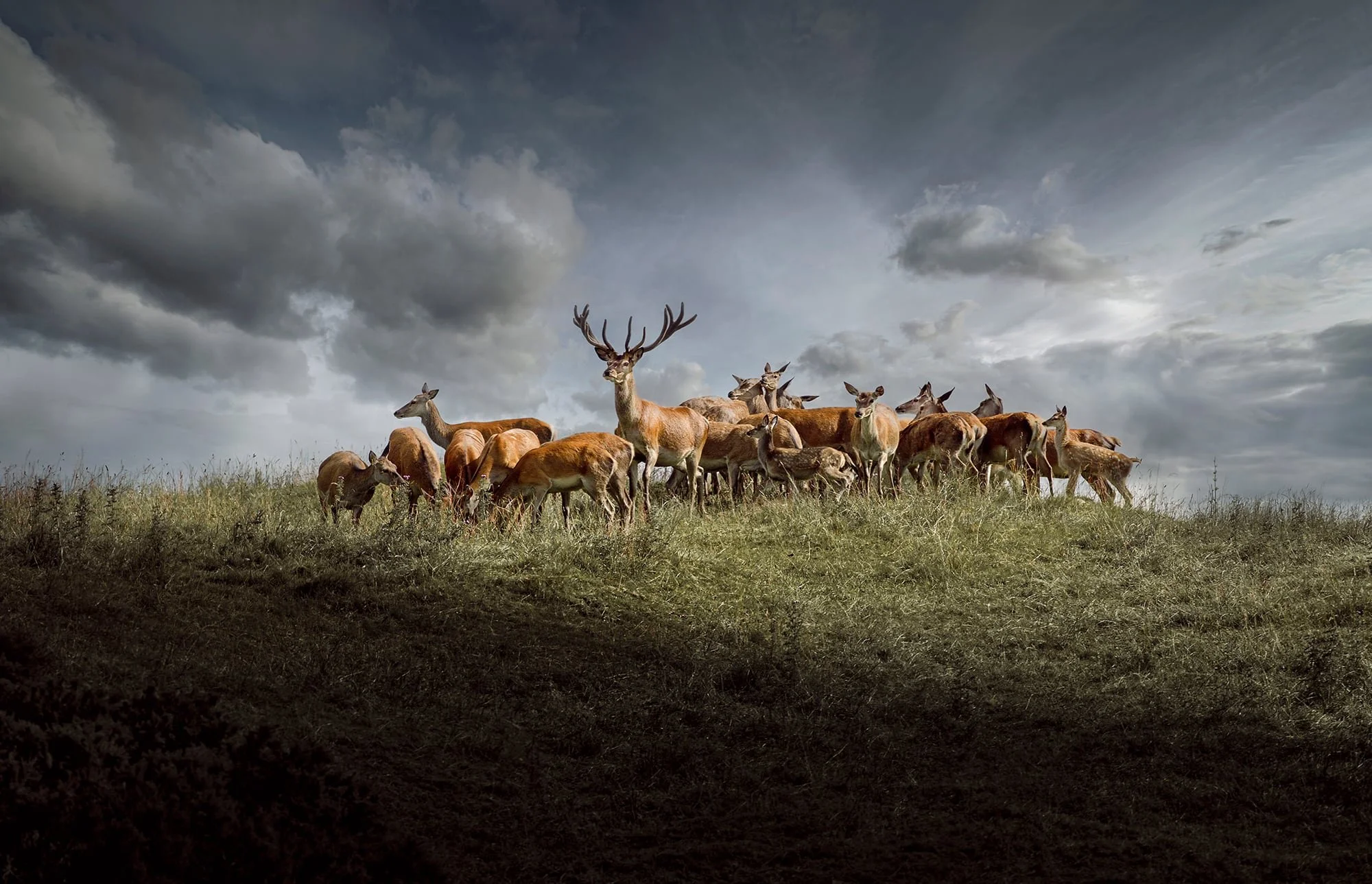
It usually comes from carefully removing anything that does not contribute to the image. This might involve changing your angle so that unwanted elements disappear, waiting for a moment when the scene becomes cleaner, or reframing entirely so that only the essential parts remain.
In commercial photography this discipline becomes very obvious. When photographing for international campaigns, every reflection on the bodywork and every element in the background must be considered. The final image may look effortless but achieving that simplicity often requires removing lots of distractions.
Ultimately, photography is not about showing everything, it’s about showing only what matters.
It’s All About Decisions
The longer I work in photography, the more I realise that cameras themselves are only a small part of the process. The photograph isn’t created by the camera, it’s created by a series of decisions. Where you stand, what you include, what you leave out, when you press the shutter.
Your eye recognises the possibility of the photograph, your mind interprets the scene, your experience of light guides you and your patience allows the moment to develop.
When photographers begin to think this way, something changes. Instead of reacting to the world, they start anticipating it, shaping it. They begin to recognise photographs forming before they exist or find it easier to shape that scene into what they imagined in their minds.
And that, to me, is the real essence of photography. Not simply recording what is there, but recognising the precise moment when what is there becomes worth photographing.